

Sunglass Lens & Frames Guide
Everything You Need to Know About Lenses, Frames, and Eyewear Technology
Buying sunglasses today involves far more than simply choosing a style you like. Modern sunglasses are built using a wide variety of lens materials, frame materials, coatings, and technologies that all affect how they perform in different environments. Whether you're shopping for lightweight everyday sunglasses, rugged hiking eyewear, safety glasses for work, or premium polarized lenses for driving, understanding the technology behind each feature helps you make a smarter purchase.
This guide serves as the complete technical reference for the EDCBuzz sunglasses collection. We'll explain the advantages and disadvantages of every major lens material, compare frame materials, break down popular lens technologies, and help you understand why features like UV protection, impact resistance, and ANSI safety ratings matter.
If you're still deciding what type of sunglasses best fits your lifestyle, start with our How To Choose Sunglasses guide before exploring our complete collection of EDC Sunglasses.
Explore This Guide
Jump directly to the section you're most interested in, or scroll through the complete guide from start to finish to learn everything you need to know about sunglass materials, technologies, and long-term ownership.

Lens Materials
The lens material is arguably the single biggest factor affecting how a pair of sunglasses performs. It determines optical clarity, scratch resistance, weight, impact protection, durability, and even long-term comfort. No material is perfect for every situation, which is why premium manufacturers often choose different lens materials depending on the intended purpose of the sunglasses.
For example, mountain sunglasses prioritize impact resistance and lightweight construction, while premium driving sunglasses often emphasize optical clarity and scratch resistance. Understanding these differences makes it much easier to compare products and recognize whether you're paying for meaningful improvements or simply premium branding.
If you're trying to decide between the two most common lens materials, our guide to Choosing Between Glass and Polycarbonate Lenses explores the comparison in greater detail.

Glass
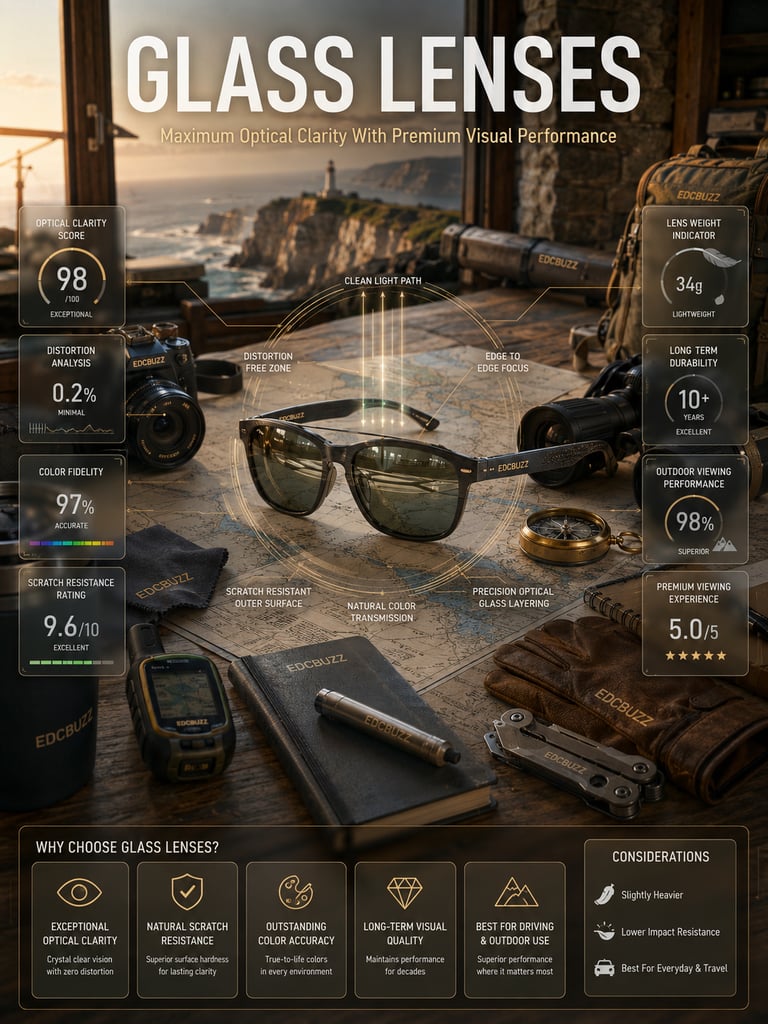
Glass remains the benchmark for optical quality. Before modern plastics became widely available, nearly every premium pair of sunglasses used glass lenses because of their outstanding clarity and exceptional resistance to scratching. Even today, many luxury brands continue to use mineral glass for buyers who value the best possible viewing experience.
Unlike softer plastics, properly manufactured glass produces extremely crisp vision with very little distortion. Colors remain natural, edges stay sharp, and fine details are easier to see during long hours outdoors. This makes glass especially popular among drivers, photographers, boaters, and anyone who spends significant time in bright environments where visual precision matters.
One of glass's biggest advantages is its natural scratch resistance. While no lens is completely scratch-proof, glass holds up remarkably well over years of regular use when properly cared for. Buyers who tend to keep one pair of sunglasses for many seasons often appreciate this long-term durability.
Advantages
Exceptional optical clarity with minimal distortion.
Naturally resistant to scratches.
Excellent long-term visual performance.
Premium feel and appearance.
Ideal for driving and everyday outdoor use.
Drawbacks
Glass lenses are heavier than modern plastics, which can become noticeable during extended wear or physically demanding activities. They are also more likely to crack under severe impact, making them less suitable for high-impact sports or hazardous work environments.
Best For
Glass lenses work best for everyday carry, driving, travel, boating, fishing, and premium lifestyle sunglasses where visual clarity and scratch resistance take priority over impact protection.
For a real-world comparison, see Serengeti Anteo vs Oakley Sutro TI Sweep (Glass vs Polycarbonate).
Polycarbonate
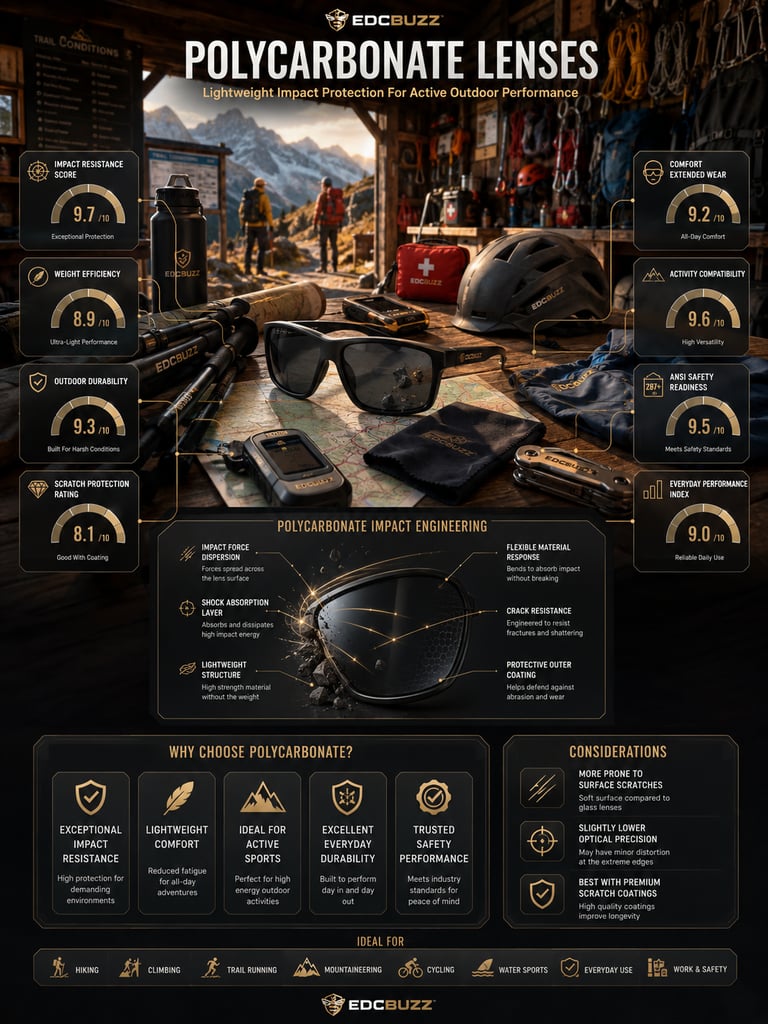
Polycarbonate is the most common lens material found in modern sports sunglasses and safety eyewear. Originally developed for applications requiring exceptional impact resistance, it quickly became the preferred material for outdoor recreation because it combines lightweight comfort with outstanding durability.
Unlike glass, polycarbonate is extremely resistant to impacts. It can withstand flying debris, accidental drops, and everyday abuse that might crack or shatter traditional glass lenses. This makes it a popular choice for cycling, running, hiking, construction work, and safety glasses.
Polycarbonate is also significantly lighter than glass, reducing pressure on your nose and ears during long days outdoors. Many people immediately notice the difference when switching from heavier glass lenses to a lightweight polycarbonate frame.
Advantages
Extremely impact resistant.
Lightweight and comfortable.
Excellent for sports and outdoor activities.
Commonly used in ANSI-rated safety glasses.
Affordable to manufacture.
Drawbacks
Polycarbonate scratches more easily than glass unless protected by quality scratch-resistant coatings. Optical clarity has also improved dramatically over the years but generally doesn't match the crispness of premium mineral glass.
Best For
Polycarbonate is ideal for athletic sunglasses, hiking, cycling, work environments, tactical eyewear, and everyday users who prioritize durability over maximum optical refinement.
If workplace protection is your priority, explore our guide to Best Safety Glasses and learn more about Are Safety Glasses Good Enough for Outdoor Work?
Trivex
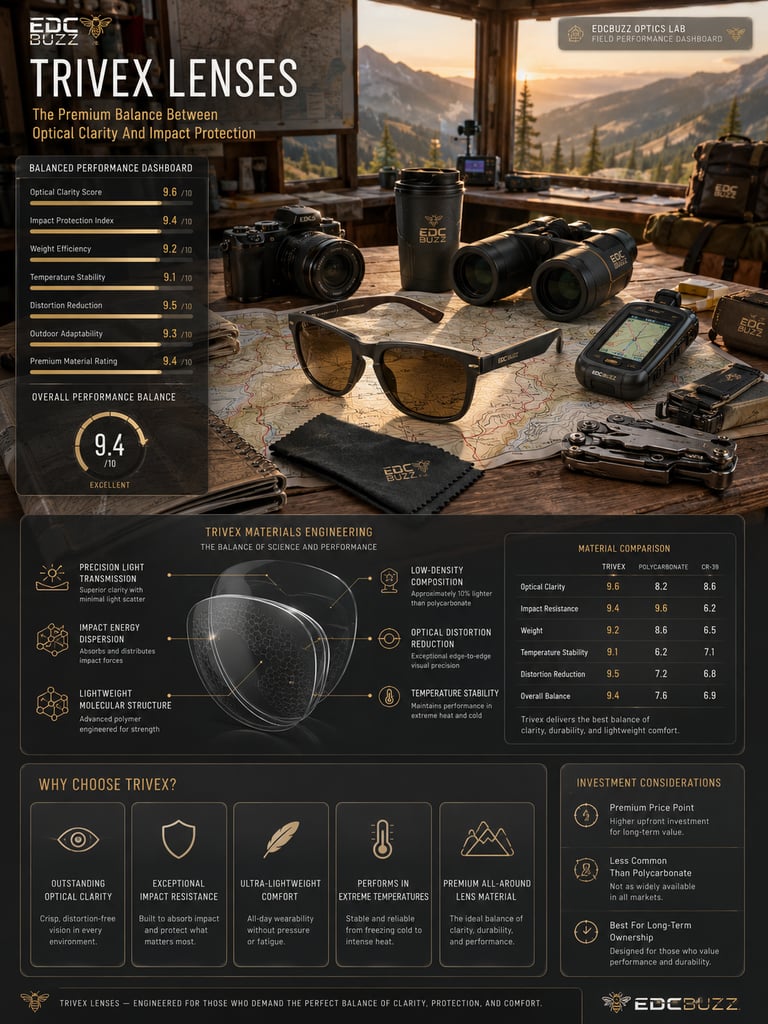
Trivex is often considered the premium alternative to polycarbonate. It offers many of the same advantages—including excellent impact resistance and lightweight comfort—while improving optical clarity and reducing distortion. Although it costs more to manufacture, many premium outdoor brands use Trivex for buyers who want the best balance between protection and visual performance.
Because Trivex has a lower density than polycarbonate, it can actually weigh slightly less while maintaining excellent durability. The material also performs exceptionally well in changing temperatures, making it a favorite among hikers, hunters, and outdoor enthusiasts who encounter a variety of environments throughout the year.
Many buyers describe Trivex as the "best of both worlds," combining much of glass's visual quality with polycarbonate's durability.
Advantages
Excellent optical clarity.
Outstanding impact resistance.
Extremely lightweight.
Performs well in changing temperatures.
Premium all-around lens material.
Drawbacks
The primary disadvantage is cost. Trivex lenses typically appear on more expensive sunglasses, making them less common in entry-level models.
Best For
Trivex is an excellent choice for premium everyday sunglasses, hiking, tactical use, hunting, and outdoor recreation where both clarity and durability are equally important.
CR-39
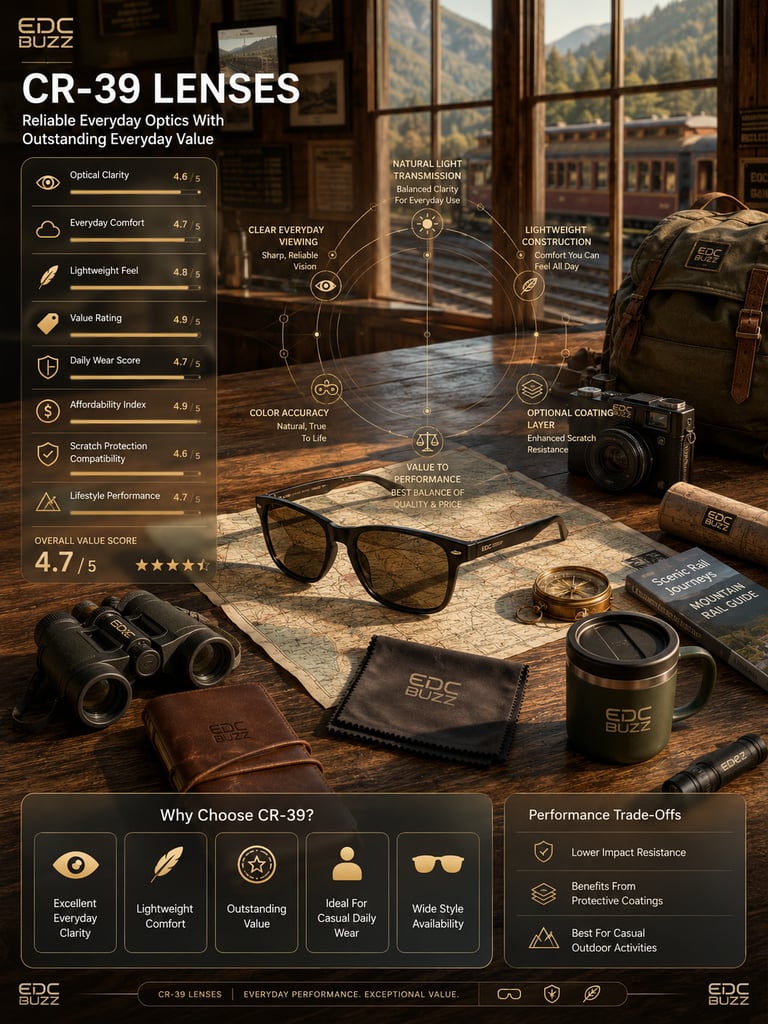
CR-39 was one of the first plastic lens materials to become widely accepted in eyewear and remains popular today because it offers a good balance of optical quality, affordability, and lightweight comfort. While it doesn't match the impact resistance of polycarbonate or Trivex, it provides clearer vision than many lower-cost plastics and is often found in lifestyle sunglasses.
Many casual sunglasses use CR-39 because it delivers reliable everyday performance without significantly increasing manufacturing costs. For walking around town, vacations, commuting, and general outdoor use, it performs more than adequately.
Although it isn't typically recommended for demanding sports or hazardous work environments, CR-39 continues to serve as a dependable option for buyers looking for comfortable everyday sunglasses at reasonable prices.
Advantages
Good optical clarity.
Lightweight and comfortable.
Affordable.
Common in everyday sunglasses.
Easy to manufacture in a wide variety of lens colors.
Drawbacks
CR-39 is less impact resistant than polycarbonate or Trivex and generally isn't suitable for safety eyewear or high-impact sports. It also benefits from protective coatings to improve scratch resistance.
Best For
CR-39 is well suited for casual everyday wear, commuting, travel, and buyers seeking dependable performance without paying premium prices.
If budget is one of your biggest considerations, our guides to Best Budget Sunglasses, goodr FXG vs KOO Supernova (Cheap vs Expensive), and How Much Should You Spend on Sunglasses? can help you decide where your money is best spent.
Frame Materials
While lenses often receive most of the attention, the frame plays an equally important role in comfort, durability, flexibility, and long-term reliability. A great pair of sunglasses should feel secure without creating pressure points, survive years of everyday use, and match the activities you enjoy most.
Modern manufacturers use everything from flexible polymers to aerospace-grade metals and carbon fiber composites. Each material offers unique strengths, which is why you'll often find different frame materials recommended for driving, hiking, tactical use, or athletic performance.
If you're still deciding which style best fits your everyday carry, our How To Choose Sunglasses for Everyday Carry guide provides an excellent starting point before diving into the technical details below.
TR90
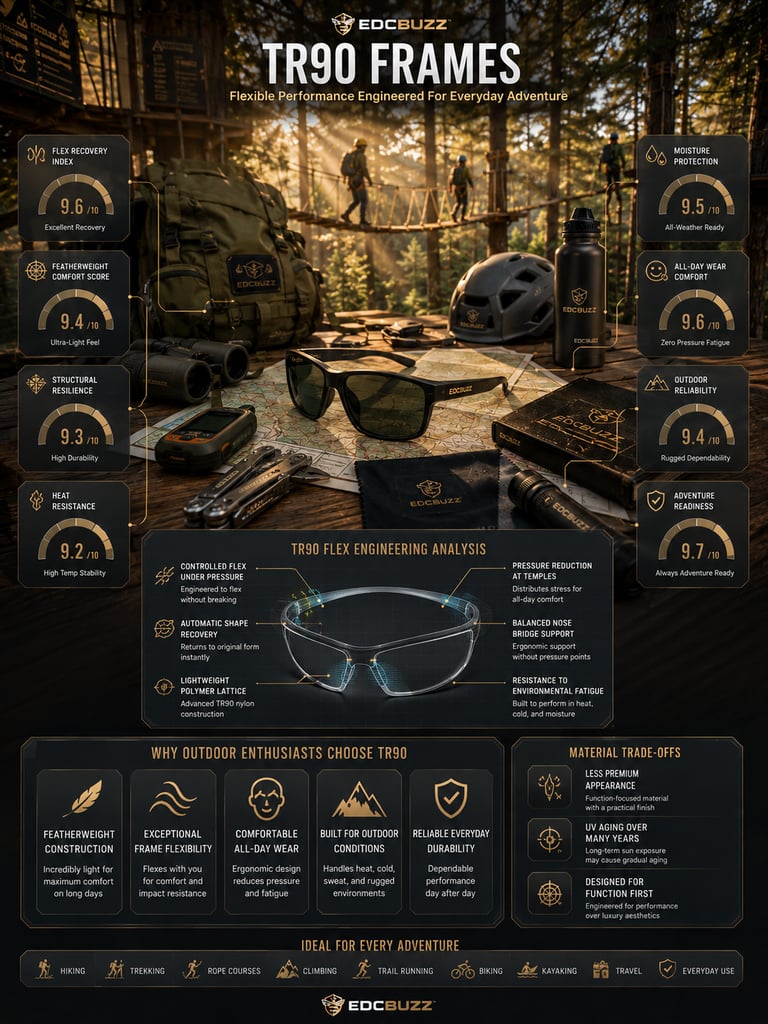
TR90 has become one of the most popular frame materials in modern sunglasses thanks to its outstanding combination of flexibility, lightweight comfort, and durability. Originally developed as a high-performance thermoplastic, TR90 can bend significantly without breaking, making it an excellent choice for active lifestyles.
One of the biggest reasons manufacturers favor TR90 is comfort. Because the material is incredibly light, it places very little pressure on your nose or ears, allowing many people to wear their sunglasses comfortably for an entire day. It's also highly resistant to heat, sweat, and everyday environmental exposure, making it well suited for year-round outdoor use.
You'll find TR90 used extensively in athletic sunglasses, hiking models, and everyday carry eyewear because it offers dependable performance without adding unnecessary weight.
Advantages
Extremely lightweight.
Flexible without becoming weak.
Comfortable for extended wear.
Resistant to heat and moisture.
Excellent everyday durability.
Drawbacks
TR90 doesn't provide the premium appearance of materials like acetate or titanium. While extremely durable, it can eventually lose some flexibility after years of heavy use and UV exposure.
Best For
TR90 is ideal for everyday carry, hiking, travel, driving, running, and athletic sunglasses where comfort is one of the highest priorities.
Many of our favorite models featured in Best Athletic Sunglasses and Best EDC Sunglasses use TR90 because of its excellent balance between comfort and durability.
Nylon
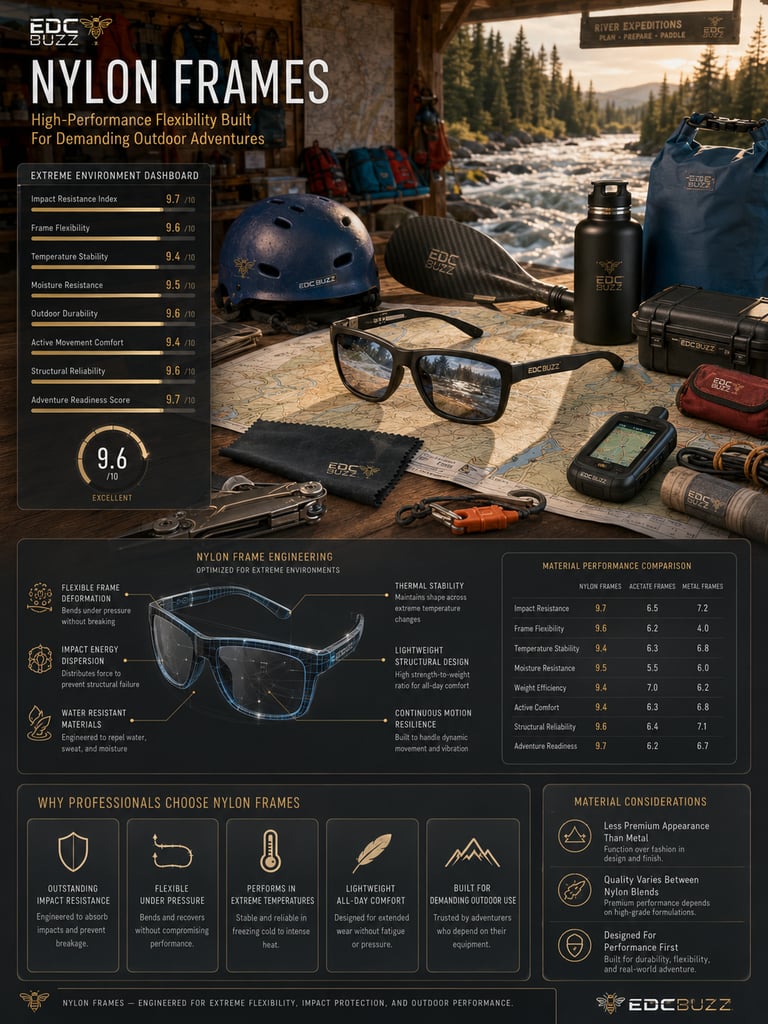
Nylon frames are another favorite among performance sunglasses. Similar to TR90, nylon offers impressive flexibility while adding exceptional impact resistance. Manufacturers often use specialized nylon blends to produce frames capable of handling demanding outdoor environments without becoming brittle or uncomfortable.
Nylon also performs extremely well across a wide range of temperatures. Whether you're hiking in freezing mountain conditions or spending the afternoon under intense summer heat, quality nylon frames maintain their shape remarkably well.
Many premium sports sunglasses rely on nylon because it remains lightweight while standing up to constant movement and rough handling.
Advantages
Excellent impact resistance.
Lightweight construction.
Flexible and durable.
Performs well in extreme temperatures.
Comfortable during active movement.
Drawbacks
Although durable, nylon doesn't always provide the same premium appearance as metal or acetate frames. Lower-quality nylon blends may also feel less rigid than some buyers prefer.
Best For
Nylon is an outstanding choice for hiking, cycling, running, tactical use, fishing, and other demanding outdoor activities.
If outdoor performance is your priority, you'll find many nylon-framed options in our Best Hiking Sunglasses and Best Tactical Sunglasses guides.
Acetate
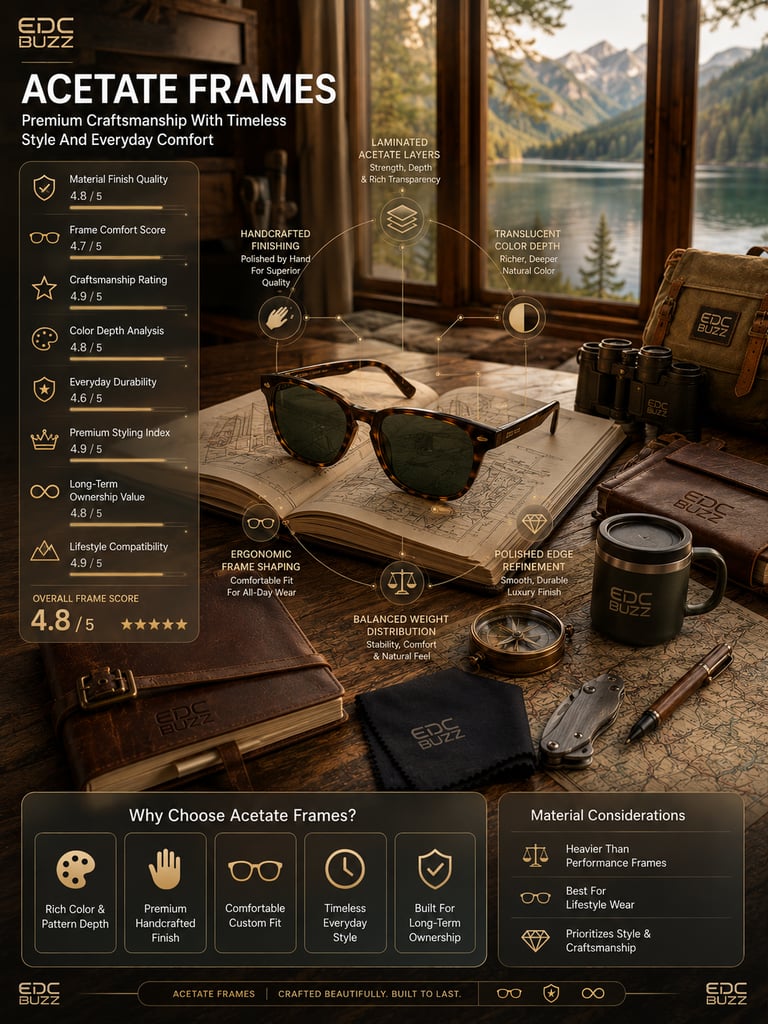
Acetate is one of the most recognizable materials used in premium lifestyle sunglasses. Unlike inexpensive molded plastics, acetate is produced from plant-based cellulose and allows manufacturers to create rich colors, layered finishes, and distinctive patterns that are difficult to replicate with synthetic polymers.
Beyond appearance, acetate also offers excellent comfort because it can be carefully shaped and polished during manufacturing. Many luxury eyewear brands continue to favor acetate because it combines durability with timeless styling.
Although heavier than TR90 or nylon, many buyers appreciate the substantial feel and premium craftsmanship that acetate provides.
Advantages
Premium appearance.
Rich colors and unique patterns.
Comfortable when properly fitted.
Durable for everyday use.
Excellent craftsmanship potential.
Drawbacks
Acetate frames generally weigh more than modern performance materials and can become less suitable for high-intensity sports where minimizing weight is important.
Best For
Acetate excels in lifestyle sunglasses, premium everyday wear, travel, business settings, and buyers who prioritize style alongside performance.
If you're shopping for high-end everyday eyewear, our Best Premium Sunglasses guide features many excellent acetate options.
Aluminum
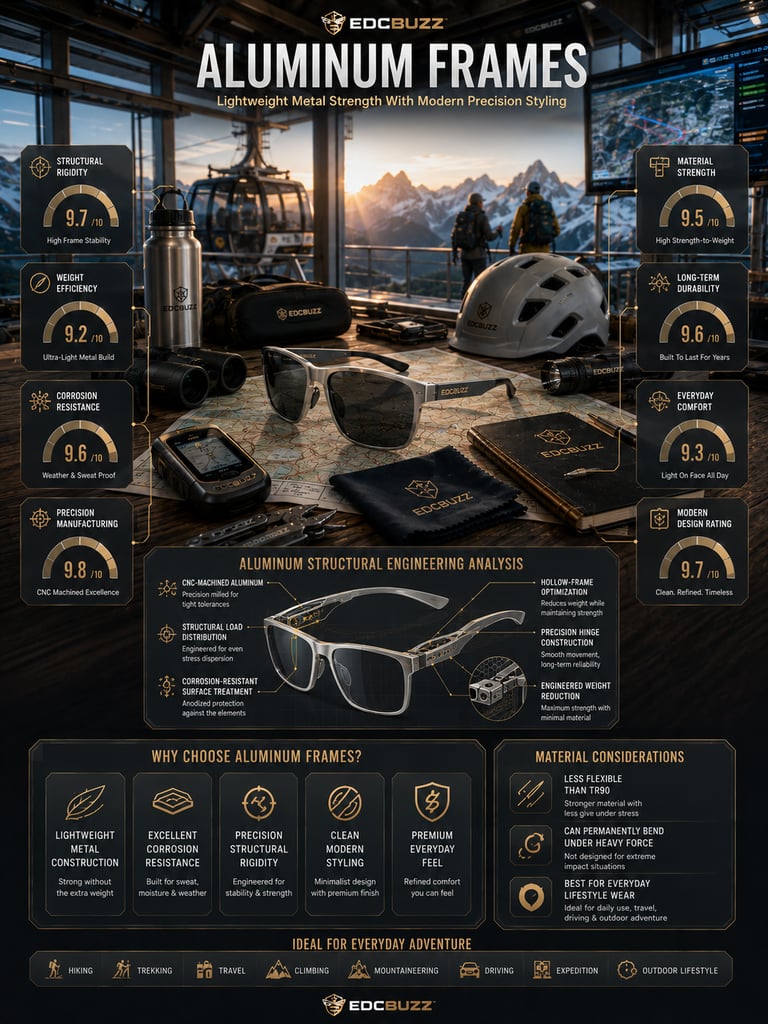
Aluminum frames offer a clean, modern appearance while remaining lighter than many traditional metal alloys. They resist corrosion well and provide excellent structural rigidity, making them attractive for buyers looking for sleek, minimalist sunglasses.
Unlike flexible polymers, aluminum maintains its shape exceptionally well. However, because it doesn't flex as easily, it may be less forgiving if accidentally bent during heavy use.
Many manufacturers pair aluminum frames with premium lenses to create stylish everyday sunglasses that balance durability with modern aesthetics.
Advantages
Lightweight metal construction.
Corrosion resistant.
Clean modern appearance.
Strong structural rigidity.
Premium feel.
Drawbacks
Aluminum doesn't flex as much as TR90 or nylon, making it more susceptible to permanent bending if mishandled.
Best For
Aluminum works well for everyday wear, commuting, travel, driving, and buyers seeking lightweight metal sunglasses.
Titanium
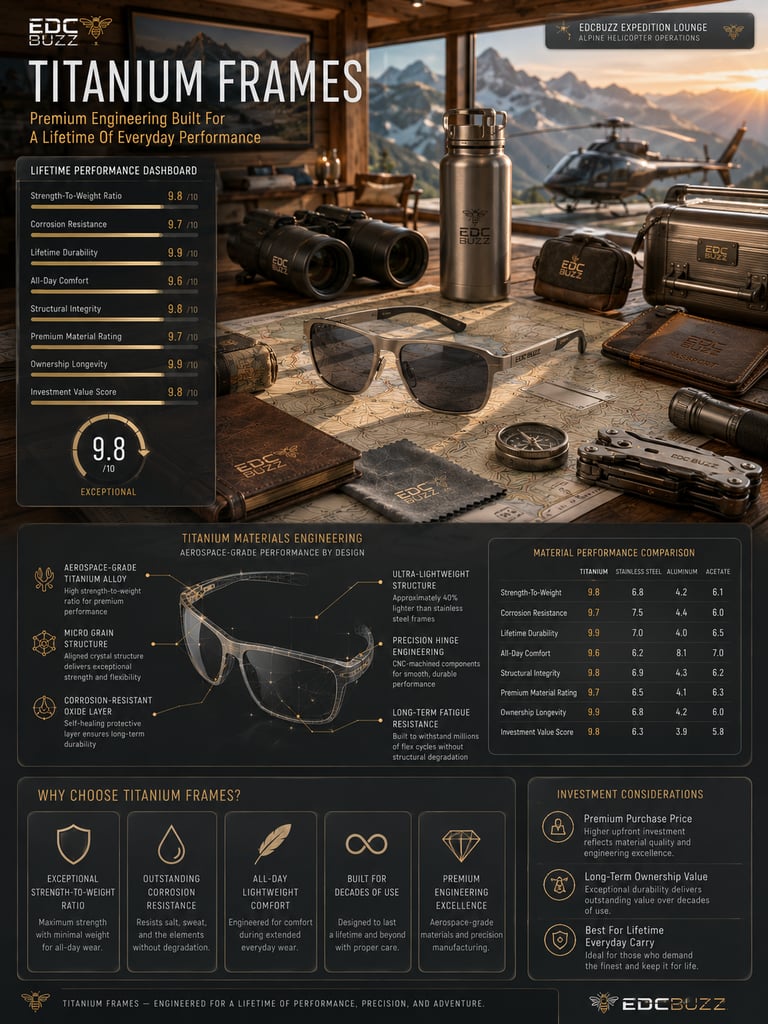
Titanium is widely considered one of the finest frame materials available. Stronger than many traditional metals while weighing significantly less, titanium provides an outstanding combination of durability, comfort, and corrosion resistance.
One of titanium's greatest strengths is longevity. It resists rust, sweat, saltwater exposure, and daily wear better than many competing materials. Even after years of regular use, titanium frames often retain their appearance and structural integrity remarkably well.
Although titanium increases manufacturing costs, many buyers consider it a worthwhile investment because of its exceptional comfort and long-term durability.
Advantages
Extremely lightweight.
Outstanding strength.
Corrosion resistant.
Comfortable for all-day wear.
Excellent long-term durability.
Drawbacks
Titanium frames generally cost considerably more than polymer or aluminum alternatives, placing them firmly within the premium sunglasses category.
Best For
Titanium is ideal for premium everyday carry, frequent travelers, professionals, and anyone planning to keep one quality pair of sunglasses for many years.
You'll find titanium featured throughout our Best Premium Sunglasses guide, as well as premium comparisons like Serengeti Anteo vs Oakley Sutro TI Sweep (Glass vs Polycarbonate).
Carbon Fiber
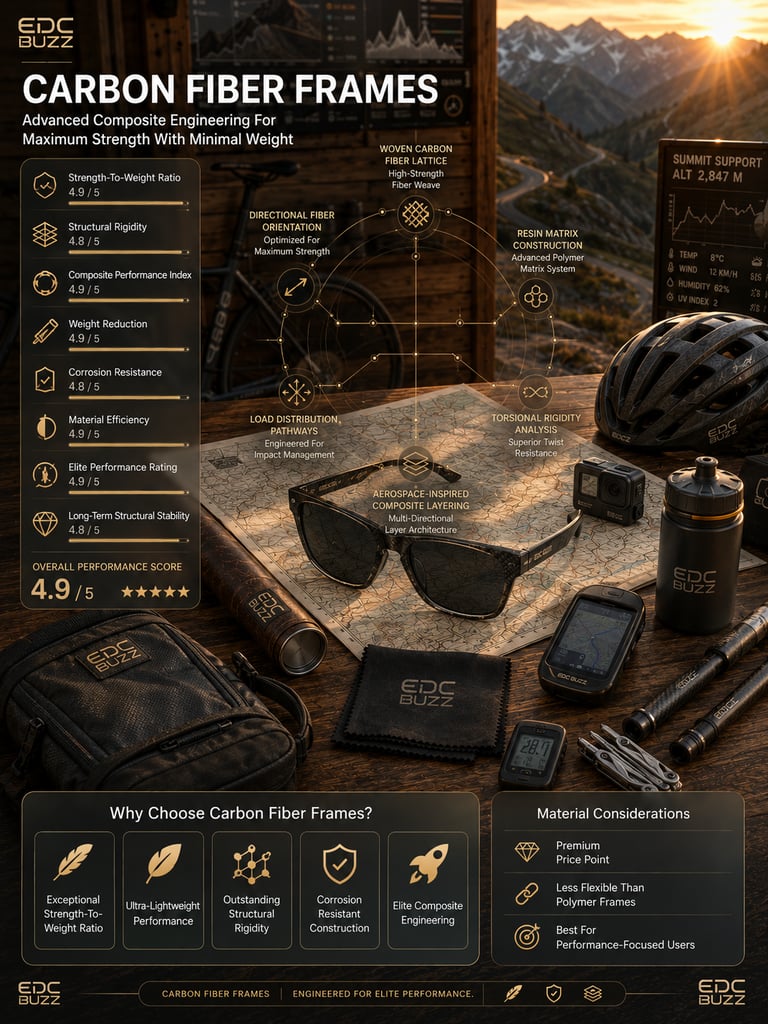
Carbon fiber represents one of the most advanced materials used in modern eyewear. Known for its exceptional strength-to-weight ratio, it allows manufacturers to build incredibly lightweight frames without sacrificing structural rigidity.
Originally popularized in aerospace, motorsports, and competitive cycling, carbon fiber has gradually found its way into premium sunglasses aimed at serious outdoor enthusiasts and athletes.
Although relatively uncommon compared to TR90 or titanium, carbon fiber delivers excellent performance for buyers seeking cutting-edge materials.
Advantages
Extremely lightweight.
Outstanding strength.
Excellent rigidity.
Corrosion resistant.
Premium engineering.
Drawbacks
Carbon fiber is expensive to manufacture and typically appears only on premium sunglasses. It also offers less flexibility than polymer frame materials, making proper fit especially important.
Best For
Carbon fiber is best suited for premium athletic sunglasses, cycling, endurance sports, hiking, and buyers who appreciate advanced materials and engineering.
If you're deciding whether premium construction justifies the additional cost, our guides to Why Do Premium Sunglasses Cost So Much? and Do Expensive Sunglasses Really Protect Your Eyes Better? explain where premium materials begin making a meaningful difference.
Lens Technologies
Modern sunglasses do much more than simply darken your vision. Today's premium eyewear uses specialized lens technologies that reduce glare, adapt to changing light, improve comfort, and increase durability. While many sunglasses combine several of these features into a single lens, understanding what each technology actually does makes it much easier to decide which upgrades are worth paying for.
Some technologies improve optical performance, while others are designed to protect the lens itself. The key is matching the technology to your lifestyle rather than assuming the most expensive option is automatically the best choice.
If you're still deciding which sunglasses fit your everyday carry, our How To Choose Sunglasses guide provides an excellent overview before diving into the technical details below.
Polarized
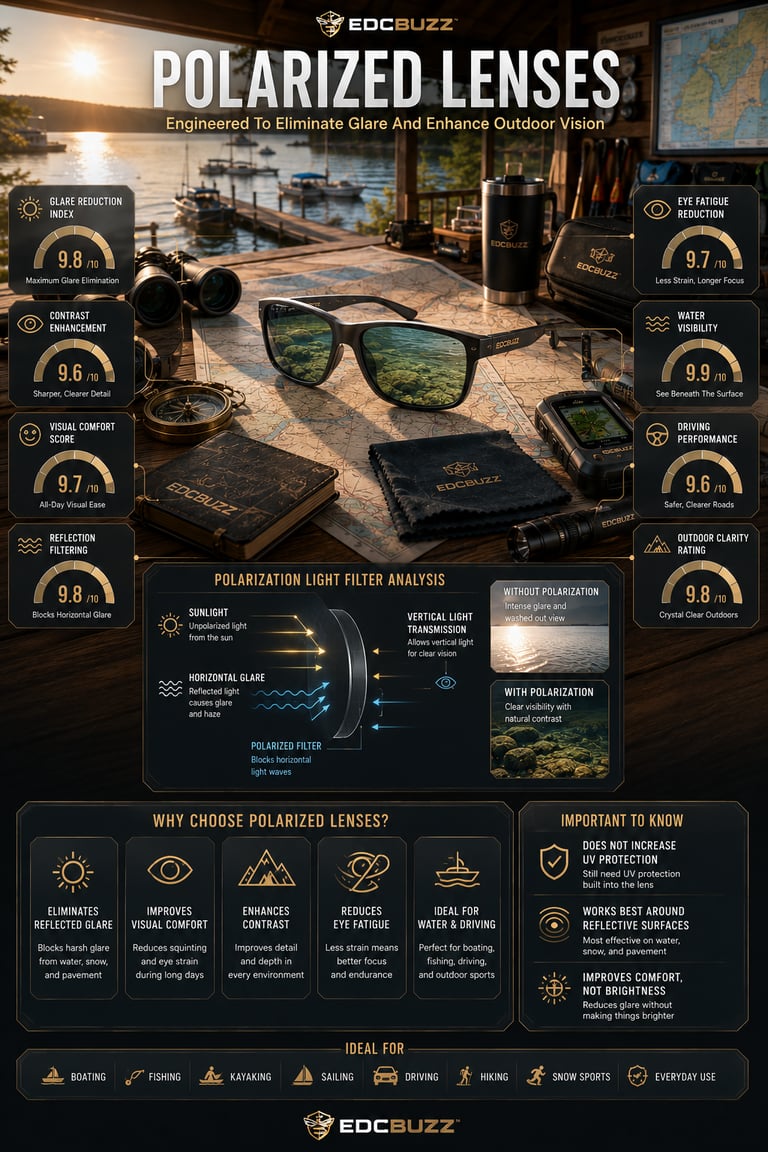
Polarized lenses are one of the most popular upgrades available in modern sunglasses, and for good reason. Unlike standard tinted lenses that simply reduce overall brightness, polarized lenses contain a special filter that blocks horizontally reflected light—the type responsible for intense glare coming from roads, water, snow, vehicle hoods, and other flat surfaces.
The result is improved visual comfort, better contrast, reduced eye fatigue, and clearer vision during bright outdoor conditions. Many people notice the improvement immediately the first time they wear polarized sunglasses while driving or spending time around lakes, beaches, or open highways.
Polarization doesn't increase UV protection—both polarized and non-polarized sunglasses can provide full UV400 protection. Instead, it improves comfort by reducing reflected glare.
How It Works
Polarized filters allow vertical light to pass through while blocking much of the horizontally reflected light responsible for glare. This creates a more comfortable viewing experience without making everything appear unnaturally dark.
Benefits
Dramatically reduces glare.
Improves visual comfort.
Enhances contrast in bright environments.
Reduces eye strain.
Excellent for driving and water activities.
Best Uses
Polarized lenses are ideal for driving, boating, fishing, beach vacations, hiking near water, and everyday outdoor use.
For a deeper explanation, see What Are Polarized Sunglasses and Are They Worth It?, Polarized Sunglasses and UV Protection Explained, Are Polarized Sunglasses Good for Driving?, and Do You Need Polarized Sunglasses for Fishing?
If you're comparing different approaches to glare reduction, our comparison Ray-Ban RB3025 vs Randolph Concorde Aviator (Polarized vs Non-Polarized) provides a practical real-world example.
Photochromic
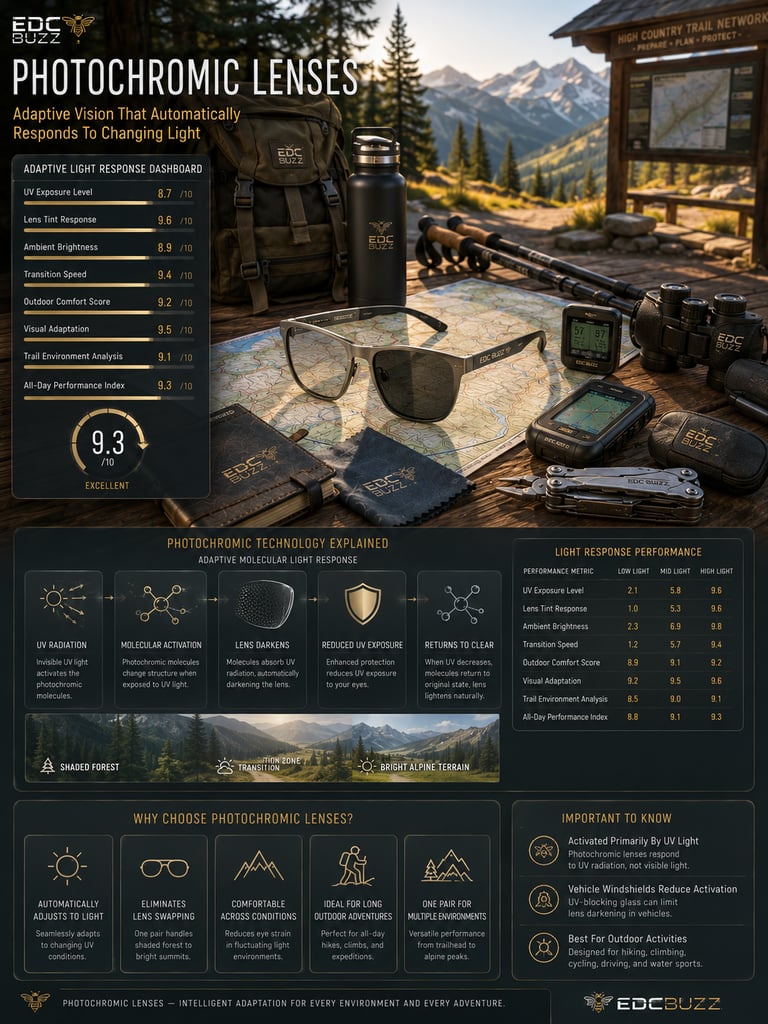
Photochromic lenses automatically adjust their tint based on ultraviolet light exposure. In bright sunshine they darken to reduce brightness, while in lower-light conditions they gradually become lighter, allowing more visible light to pass through.
This automatic adjustment makes them especially valuable for people who frequently move between changing environments. Hikers walking through forests, mountain climbers, backpackers, cyclists, and outdoor workers often benefit from not having to swap sunglasses or change lenses throughout the day.
It's important to remember that photochromic lenses respond primarily to UV light rather than visible brightness. Because modern vehicle windshields block much of the sun's ultraviolet radiation, many photochromic lenses won't darken fully while you're driving.
How It Works
Special light-sensitive molecules inside the lens react to ultraviolet radiation. As UV exposure increases, the molecules darken. When UV exposure decreases, they gradually return to a lighter state.
Benefits
Automatically adjusts to changing light.
Eliminates the need to swap lenses.
Comfortable across varying conditions.
Excellent for long outdoor adventures.
Reduces the need to carry multiple pairs.
Best Uses
Photochromic lenses are ideal for hiking, backpacking, mountaineering, cycling, trail running, and outdoor adventures where lighting changes frequently.
Learn more in Photochromic Lenses Explained: How They Work and When Should You Wear Photochromic Sunglasses?
For a practical comparison, see Julbo Shield REACTIV vs Maui Jim Stone Shack (Photochromic vs Polarized).
Mirrored
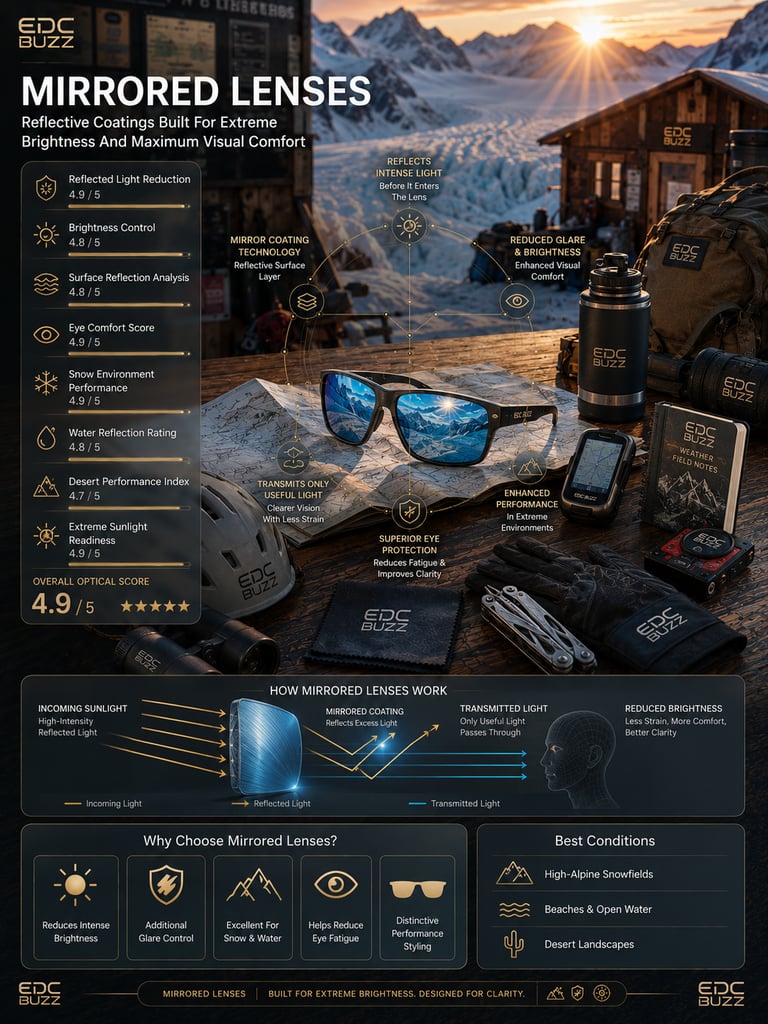
Mirrored lenses feature a highly reflective coating applied to the outside surface of the lens. Besides creating their distinctive appearance, these coatings reflect additional light away from the lens before it reaches your eyes.
Because mirrored coatings reduce the amount of light entering the lens, they're especially useful in environments with intense sunlight, including beaches, deserts, snowy mountains, and open water.
Many premium sunglasses combine mirrored coatings with polarized lenses to provide both glare reduction and additional brightness control.
How It Works
A thin reflective coating bounces away a portion of incoming sunlight before it enters the lens, helping reduce brightness under extremely sunny conditions.
Benefits
Reduces brightness.
Helps limit eye fatigue.
Adds another layer of glare control.
Popular for snow and water environments.
Distinctive appearance.
Best Uses
Mirrored lenses perform best during beach vacations, skiing, boating, fishing, mountaineering, desert hiking, and other environments with intense sunlight.
If you've ever wondered whether they're mostly cosmetic, read Do Mirrored Sunglasses Actually Reduce Glare?
Anti-Reflective
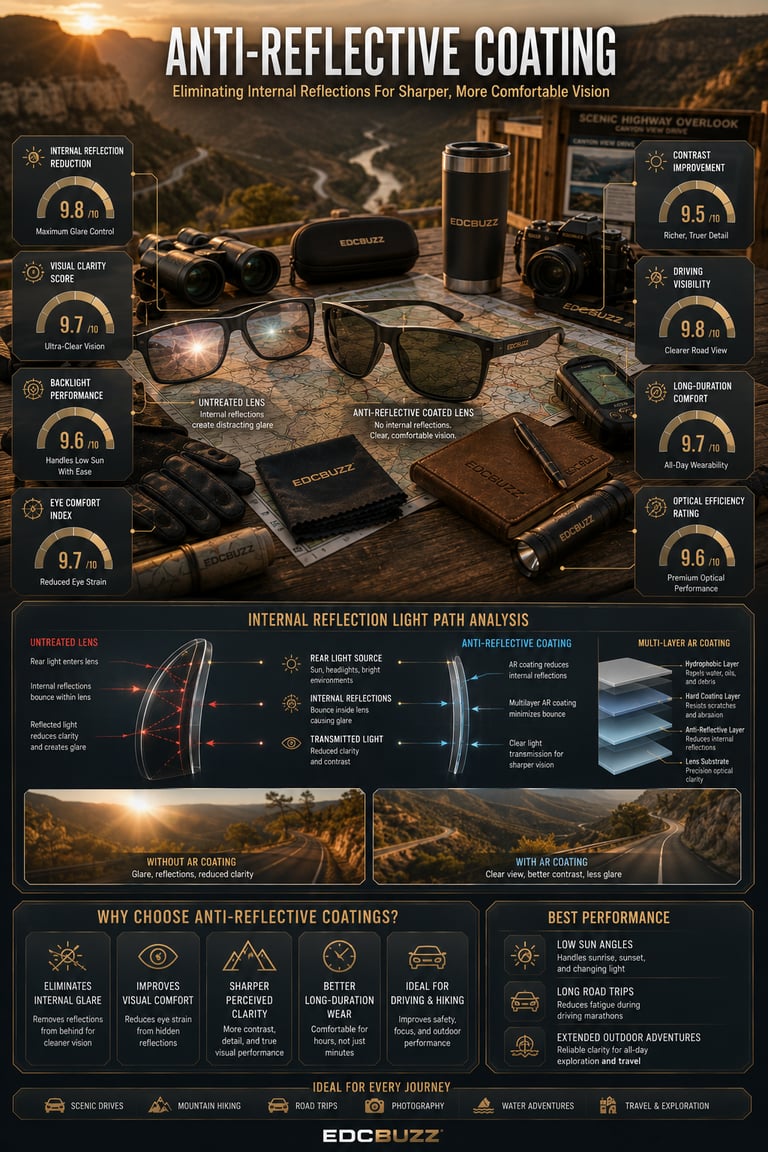
Anti-reflective (AR) coatings are often misunderstood because they're applied to the back side of many sunglass lenses rather than the front.
Their purpose isn't to make the world brighter—it is to eliminate reflections bouncing off the inside surface of the lens. Without an AR coating, bright sunlight entering from behind or above can reflect into your eyes, creating distracting glare that reduces comfort and visual clarity.
Many premium sunglasses quietly include anti-reflective coatings because they improve vision without dramatically changing how the sunglasses look.
How It Works
Microscopic coating layers reduce internal reflections by allowing more light to pass through the lens rather than bouncing back toward your eyes.
Benefits
Reduces internal glare.
Improves visual comfort.
Sharpens perceived clarity.
Helps during long hours outdoors.
Common on premium sunglasses.
Best Uses
Anti-reflective coatings benefit nearly every type of sunglasses but become especially valuable during driving, hiking, cycling, and extended outdoor use where changing light angles create distracting reflections.
Premium options featured in Best Driving Sunglasses, Best Premium Sunglasses, and Best EDC Sunglasses commonly include anti-reflective coatings alongside other advanced lens technologies.
Scratch Resistant
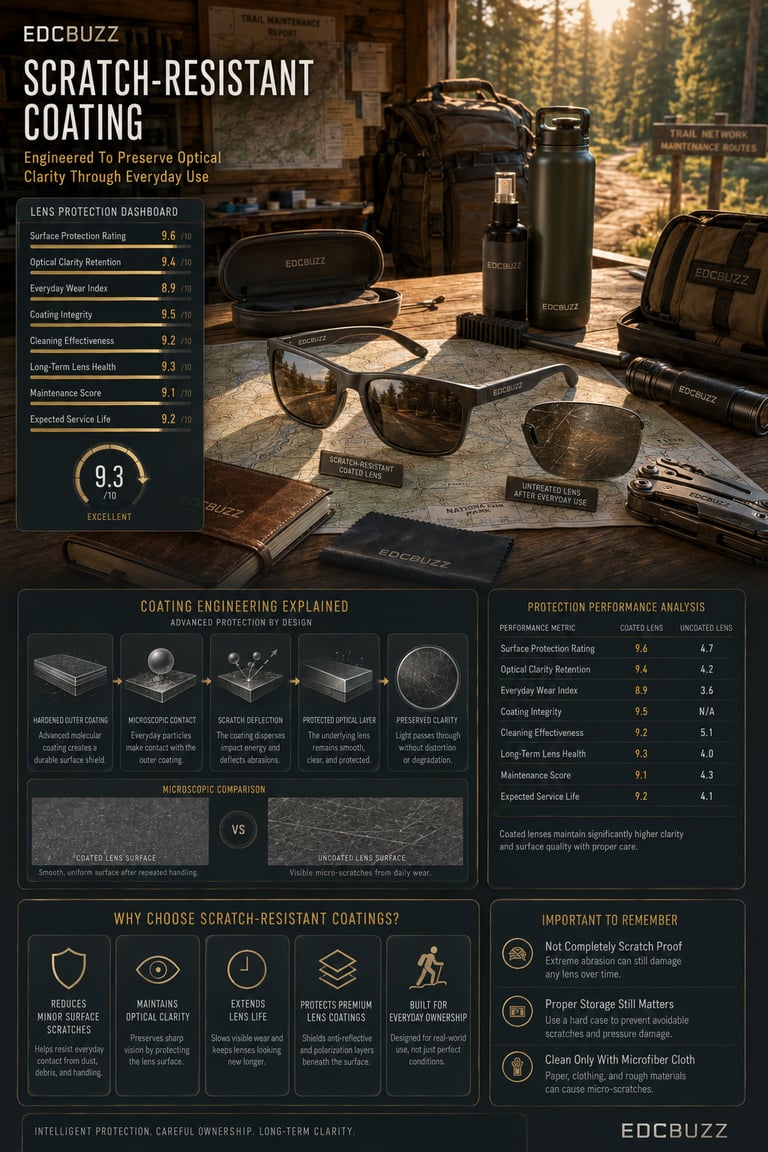
Despite the marketing language used by many manufacturers, no sunglass lens is completely scratch proof. Instead, most modern lenses receive a scratch-resistant coating that helps reduce minor surface damage during everyday use.
These coatings are particularly important for polycarbonate and CR-39 lenses because both materials are naturally softer than glass. While the coating greatly improves durability, proper cleaning and storage remain essential if you want your sunglasses to last for years.
Even the best coating can't fully protect a lens that's tossed into a backpack without a case or cleaned with a dirty shirt.
How It Works
Manufacturers apply a thin hardened coating over the lens surface to improve resistance against everyday scratches caused by dust, dirt, and routine handling.
Benefits
Helps reduce minor scratches.
Extends lens life.
Preserves optical clarity.
Protects lens coatings.
Improves long-term durability.
Limitations
Scratch-resistant coatings slow down wear—they don't eliminate it. Proper cleaning, safe storage, and careful handling remain the biggest factors affecting how long your sunglasses stay in excellent condition.
For maintenance advice, see How to Clean Sunglasses Without Scratching Them, How to Remove Scratches from Sunglass Lenses, How to Store Sunglasses Properly, and How Long Do Sunglasses Last?
Lens Colors
Choosing the right lens color is about much more than appearance. Different tints filter light differently, affecting contrast, depth perception, glare reduction, and color accuracy. While many buyers simply pick the lens that looks best, selecting the right color for your environment can noticeably improve comfort and visual performance.
No single lens color is perfect for every situation. Gray lenses preserve natural colors, brown lenses improve contrast, yellow lenses brighten low-light conditions, and copper lenses excel in changing outdoor environments. Understanding these differences will help you match your sunglasses to the activities you enjoy most.
If you're still deciding which tint best fits your needs, our guides to How Lens Colors Affect Vision Outdoors and What Color Sunglass Lens Is Best? explore the topic in even greater detail.
Gray
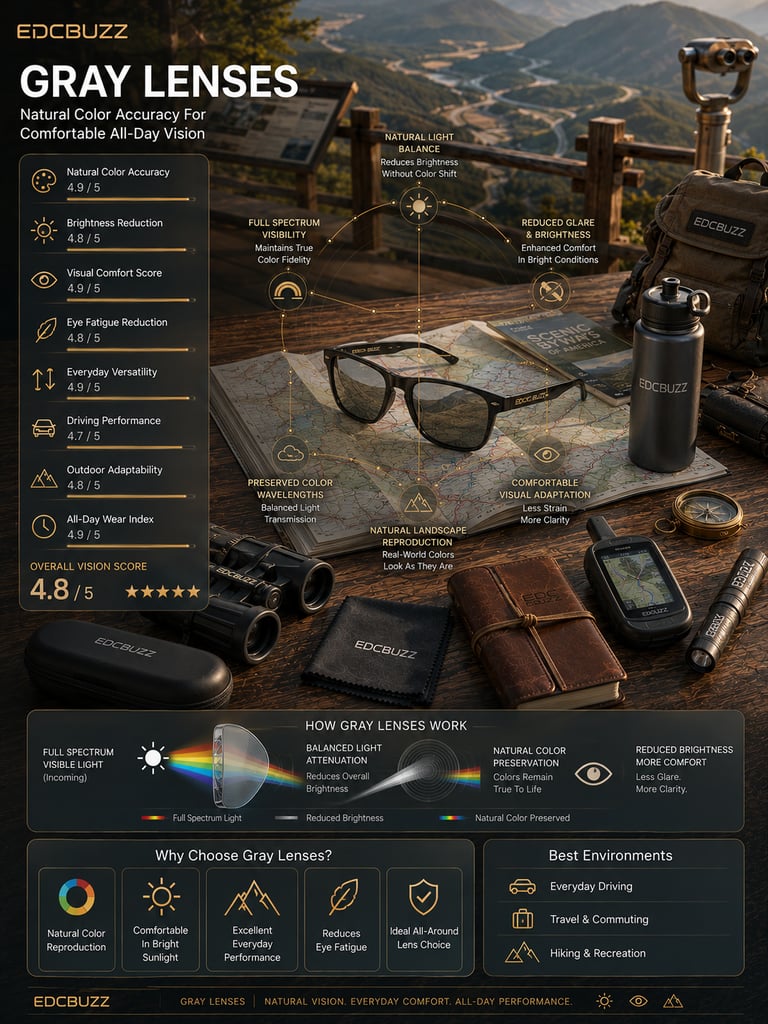
Gray is one of the most versatile sunglass lens colors available. Rather than dramatically altering colors, gray lenses reduce overall brightness while preserving natural color balance. This makes them comfortable to wear for long periods because your eyes perceive the environment much as they normally would—just with less glare and reduced light intensity.
Because of their neutral appearance, gray lenses are commonly found in premium everyday sunglasses, driving eyewear, and athletic models. They perform consistently across a wide range of outdoor conditions without overly emphasizing contrast or color.
Best Environment
Gray lenses excel during everyday driving, commuting, walking, beach trips, boating, travel, and general outdoor recreation where maintaining natural color perception is important.
Strengths
Natural color reproduction.
Excellent all-around performance.
Comfortable in bright sunlight.
Reduces eye fatigue.
Works well for everyday wear.
Considerations
While extremely versatile, gray lenses don't increase contrast as much as brown or copper lenses, making them less specialized for changing terrain or low-light environments.
For drivers, anglers, and everyday users, gray remains one of the safest all-around choices. Many models featured in Best Driving Sunglasses, Best Hiking Sunglasses, and Best EDC Sunglasses use gray lenses because of their versatility.
Brown
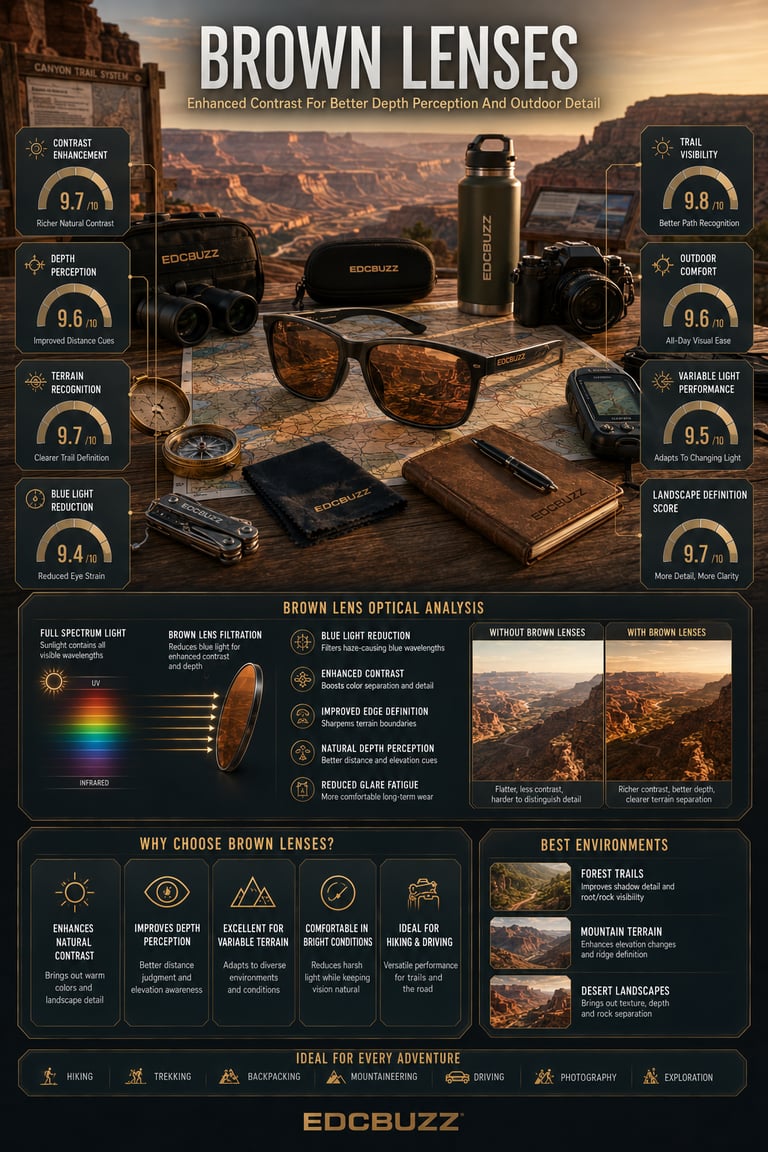
Brown lenses enhance contrast while maintaining excellent overall clarity. By filtering blue light more aggressively than gray lenses, they help objects appear more defined and can improve depth perception in many outdoor environments.
This increased contrast makes brown lenses particularly popular among hikers, hunters, golfers, and anyone spending time in forests, mountains, or mixed terrain where distinguishing details is important.
Many premium polarized sunglasses also pair brown lenses with polarization to create outstanding visual comfort in bright outdoor conditions.
Best Environment
Brown lenses perform exceptionally well during hiking, trail walking, driving, hunting, golf, and outdoor recreation where improved contrast helps identify terrain changes.
Strengths
Enhances contrast.
Improves depth perception.
Excellent in variable terrain.
Comfortable in bright conditions.
Reduces blue light effectively.
Considerations
Brown lenses slightly warm the appearance of colors. While many users enjoy this effect, buyers wanting completely natural color reproduction may prefer gray lenses instead.
For more recommendations, see Best Hiking Sunglasses and How Lens Colors Affect Vision Outdoors.
Green
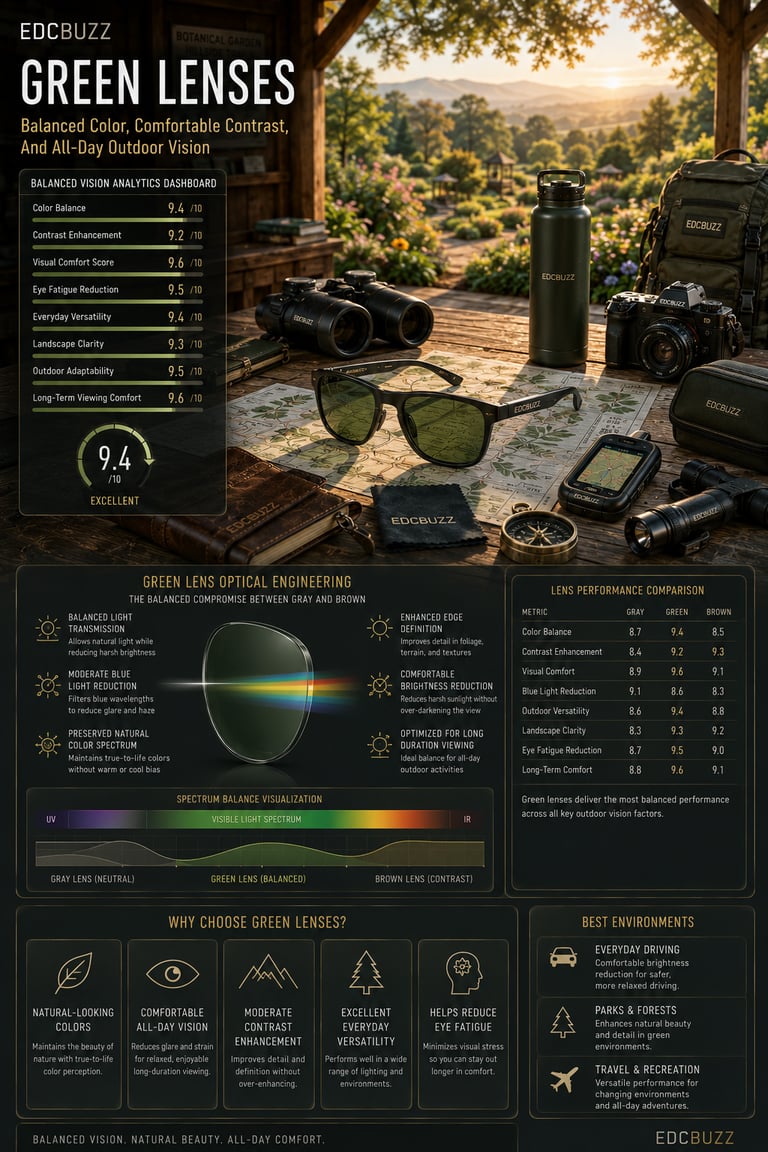
Green lenses strike an excellent balance between gray and brown. They preserve relatively natural colors while providing a slight increase in contrast that many users find comfortable for extended outdoor wear.
Because they don't dramatically alter the appearance of the surrounding environment, green lenses remain popular among people who spend entire days outdoors and want a relaxed viewing experience without excessive brightness.
Green has also become closely associated with classic premium sunglasses thanks to its long history in aviation and lifestyle eyewear.
Best Environment
Green lenses work well for everyday wear, driving, walking, boating, travel, and casual outdoor activities.
Strengths
Natural-looking colors.
Moderate contrast enhancement.
Comfortable during long wear.
Excellent all-around versatility.
Reduces eye fatigue.
Considerations
Green lenses don't maximize contrast like brown lenses or preserve perfectly neutral color like gray lenses, instead offering a balanced compromise between both.
Buyers looking for one pair of sunglasses to wear almost everywhere often find green lenses an excellent choice.
Yellow
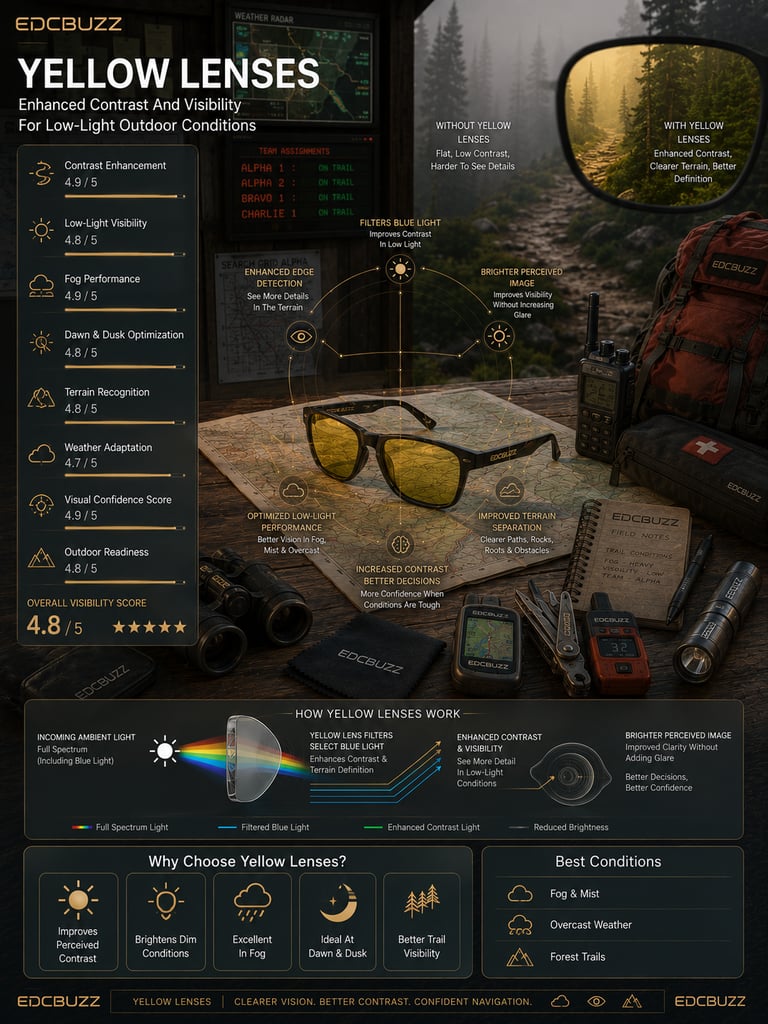
Yellow lenses are designed for situations where increasing brightness and contrast matters more than reducing sunlight. Rather than blocking large amounts of light, yellow filters improve visibility in dim, cloudy, foggy, rainy, or early morning conditions.
Because they allow more visible light to reach your eyes, yellow lenses are generally not recommended for bright midday sunshine. Instead, they're favored by shooters, cyclists, hunters, and drivers operating in poor weather or changing light.
Many people mistakenly assume yellow lenses provide superior night vision. While they can improve perceived contrast under certain conditions, they don't magically increase your ability to see in darkness.
Best Environment
Yellow lenses perform best during overcast weather, dawn, dusk, fog, light rain, wooded trails, and other lower-light environments.
Strengths
Improves perceived contrast.
Brightens dim conditions.
Helpful during overcast weather.
Popular for shooting sports.
Excellent in fog.
Considerations
Yellow lenses are generally too bright for prolonged use under intense midday sunlight, making them a specialized rather than everyday choice.
If you frequently encounter changing weather, When Should You Wear Photochromic Sunglasses? may also be worth reading.
Blue
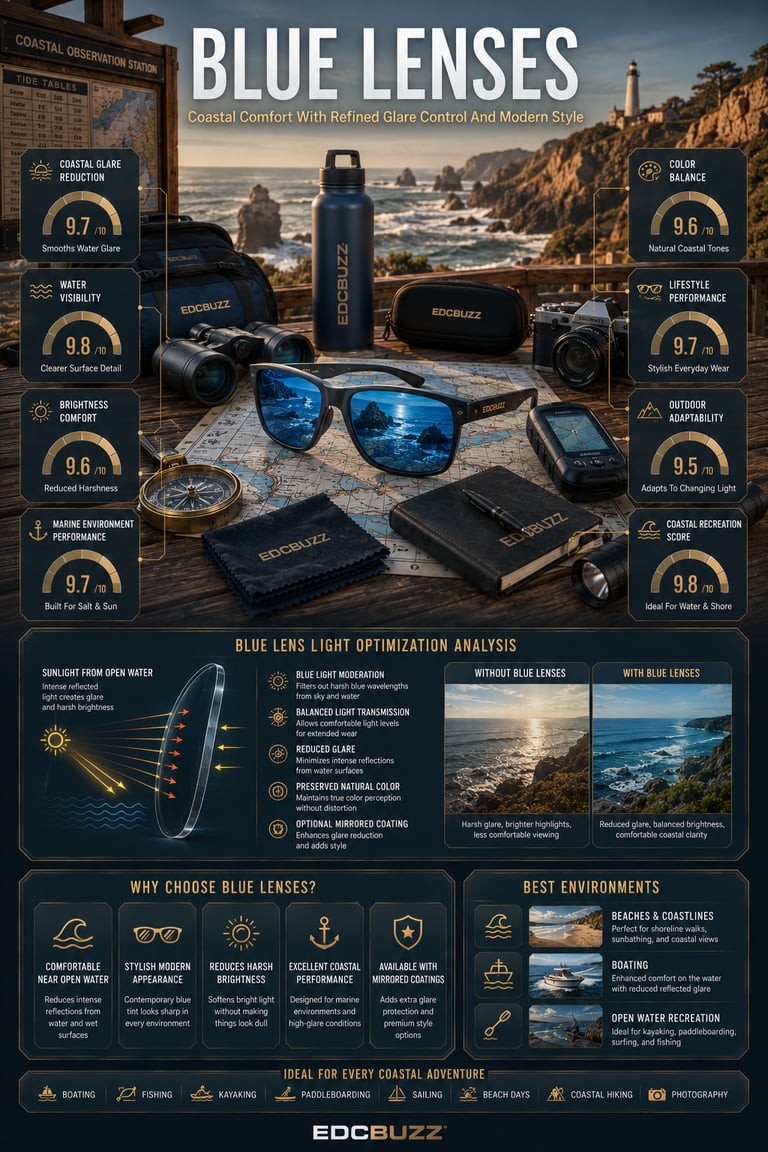
Blue lenses are less common than gray or brown but have gained popularity for both their distinctive appearance and specialized performance. Depending on the exact tint, blue lenses can help reduce glare in bright coastal environments while maintaining comfortable color perception.
Many premium lifestyle sunglasses use blue mirror coatings rather than fully blue-tinted lenses, combining functional glare reduction with a modern appearance.
Because blue lenses vary significantly between manufacturers, buyers should focus on overall performance rather than color alone.
Best Environment
Blue lenses are commonly used for coastal environments, beach vacations, boating, open water, and bright sunny conditions.
Strengths
Stylish appearance.
Comfortable near water.
Available with mirrored coatings.
Reduces harsh brightness.
Popular for coastal use.
Considerations
Performance varies more between manufacturers than with traditional gray or brown lenses, making overall lens quality especially important.
If you're considering mirrored options, see Do Mirrored Sunglasses Actually Reduce Glare?
Copper
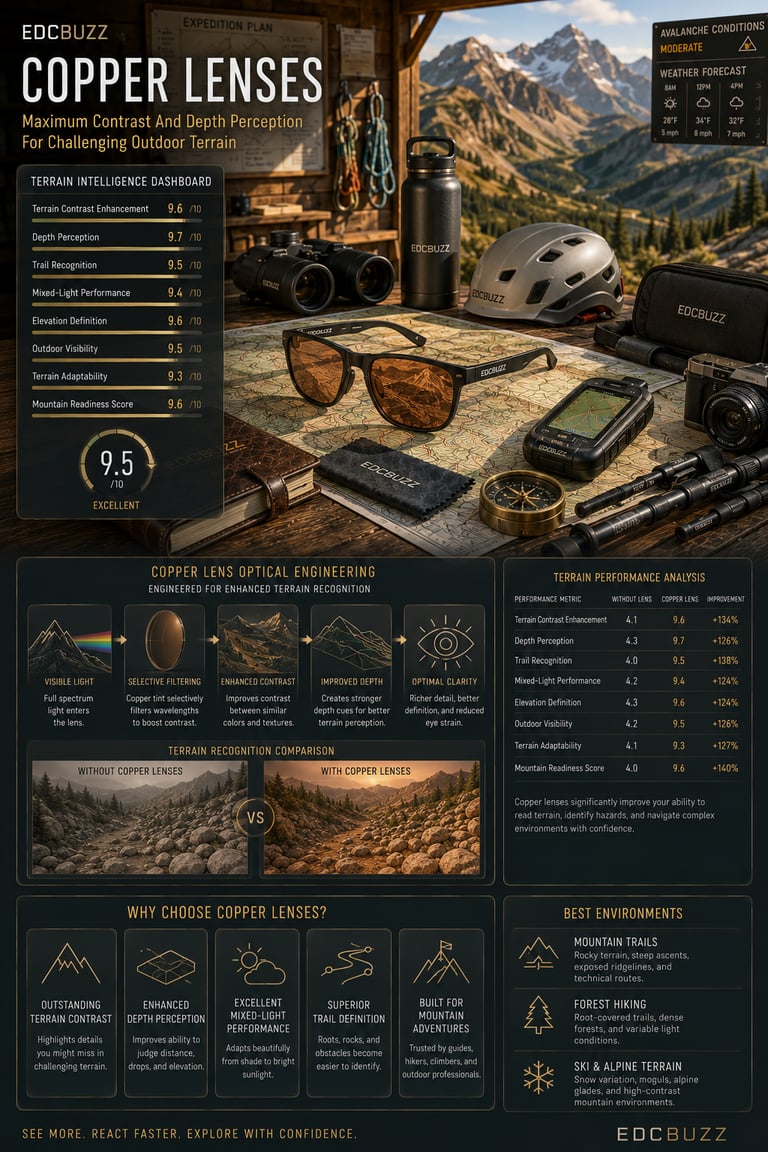
Copper lenses combine many of the advantages of brown lenses while further enhancing contrast and depth perception. They perform exceptionally well in environments where terrain constantly changes, making them popular among hikers, mountain bikers, hunters, skiers, and outdoor enthusiasts.
Many photochromic mountain sunglasses use copper-based tints because they maintain excellent visibility across a wide range of conditions while helping identify changes in rocks, roots, snow, and uneven ground.
Copper lenses often feel more vibrant than gray without becoming overly warm like some darker brown tints.
Best Environment
Copper lenses excel during hiking, mountain biking, skiing, hunting, backpacking, and changing outdoor terrain.
Strengths
Outstanding contrast.
Excellent depth perception.
Great in changing terrain.
Comfortable in mixed lighting.
Popular for mountain environments.
Considerations
While excellent outdoors, copper slightly alters natural color perception, making it less appealing for buyers wanting perfectly neutral vision.
For adaptive mountain eyewear, compare Julbo Shield REACTIV vs Maui Jim Stone Shack (Photochromic vs Polarized) to see how lens color and photochromic technology work together in demanding environments.
UV Protection
Protecting your eyes from ultraviolet (UV) radiation is the single most important job any pair of sunglasses performs. While lens color, frame style, and premium features often receive the most attention, none of them matter if your sunglasses fail to block harmful UV rays. Long-term exposure to ultraviolet radiation can contribute to eye fatigue, cataracts, macular degeneration, and damage to the surface of the eye, making proper UV protection an essential feature rather than a luxury.
Fortunately, effective UV protection isn't limited to expensive sunglasses. Many affordable models provide complete UV400 protection, while some premium models justify their higher price through better optics, stronger materials, or improved durability rather than additional UV filtering.
Understanding what UV protection actually means helps separate meaningful specifications from marketing claims.
If you're wondering whether polarization improves UV protection, read Polarized Sunglasses and UV Protection Explained.
What Is UV400?
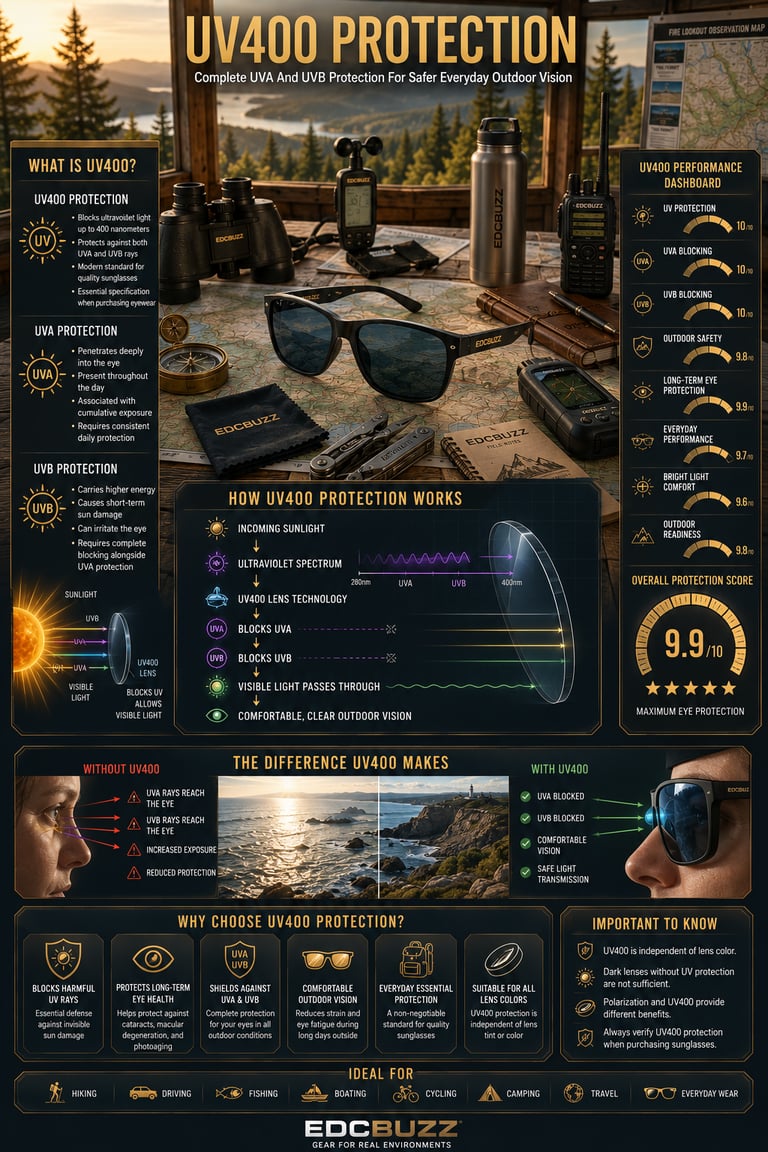
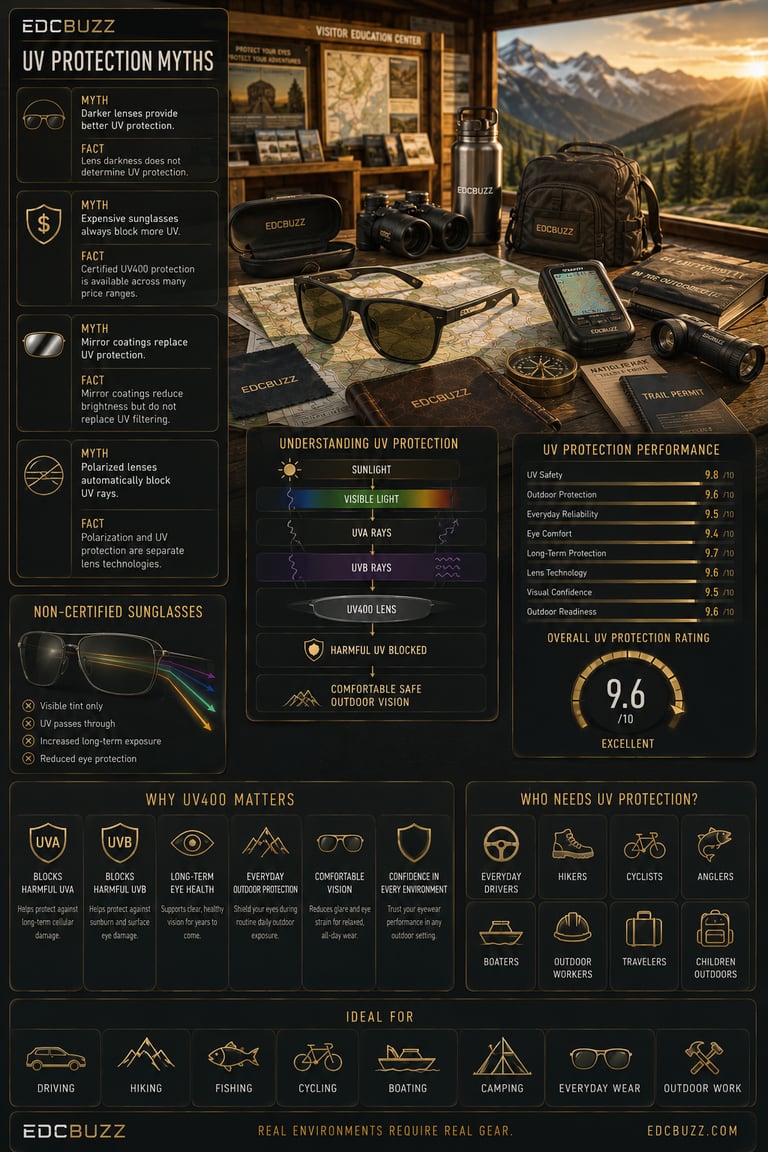
The term "UV400" indicates that a lens blocks ultraviolet light with wavelengths up to 400 nanometers. This includes both UVA and UVB rays, which account for nearly all of the ultraviolet radiation that reaches the Earth's surface.
Simply put, UV400 is considered the modern standard for quality sunglasses. Whether your lenses are gray, brown, polarized, photochromic, mirrored, or completely clear safety lenses, they should always provide full UV400 protection.
When shopping for sunglasses, UV400 is one of the first specifications you should verify.
UVA Protection
UVA rays penetrate deeply into the eye and remain relatively consistent throughout the day and throughout the year. Long-term exposure has been associated with cumulative damage that can contribute to cataracts and other age-related eye conditions.
Because UVA exposure occurs even on cloudy days, quality sunglasses should provide full protection whenever you're outdoors.
UVB Protection
UVB rays carry more energy than UVA and are primarily responsible for short-term sun damage. They can irritate the surface of the eye and contribute to long-term vision problems after repeated exposure.
Quality sunglasses should block both UVA and UVB equally rather than emphasizing one over the other.
UV Protection Myths
One of the biggest misconceptions is that darker lenses automatically provide better protection.
In reality, lens darkness has almost nothing to do with UV protection. A lightly tinted pair of sunglasses with certified UV400 protection protects your eyes far better than dark fashion sunglasses without proper UV filtering.
Another common myth is that expensive sunglasses offer stronger UV protection than inexpensive models. While premium sunglasses often feature superior optics, materials, and coatings, many affordable sunglasses provide the exact same UV400 protection.
If you're comparing premium and budget eyewear, Do Expensive Sunglasses Really Protect Your Eyes Better? explains where premium models actually earn their higher prices.
Who Needs UV Protection?
Everyone. Whether you're driving to work, walking the dog, hiking mountain trails, fishing, cycling, working outdoors, or relaxing at the beach, your eyes benefit from full UV protection. Even children should wear properly fitted sunglasses during extended outdoor activities.
Many safety glasses also provide full UV400 protection, making them excellent choices for outdoor work where both impact resistance and ultraviolet protection are important.
For workplace recommendations, explore Best Tactical Sunglasses and Best Hiking Sunglasses.
Impact Protection
While UV protection shields your eyes from invisible radiation, impact protection guards against physical hazards. The two are completely different features, yet many buyers mistakenly assume one automatically includes the other.
Impact-resistant lenses are designed to withstand drops, flying debris, accidental impacts, and the demands of active outdoor use. Whether you're hiking rough trails, operating power equipment, cycling, or working around machinery, choosing the appropriate level of impact protection helps reduce the risk of serious eye injuries.
The best lens material depends on how you plan to use your sunglasses.
Lens Material Matters
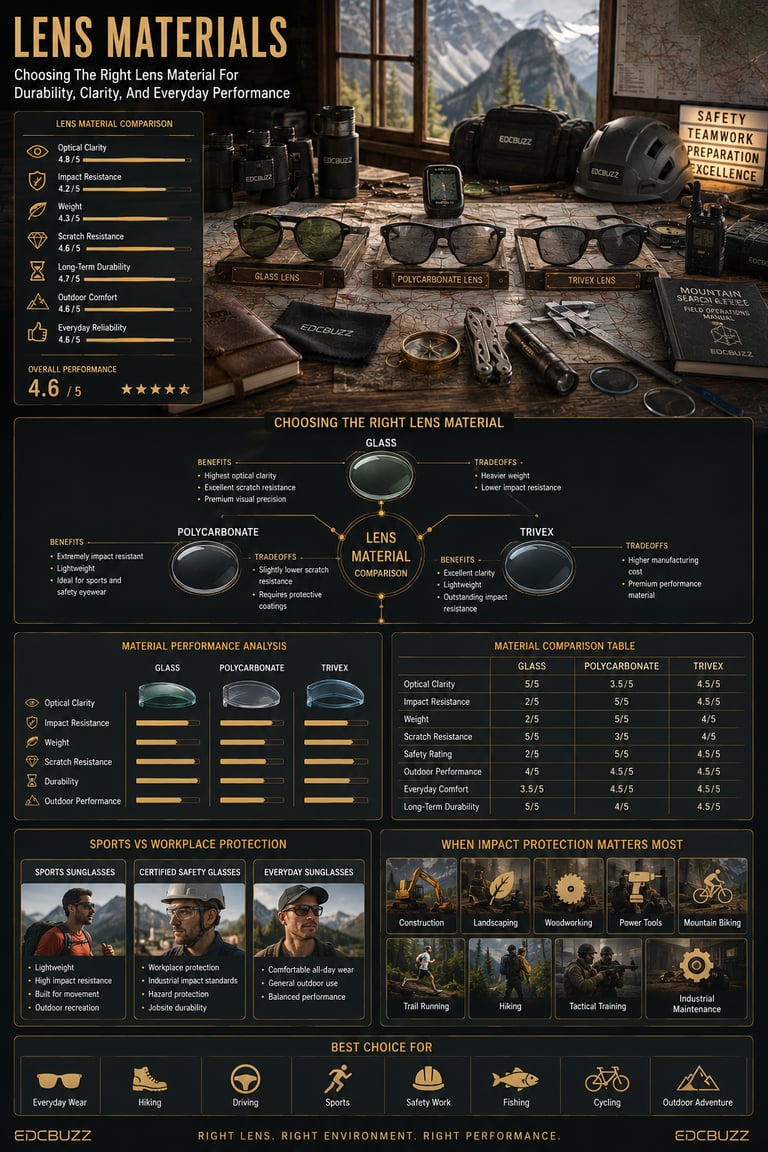
Glass lenses provide exceptional clarity and scratch resistance but are generally less suitable for high-impact environments. Polycarbonate and Trivex lenses were specifically developed to absorb impacts while remaining lightweight. That's why you'll commonly find them in sports sunglasses, tactical eyewear, and certified safety glasses. If impact resistance is your highest priority, polycarbonate and Trivex are usually the preferred options.
For a detailed comparison, see Choosing Between Glass and Polycarbonate Lenses.
Sports vs Workplace Protection
Many premium sports sunglasses are incredibly durable, but they aren't necessarily safety glasses. Sports sunglasses are designed to withstand accidental drops, trail debris, and active movement. Certified safety glasses are engineered to survive standardized impact testing intended to protect workers from serious hazards. Although they may look similar, the intended use is very different.
Our comparison Mechanix Vision Type-E vs Oakley Half Jacket 2.0 (Safety Glasses vs Sunglasses) explains these differences in greater detail.
When Impact Protection Matters Most
Impact-resistant eyewear becomes especially important during:
Construction work
Landscaping
Woodworking
Power tool operation
Mountain biking
Trail running
Hiking
Tactical training
Industrial maintenance
Even recreational activities can expose your eyes to unexpected hazards, making durable lenses a worthwhile investment.
ANSI Ratings
Not all protective eyewear is created equally. If your sunglasses will be used around machinery, construction materials, flying debris, or other workplace hazards, you'll likely encounter ANSI safety ratings.
ANSI stands for the American National Standards Institute, which develops performance standards for protective eyewear sold in the United States.
Unlike standard sunglasses, ANSI-certified safety glasses undergo specific impact testing to verify that they can withstand hazards commonly found in industrial and construction environments.
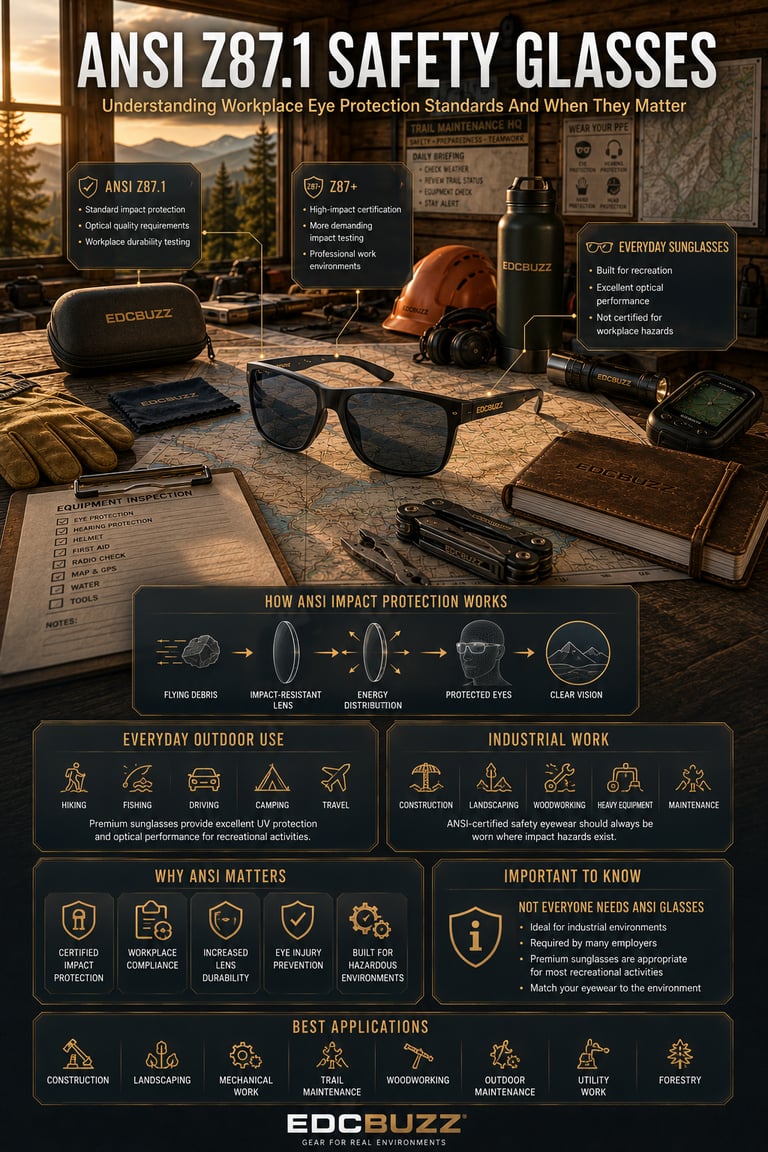
What Is ANSI Z87.1?
ANSI Z87.1 is the primary safety standard used for occupational eye protection. Eyewear meeting this standard has been tested for impact resistance, lens retention, optical quality, and overall durability. Depending on the certification level, products may also be tested against high-velocity impacts and other workplace hazards.
If your employer requires safety eyewear, ANSI certification is often mandatory.
What Does Z87+ Mean?
The "+" designation indicates high-impact protection. While standard Z87-rated eyewear provides basic protection, Z87+ models pass additional impact testing designed for more demanding environments.
Construction workers, mechanics, welders, landscapers, maintenance technicians, and industrial professionals often require Z87+ eyewear depending on their workplace safety policies.
Do You Need ANSI-Rated Sunglasses?
Not everyone. If you're primarily driving, hiking, fishing, traveling, or enjoying outdoor recreation, standard premium sunglasses usually provide all the protection you need. However, if you're operating power equipment, working around machinery, cutting wood, grinding metal, or working in environments where flying debris is possible, ANSI-certified safety glasses should always replace traditional sunglasses.
No amount of premium optics can substitute for certified impact protection.
If you're unsure which type of eyewear fits your work, read Are Safety Glasses Good Enough for Outdoor Work?
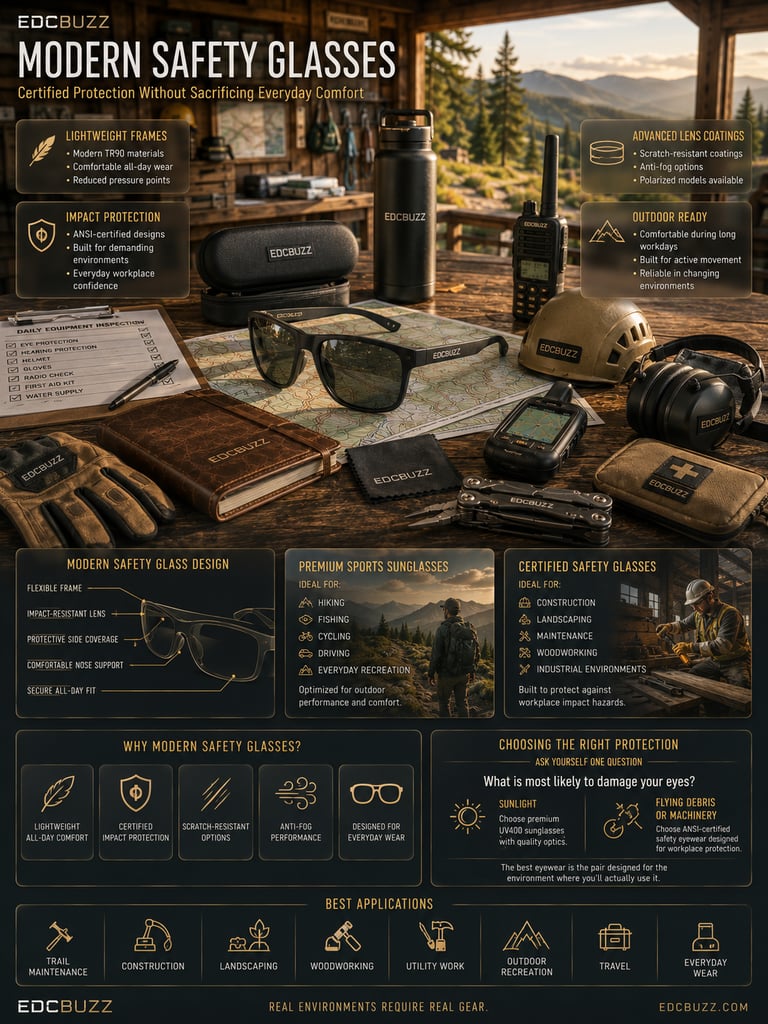
Safety Glasses Can Still Be Comfortable
Modern safety glasses have improved dramatically over the past decade. Many now feature lightweight TR90 or nylon frames, wraparound protection, anti-fog coatings, scratch-resistant lenses, and even polarized options for outdoor workers.
Today's best safety glasses feel much closer to premium sports sunglasses than the bulky protective eyewear many people remember.
Our Best Safety Glasses guide highlights several excellent options that balance comfort with certified protection.
Choosing the Right Protection
When buying sunglasses, ask yourself one simple question:
What is most likely to damage my eyes?
If the answer is sunlight, UV protection and quality optics should be your focus.
If the answer is flying debris, machinery, or workplace hazards, impact protection and ANSI certification become far more important than premium lens coatings or designer branding.
The best sunglasses aren't simply the most expensive pair—they're the ones designed for the environment where you'll actually wear them.
Cleaning & Maintenance
Even the highest-quality sunglasses require regular care to continue performing at their best. Dirt, dust, sunscreen, sweat, and skin oils gradually accumulate on both the lenses and frames, reducing clarity and potentially damaging specialized coatings over time.
Fortunately, maintaining your sunglasses doesn't require expensive cleaning products or complicated routines. A few simple habits can dramatically extend the life of your eyewear while preserving the optical performance you paid for.
Whether you own budget sunglasses or premium titanium frames with polarized glass lenses, proper cleaning is one of the easiest ways to protect your investment.
Clean the Lenses First
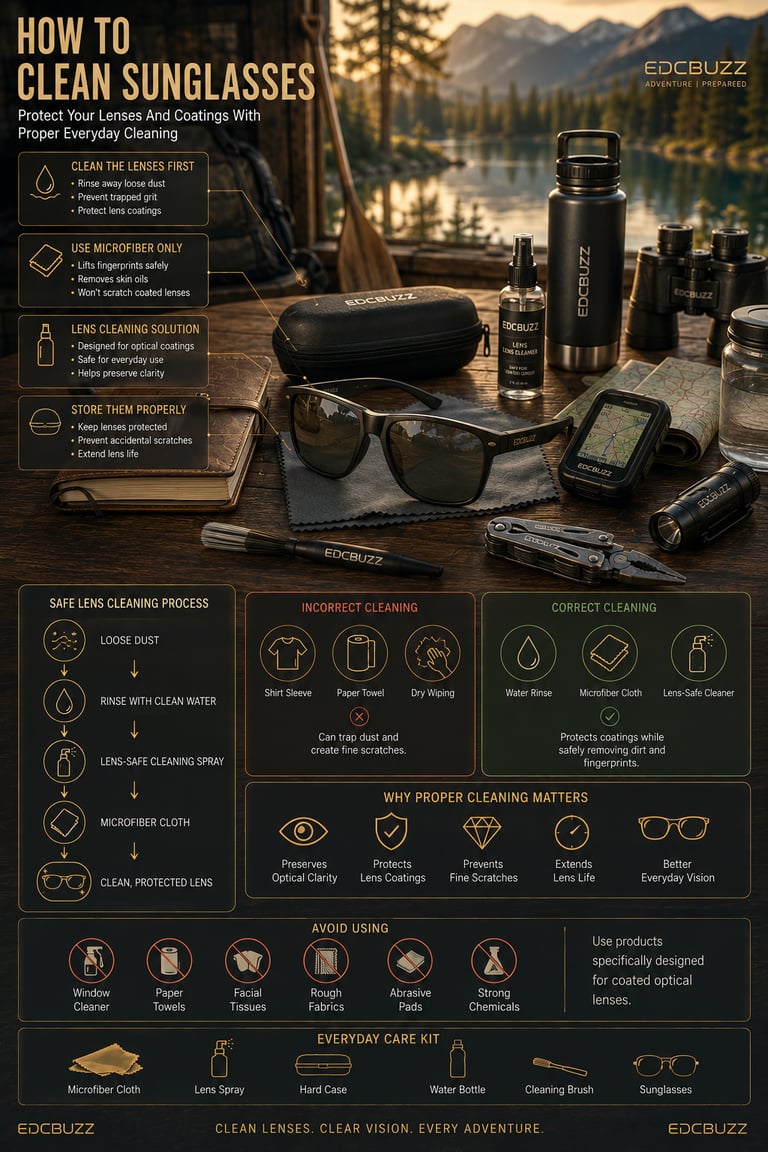
The most common mistake people make is wiping dirty lenses with a shirt, paper towel, or whatever cloth happens to be nearby. Dust particles trapped between the fabric and the lens can act like fine sandpaper, gradually creating thousands of tiny scratches.
Instead, begin by rinsing your sunglasses with clean, lukewarm water. This removes loose dirt before you touch the lens surface.
After rinsing, use a microfiber cloth specifically designed for eyewear. These cloths lift oils and fingerprints without scratching modern lens coatings.
If additional cleaning is needed, apply a lens-safe cleaning solution rather than household glass cleaners.
For a complete walkthrough, read How to Clean Sunglasses Without Scratching Them.
Avoid Household Cleaners
Many common household cleaning products contain ammonia, alcohol, bleach, or other chemicals that can slowly damage lens coatings.
Avoid using:
Window cleaner
Paper towels
Facial tissues
Rough clothing
Abrasive cleaning pads
Strong chemical cleaners
Instead, use products specifically designed for coated optical lenses.
Caring for Frame Materials
Different frame materials require slightly different care.
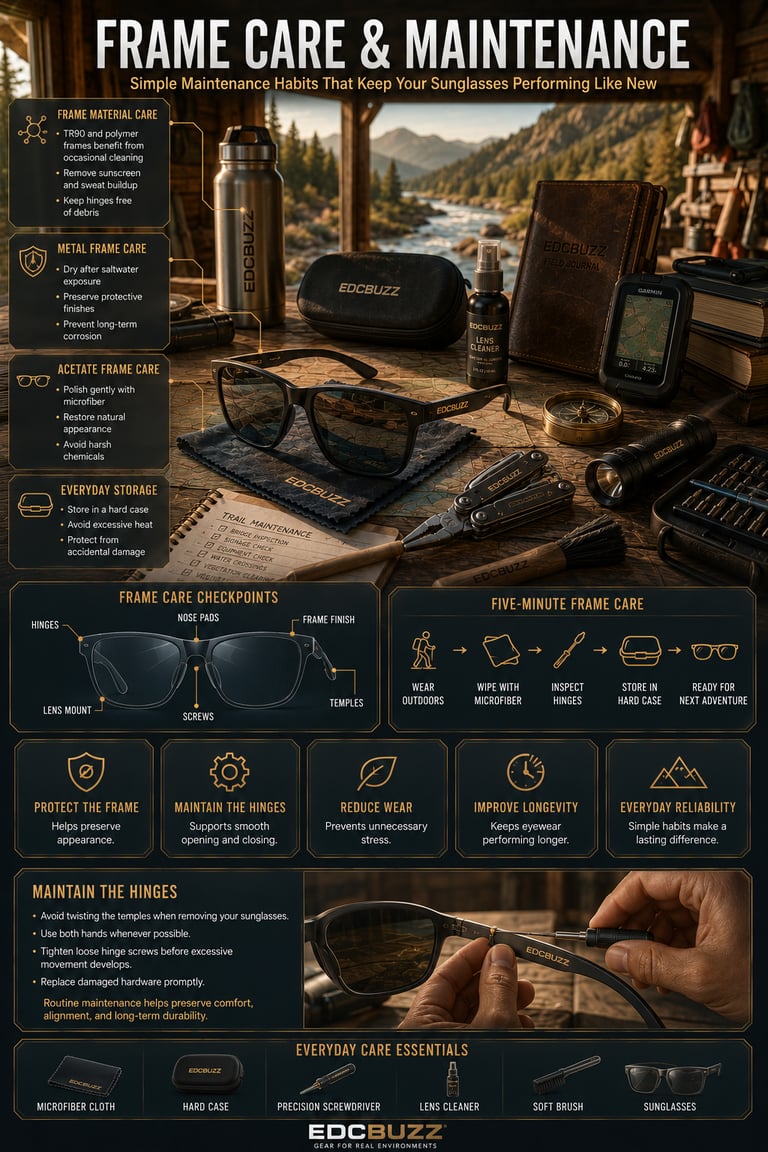
Polymer frames like TR90 and nylon benefit from occasional cleaning to remove sweat and sunscreen buildup around the hinges.
Metal frames should be dried after exposure to saltwater to help preserve their finish.
Acetate frames occasionally benefit from gentle polishing with a clean microfiber cloth to restore their natural shine.
Regardless of material, avoid twisting the temples when removing your sunglasses. Using both hands helps reduce unnecessary stress on the hinges.
Maintain the Hinges
The hinges are one of the hardest-working parts of any pair of sunglasses.
Over time, screws may loosen through normal use. If your sunglasses begin sitting unevenly or the temples no longer hold their position, tightening the hinge screws can often restore the original fit in just a few minutes.
Our guide to How to Tighten Loose Sunglass Hinges explains how to safely perform this simple maintenance without damaging the frame.
Storage
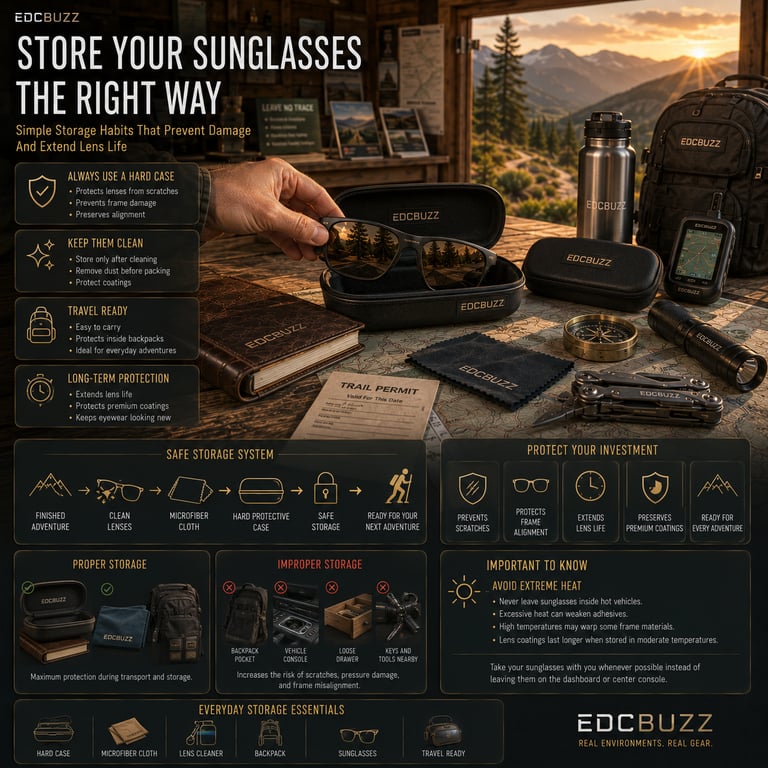
How you store your sunglasses has a direct impact on how long they last. Even premium lenses with scratch-resistant coatings can be damaged by careless storage habits.
Fortunately, protecting your sunglasses between uses requires very little effort.
Always Use a Case
A hard protective case remains the safest place to store your sunglasses whenever they aren't being worn.
Many scratches occur not while wearing sunglasses, but while they're tossed into backpacks, center consoles, gym bags, purses, or drawers alongside keys and other hard objects.
Using a protective case dramatically reduces accidental damage while also helping preserve frame alignment.
Don't Leave Them in Hot Vehicles
High temperatures inside parked vehicles can exceed 140°F during summer months.
Excessive heat may weaken adhesives, warp some frame materials, shorten the life of lens coatings, and reduce the flexibility of certain plastics.
Whenever possible, take your sunglasses with you instead of leaving them on the dashboard or center console.
Store Them Lens-Up
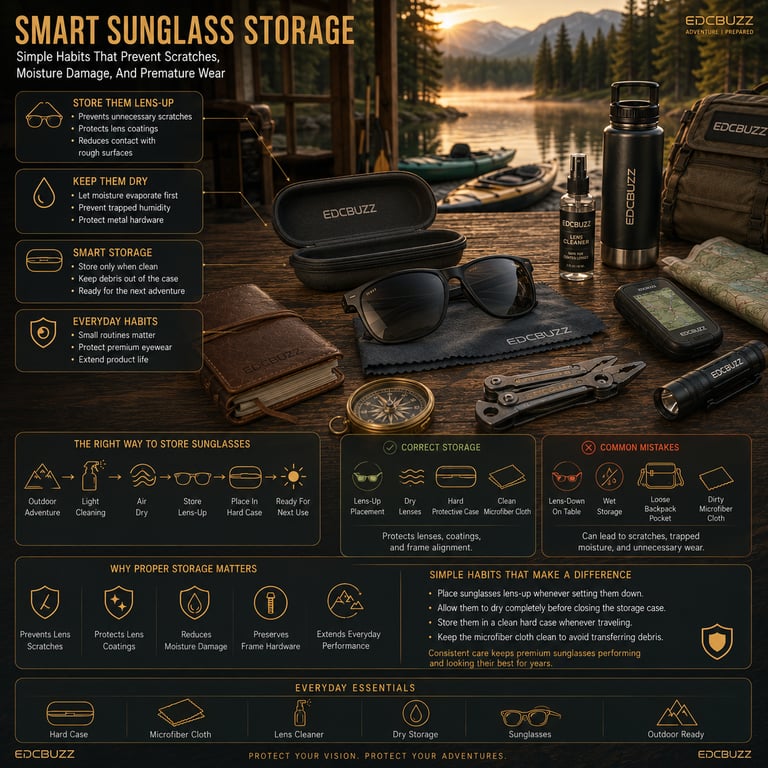
If you need to temporarily set your sunglasses on a table, place them with the lenses facing upward.
Setting sunglasses lens-down on hard surfaces creates unnecessary opportunities for scratches.
Although this habit seems minor, consistently storing them correctly can significantly extend lens life.
Keep Them Dry
After boating, beach trips, hiking in the rain, or outdoor work, allow your sunglasses to dry before placing them inside a storage case.
Moisture trapped inside enclosed cases can eventually affect metal hardware and encourage buildup around hinges.
For additional storage advice, read How to Store Sunglasses Properly.
Replacement
No pair of sunglasses lasts forever.
Even premium eyewear eventually develops worn coatings, scratched lenses, stretched frames, or loose hinges after years of regular use. Recognizing when it's time to replace your sunglasses helps maintain both comfort and eye protection.
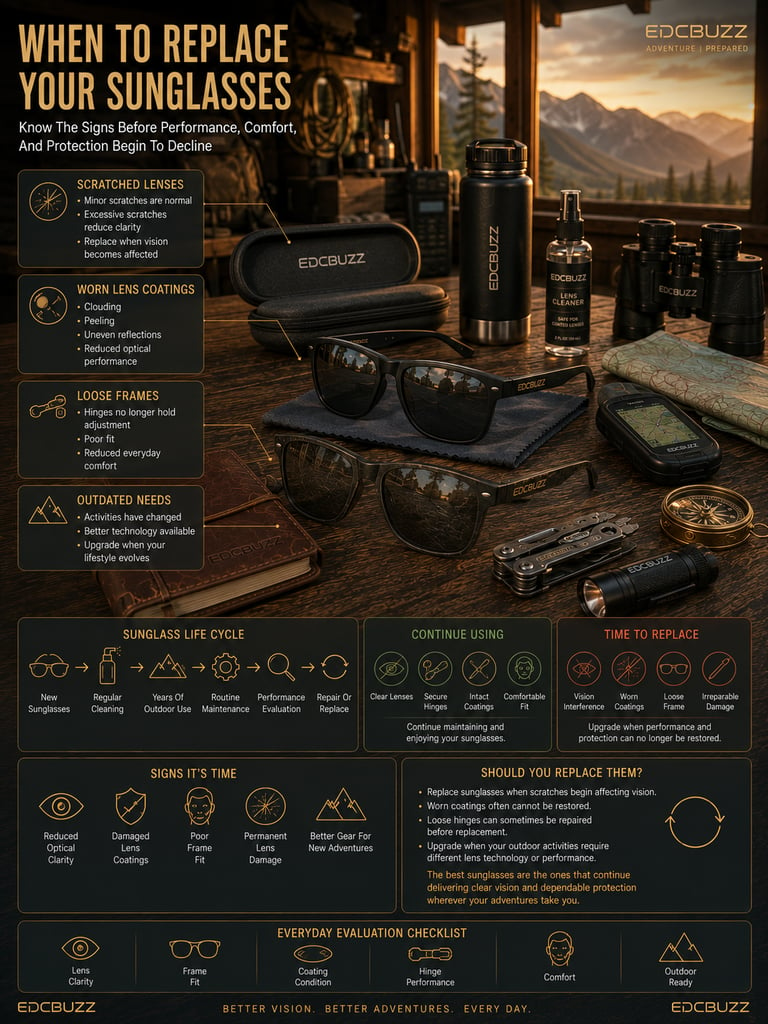
Scratched Lenses
Minor surface marks are normal over time, but excessive scratching can reduce visual clarity and contribute to eye fatigue. If scratches begin interfering with your vision rather than remaining purely cosmetic, replacement may be the better option.
Before replacing your sunglasses entirely, see How to Remove Scratches from Sunglass Lenses to determine whether the damage can be improved.
Worn Lens Coatings
Modern sunglasses often combine multiple coatings including anti-reflective, mirrored, hydrophobic, oleophobic, and scratch-resistant layers. As these coatings wear, you may notice uneven reflections, cloudy spots, peeling, or changes in visual clarity.
Once coatings begin failing, replacement is generally more practical than attempting repairs.
Loose Frames
Frames naturally loosen over years of use. Small adjustments and hinge tightening often restore proper fit, but severely stretched frames or cracked components usually indicate it's time for replacement.
Premium manufacturers sometimes offer replacement parts, making repairs worthwhile before purchasing entirely new sunglasses.
Outdated Needs
Sometimes your sunglasses haven't failed—they simply no longer match your lifestyle. A pair that worked perfectly for daily commuting may not be ideal once you begin hiking regularly, spending more time on the water, or working outdoors. As your activities change, upgrading to sunglasses designed for those environments often provides more value than continuing to use a pair that no longer fits your needs.
If you're wondering whether your current pair has simply reached the end of its life, read When Is It Time to Replace Your Sunglasses? and How Long Do Sunglasses Last?
Frequently Asked Questions
What is the best lens material for everyday sunglasses?
There isn't a single best option. Glass provides exceptional clarity and scratch resistance, polycarbonate offers outstanding impact protection, Trivex balances clarity with durability, and CR-39 delivers excellent everyday value. The right material depends on how you'll use your sunglasses most often.
Are polarized lenses worth buying?
For most people, yes. Polarized lenses significantly reduce glare from roads, water, snow, and other reflective surfaces, making them especially valuable for driving, fishing, boating, and everyday outdoor activities.
Learn more in What Are Polarized Sunglasses and Are They Worth It?
What frame material lasts the longest?
Titanium is generally considered one of the most durable premium frame materials thanks to its excellent corrosion resistance, lightweight construction, and long-term strength. High-quality TR90 and nylon frames also provide excellent durability for active outdoor use.
Is UV400 really necessary?
Absolutely. UV400 protection blocks virtually all harmful UVA and UVB radiation reaching your eyes. Regardless of price, every quality pair of sunglasses should provide complete UV400 protection.
Do expensive sunglasses actually perform better?
Premium sunglasses often provide better optics, stronger materials, improved coatings, and lighter construction. However, many affordable sunglasses offer excellent UV protection and everyday performance.
For a detailed comparison, read Do Expensive Sunglasses Really Protect Your Eyes Better?
Can scratched sunglasses damage your eyes?
Minor scratches won't permanently damage your eyes, but they can reduce visual clarity, increase glare, and contribute to eye fatigue during extended wear. If scratches become distracting, replacing the lenses or sunglasses is usually the best solution.
How often should sunglasses be replaced?
A quality pair can easily last many years with proper care. Replacement usually becomes necessary because of worn coatings, severe scratches, broken frames, or changing lifestyle needs rather than age alone.
What is the most important feature to look for?
Complete UV400 protection should always come first. After that, choose lens material, frame material, lens technology, and style based on the activities you enjoy most.
Final Thoughts
Understanding sunglass technology makes shopping far less confusing. Instead of focusing solely on brand names or price tags, you can evaluate sunglasses based on the features that genuinely affect comfort, durability, protection, and long-term performance.
Whether you choose lightweight TR90 frames, premium titanium construction, glass lenses for exceptional clarity, or impact-resistant polycarbonate for demanding outdoor adventures, the best sunglasses are the ones designed for the environments where you'll actually use them.
Remember that no single combination of materials is perfect for every situation. Drivers often benefit most from polarized lenses, hikers may appreciate photochromic technology, outdoor workers should consider ANSI-certified safety glasses, and everyday users frequently find the best value by balancing durability, comfort, and optical quality.
As you continue exploring the EDCBuzz sunglasses collection, you'll notice these materials and technologies referenced throughout our buying guides, product reviews, and comparison articles. With the knowledge you've gained here, you'll be able to confidently compare sunglasses, recognize meaningful differences between models, and choose eyewear that serves you well for years to come.
Whether you're searching for Best EDC Sunglasses, comparing Best Premium Sunglasses with Best Budget Sunglasses, or learning How To Choose Sunglasses, this guide serves as your technical reference whenever questions about lenses, frames, coatings, or protection arise. It was built to help you make informed decisions—not simply buy more expensive sunglasses.

Contact@TheBuzzHQ.com
© 2026 EDCBuzz. All rights reserved.
EDCBuzz
Master everyday carry systems with clarity and precision. Built for real environments and practical use.
For educational purposes only.
General Inquiries: