
What Color Sunglass Lens Is Best?
Explore the best sunglass lens color for your daily needs, balancing comfort, contrast, and UV protection for varying light conditions.
EDC SUNGLASSES
The EDCBuzz Editorial Team - Led by AJ “Buzz” Eichman
7/4/20268 min read
When you first pick up a pair of sunglasses, the lens color might seem like a minor detail compared to frame style or brand name. Over time, though, the color of those lenses turns out to be far more impactful on everyday comfort and vision clarity than you might have guessed. Like choosing your favorite EDC knife or flashlight, the best sunglass lens color isn't about flash—it’s about what works in the real world, where light and environment are constantly changing.
Sunglass lens colors do more than just tint your view; they change how colors pop, how much glare hits your eyeballs, and how well you can see details in different lighting conditions. Picking the wrong color can leave you squinting in bright light or struggling to see in overcast weather. On the other hand, matching lens color to your typical environment can turn your sunglasses from a nice accessory into a practical tool you actually carry every day.
In this guide, I’ll break down the key sunglass lens colors, the pros and cons of each, and how they behave after real-world use—not just the first few minutes in the store. I’ve spent enough time under the sun to notice what really matters when those lenses settle into daily life. If you've ever wondered about EDC Sunglasses or exploring a complete Sunglass Lens & Frames Guide, you’re in the right place.
Quick Verdict
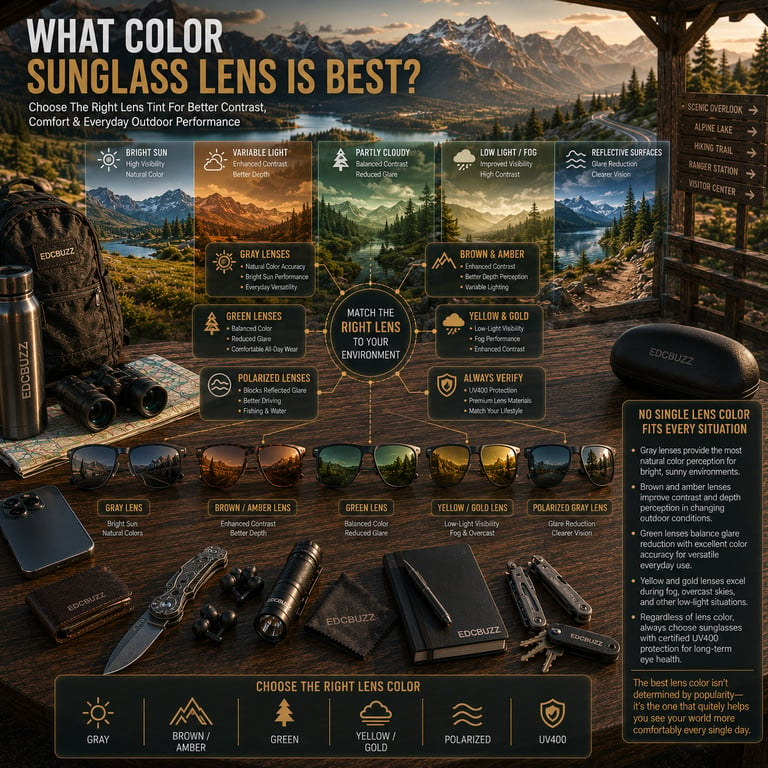
Gray lenses offer neutral color perception and work well in bright sunlight without distorting colors.
Brown and amber lenses boost contrast and depth, performing best in variable, hazy, or partly cloudy light.
Yellow and gold lenses shine in low-light or foggy conditions but can make colors look odd in bright sun.
Green lenses reduce glare while preserving color accuracy, great for moderate to bright conditions.
Polarized lenses reduce glare from reflective surfaces, improving comfort for activities like driving or fishing.
UV protection is essential regardless of lens color to safeguard your eyes from harmful rays.
Why Lens Color Matters in Sunglasses
At face value, sunglasses are about keeping the sun out of your eyes, but the lens color really defines how well they perform this job. Each tint filters light differently, which affects color perception, contrast, and glare reduction. That means some lenses help you spot details better when cycling on a sunny day, while others might be better suited to a cloudy hike or early evening run.
After spending weeks with various lens colors, one thing stands out: the first impression often changes after real use. A lens that initially seems vibrant can become exhausting to look through after a few hours. Others that felt dull at first can turn out to be dependable daily wearers. Like breaking in a good belt, lens colors reveal their true character after the novelty fades and the daily grind kicks in. Understanding How Dark Should Sunglasses Be? also helps when balancing tint with real-world visibility.
Gray Lenses: The Balanced Choice
Gray lenses are the classic for a reason. They reduce overall brightness without messing with color balance, so the world looks natural—just darker. This makes gray one of the best all-around lens colors for people who want neutral color perception with good glare reduction.
After wearing gray lenses through a week of urban commuting and weekend outdoor strolls, what I noticed was their consistency. The weight felt manageable over a full day, and the lack of color distortion meant no visual fatigue from unnatural hues. The downside, if you want to call it that, is that gray lenses don't enhance contrast much. On a hazy day, details can stay a bit flat. But for bright, direct sunlight, they’re a solid team player that fits right into daily use without complaint. If you spend time around demanding environments, many Best Safety Glasses use gray or smoke lenses for this very reason.
Brown and Amber Lenses for Contrast
If you’re after richer contrast and depth perception, brown or amber lenses excel. They filter blue light and enhance earthy tones, which makes the outdoors feel almost three-dimensional. This is especially handy in variable weather—think partly cloudy skies or hazy afternoons when your vision needs a little help to separate shapes and shadows.
After testing these lenses on a few cycling trips and casual hikes, the thing that stuck was their ability to reveal texture and depth without sacrificing too much overall brightness. But the trade-off is that colors shift slightly warmer. Not a dealbreaker unless you’re color-critical, but it’s worth noting if you spend much time distinguishing subtle color details in your environment. It's also worth considering How Much Should You Spend on Sunglasses? before investing in premium lens technologies.
Yellow and Gold Lenses: Low Light Specialists
Yellow and gold lenses often get a bad rap for being “too bright” or distorting colors, and to some extent, they’re right. These lenses really shine—pun intended—in low-light settings where you need maximum contrast to pick out shapes. Think foggy mornings, dusk, or overcast hunting for your keys on the ground.
I carried yellow lenses for a couple of week-long foggy rainforest hikes, and their contrast boost was undeniable. The downside is that in full sunlight, the outlook becomes overly warm, and colors can start looking cartoonish, which gets tiring after a while. They’re specialized tools, not something I’d reach for on a bright, sunny day—but in the right conditions, they’re invaluable. Many shooters and professionals comparing Mechanix Vision Type-E vs Oakley Half Jacket 2.0 (Safety Glasses vs Sunglasses) also notice how lens tint changes visibility.
Green Lenses for Color Accuracy and Reduced Glare
Green lenses offer a middle ground—reducing glare and enhancing contrast without heavy color distortion. This makes them popular for people who want better visibility across various lighting conditions without sacrificing the natural look of colors.
Over time, green lenses impressed me by balancing comfort and clarity. They don’t make the world look dramatically different, but they subtly cut the haze on sunny and moderately bright days, which helps reduce eye fatigue. They also have a nicer pocket feel compared to bulkier polarized options—always a bonus when you’re not in a rush to pull your sunglasses out and put them back repeatedly. Avoiding Common Mistakes People Make When Buying Sunglasses can also help ensure you choose the right tint for your environment.
The Role of Polarized Sunglasses
Polarization takes sunglass lens performance up a notch by filtering out horizontally polarized light—the main cause of glare reflecting off surfaces like water, roads, or car hoods. This makes polarized lenses especially useful for outdoor activities like fishing, boating, or driving where glare can be both annoying and dangerous.
However, after wearing polarized lenses day in and day out, I noticed a couple of quirks. For one, they can sometimes interfere with visibility on digital screens, which might be a nuisance if you’re frequently checking your phone on the go. Also, polarized lenses often carry a bit more weight and bulk, so long-term pocket comfort might take a hit.
That said, when glare is the main enemy, polarization is a clear winner that justifies the extra trade-offs. They don’t automatically improve color accuracy but greatly increase visual comfort in glare-heavy situations. If durability is a priority, many of the Best Tactical Sunglasses pair polarized lenses with rugged frame materials.
UV Protection: The Most Important Feature
Lens color and tint are only part of the story. The single most essential feature in any sunglass lens is UV protection, which blocks harmful UVA and UVB rays that can damage your eyes over time. It’s important to understand that a dark lens doesn’t automatically mean good UV protection. Some cheap dark lenses offer little UV defense, while clear lenses can have excellent coatings.
Over the weeks wearing various sunglasses, I learned not to trust tint darkness as a proxy for UV safety. Instead, look for lenses with certified UV protection coatings. This feature is non-negotiable if you want to safeguard your eyes long term, no matter what lens color you prefer. It’s one of the biggest differences highlighted in goodr FXG vs KOO Supernova (Cheap vs Expensive).
How to Choose the Right Lens Color for Your Needs
Picking the best sunglass lens color boils down to matching your typical environments and activities. If you’re mostly in bright sunlight and want natural colors, gray is the trustworthy everyday choice. For variable or partly cloudy conditions, brown or amber lenses add welcome depth and contrast.
If you spend time in low-light or foggy settings, yellow or gold lenses give that much-needed contrast enhancement, though they’re less suitable for all-day outdoor use. For moderate to bright days where you want a little extra comfort but still want true color perception, green lenses strike a nice balance.
If your daily grind involves glare-heavy surfaces—like water, roads, or glass—adding polarized lenses is worth considering, but be mindful of screen visibility issues and weight. Above all, verify UV protection with any pair you carry; this is the only feature you want to carry unquestioned. Proper maintenance matters too, especially if you want to avoid replacing your eyewear sooner than necessary, so knowing When Is It Time to Replace Your Sunglasses? can be helpful.
Common Mistakes When Choosing Lens Colors
Choosing sunglass lens color can be deceptively tricky. A few common mistakes tend to come up:
Picking lenses based purely on how they look, ignoring real-world lighting conditions and activities. Pretty colors don’t always translate to good visual performance.
Assuming polarized lenses are necessary for every environment. They excel in glare-heavy scenarios but add bulk and may complicate screen viewing.
Overlooking UV protection in favor of lens tint darkness. Dark doesn’t always mean safe. Always confirm UV blocking specs.
Opting for yellow or gold lenses for bright sunny days, which often leads to color distortion and visual fatigue.
Neglecting lens material and coatings, which affect scratch resistance, weight, and optical clarity.
Expecting a single lens color to cover all lighting situations equally well; reality usually calls for at least knowing your options.
FAQs About Sunglass Lens Colors
Which sunglass lens color is best for driving?
Gray and polarized lenses are generally best for driving due to their neutral color perception and glare reduction. Brown lenses also work well in changing light conditions but can slightly warm the view.
Are polarized sunglasses always better than non-polarized?
Not always. Polarized lenses significantly reduce glare, which is useful for fishing, boating, and driving. However, they can interfere with viewing digital screens and add weight. For everyday urban use without major glare, non-polarized lenses might suffice.
Do lens colors affect UV protection?
Lens color alone does not dictate UV protection. A dark or tinted lens without proper UV coating may not protect your eyes. Always look for sunglasses labeled with 100% UV protection regardless of lens tint.
What lens color is best for outdoor sports and activities?
It depends on the activity and lighting. Brown and amber lenses improve contrast and depth perception, helping in sports like cycling and hiking. Green lenses work well in moderate light, while polarized options help cut glare during water-based sports.
Can I use one lens color for all lighting conditions?
No lens color perfectly suits every lighting scenario. Gray is the most versatile for bright conditions, while brown offers more contrast in variable light, and yellow excels in low-light. Some people rotate between lenses based on environment.
How do lens materials influence sunglass performance?
Lens materials like polycarbonate, glass, or plastic affect weight, clarity, and scratch resistance. Polycarbonate is lightweight and impact-resistant but can scratch easier than glass, which offers pristine optics but usually weighs more. Minor lens damage can sometimes be improved by learning How to Remove Scratches from Sunglass Lenses.
Do colored lenses fade over time or with sun exposure?
High-quality lenses with UV coatings generally retain their color and performance well. Lower-end lenses without proper coatings might fade or discolor after long sun exposure.
Is lens darkness more important than lens color for eye protection?
No. Darkness affects visible light reduction but not UV protection. Proper UV-blocking coatings are critical for eye safety regardless of lens darkness.
Practical Conclusion
After spending ample time carrying and putting various sunglass lens colors through their paces, the takeaway is that no single color is universally “best.” The real question isn’t which lens color wins in a vacuum, but which suits your habits and environment. Gray lenses shine as reliable everyday performers for bright, consistent sunlight. Brown and amber add nuance in changing conditions. Yellow and gold have their niche in low light, while green brings a subtle complement of comfort and color accuracy.
Polarized lenses offer major benefits when glare threatens your vision, but they carry some trade-offs to consider for daily wear. And no matter what tint you pick, insisting on good UV protection is the bottom line for eye health.
In the end, choosing sunglass lenses is a bit like picking your everyday carry gear—it’s about striking the right balance between utility, comfort, and the environment you navigate daily. When your lenses settle into daily use and keep your eyes both safe and comfortable, that’s when you know you’ve found the right color for your eyes. And if you doze off on the couch still wearing those glasses, don’t worry—it happens to the best of us.

Contact@TheBuzzHQ.com
© 2026 EDCBuzz. All rights reserved.
EDCBuzz
Master everyday carry systems with clarity and precision. Built for real environments and practical use.
For educational purposes only.
General Inquiries: