
Photochromic Lenses Explained: How They Work
Discover how photochromic lenses adapt to UV light automatically, offering dynamic tint changes for everyday carry convenience and eye comfort.
EDC SUNGLASSES
The EDCBuzz Editorial Team - Led by AJ “Buzz” Eichman
7/4/20268 min read
In an era where smart, adaptive gear defines everyday carry (EDC), photochromic lenses stand out for their ability to respond dynamically to environmental changes. These lenses automatically adjust their tint based on the intensity of ultraviolet (UV) light, darkening when exposed to sunlight and clearing up indoors. What makes photochromic lenses particularly interesting is not just the convenience they offer but the science and materials engineering that enable this responsiveness. Rather than relying on switching glasses or manual adjustments, these lenses harness chemical reactions within their structure to modulate light transmission. Understanding how photochromic lenses work requires a look under the surface of materials, UV light activation, and the interplay of environmental factors that influence their performance. To learn how adaptive lenses fit into an everyday carry setup, explore EDC Sunglasses and Sunglasses By Activity.
Quick Verdict
Photochromic lenses contain molecules that chemically react to UV light, causing them to darken outdoors and clear indoors without manual effort.
Lens materials such as glass, polycarbonate, and plastic embed or coat these molecules, with each substrate influencing durability, weight, and clarity alongside the photochromic effect.
The speed and extent of lens darkening depend on temperature, UV exposure intensity, and material composition, with cooler conditions generally prompting faster transitions.
These lenses suit users who experience frequent changes in lighting throughout the day, providing adaptive protection and visual comfort without carrying multiple pairs of eyewear.
What Are Photochromic Lenses? Basic Science and Mechanism
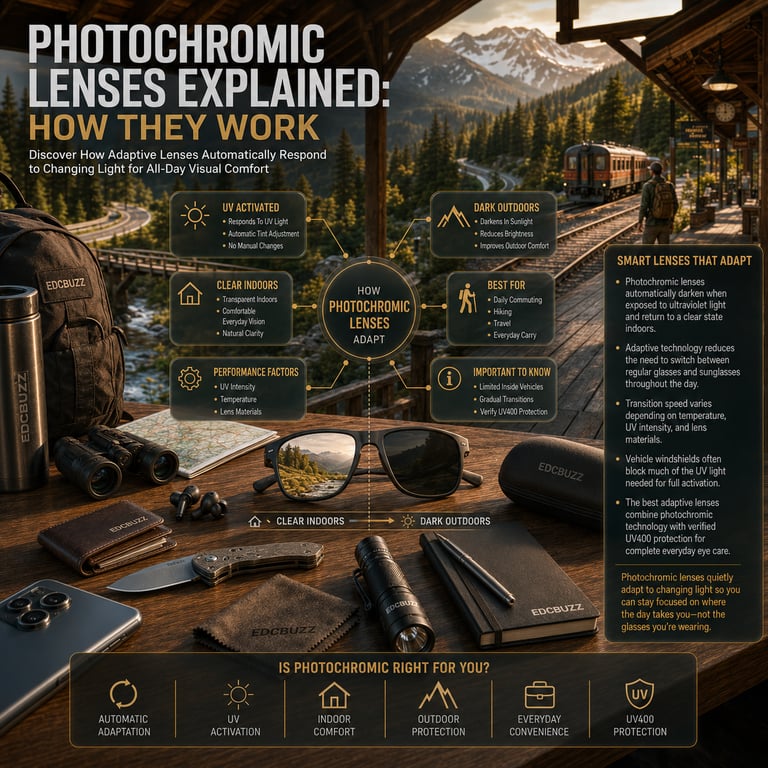
At their core, photochromic lenses are optical lenses engineered to alter their tint in response to ultraviolet radiation. The shift from clear to dark—and back again—occurs due to a reversible chemical reaction involving photochromic molecules embedded within or coated on the lens substrate. When not exposed to UV light, these molecules remain in a transparent state. Upon UV exposure, they undergo a structural rearrangement that changes their light absorption properties, absorbing more visible light and thus appearing darker.
This molecular transformation is not permanent; it reverses when UV light is removed, allowing lenses to return to their baseline clarity. The entire process is self-regulating and automatic, relying purely on ambient UV levels rather than manual switches or electronic controls. This mechanism substantially reduces eye strain caused by sudden changes in brightness, as the lenses constantly adjust to optimize light transmission in varying conditions. If you're choosing your first adaptive pair, How to Choose Sunglasses for Everyday Carry is a helpful resource.
Materials and Technology Behind Photochromic Lenses
The performance and durability of photochromic lenses depend significantly on the choice of lens substrate and the type of photochromic molecules used. Common lens materials include glass, polycarbonate, and various plastics, each bringing distinct strengths and trade-offs.
Glass lenses were among the first to utilize silver halide photochromic compounds effectively. These inorganic molecules provide strong photochromic effects with good longevity but may add weight and are more prone to shattering. Polycarbonate lenses have gained popularity for EDC purposes due to their lighter weight and impact resistance. They incorporate organic photochromic molecules, typically embedded within the lens matrix rather than coated on the surface, offering robust performance with added durability. However, the color tone and activation sensitivity can differ from glass lenses, often producing a slightly different tint.
Plastic lenses offer a middle ground, balancing weight, clarity, and cost, and can be engineered with various photochromic compounds depending on the desired performance. The integration method—whether embedded within the lens or applied as a coating—also impacts longevity and resistance to wear. Embedding molecules typically provides more durability as the photochromic compounds are protected inside the lens, whereas coatings may degrade faster with abrasion and cleaning. For a more detailed material comparison, see Choosing Between Glass and Polycarbonate Lenses.
How UV Light Triggers Lens Darkening
The trigger behind the photochromic effect is ultraviolet light, specifically wavelengths that interact with the reactive molecules inside the lens. UV radiation provides the energy required to initiate the chemical transition that changes the molecules’ structure. This structural change increases the molecules’ absorption of visible light, which results in the observable darkening of the lenses.
Notably, visible light alone does not cause this darkening, which explains why photochromic lenses remain clear indoors even under bright artificial lighting. Since some types of glass and car windshields filter out most UV rays, photochromic lenses often do not darken fully inside vehicles, which is an important practical limitation to understand. If you're wondering how tint affects vision, read How Dark Should Sunglasses Be?
Performance Factors: Temperature, Lens Material, and Environment
Several external factors influence how photochromic lenses behave in real-world conditions. Temperature, in particular, plays a significant role. The chemical reaction enabling the lenses to darken and clear out is temperature-dependent. Cooler temperatures generally enhance molecular stability in the darkened form, speeding up the darkening process and prolonging the tint. Conversely, warmer conditions can reduce both the speed and intensity of darkening because the molecules revert more quickly to their transparent state.
The type of lens material, as mentioned earlier, also affects performance. Polycarbonate lenses tend to have a more muted tint change compared to glass, but they offer superior impact resistance, which is valuable for everyday use. Additionally, different photochromic formulations can yield warmer or cooler tint shades, and some lenses adapt more consistently than others under fluctuating sunlight.
Everyday Use Cases for Adaptive Eyewear
Photochromic lenses provide practical advantages for users who navigate multiple lighting environments during their daily routines. For commuters moving between indoor offices, shaded transit, and bright outdoor conditions, these lenses serve as a seamless transition tool without needing to switch glasses or squint.
Outdoor enthusiasts who engage in activities like hiking or walking benefit from lenses that dynamically protect their eyes against UV exposure and glare, enhancing visual comfort while reducing the risk of eye fatigue. Even at home, near windows with strong sunlight, the adaptive nature of these lenses helps mitigate sudden glare without resorting to bulky sunglasses. If your focus is active lifestyles, Best Athletic Sunglasses offers additional recommendations.
Because photochromic lenses respond passively, they fit well into streamlined EDC setups where minimizing carried items improves convenience without sacrificing functionality.
Common Misconceptions About Photochromic Lenses
One frequent misunderstanding is expecting photochromic lenses to darken fully behind every type of glass surface, such as car windshields or indoor windows. Many modern windshields incorporate UV-blocking layers, which impede the activation of photochromic molecules, resulting in less or no lens tint change inside vehicles. This nuance is important for users who spend significant time driving.
Another misconception is equating photochromic lenses with polarized lenses. While both improve visual comfort outdoors, their functions differ fundamentally. Polarized lenses actively reduce glare by filtering horizontal light reflections, but do not alter tint based on UV exposure. Photochromic lenses change tint, adapting to light intensity without glare-specific filtering.
Additionally, not all photochromic lenses perform identically regarding darkening speed, color shade, or longevity. Variations are largely due to different materials and molecular formulations. It is also mistaken to assume photochromic lenses inherently provide complete UV protection. Effective UV shielding depends on the lens material and any additional coatings, independent of the photochromic effect. A practical comparison is available in Mechanix Vision Type-E vs Oakley Half Jacket 2.0 (Safety Glasses vs Sunglasses).
Buying Guide: What to Consider When Choosing Photochromic Lenses
When selecting photochromic lenses, consider the intended use environment first. For users in cooler climates, choosing lenses with formulations that darken faster and maintain tint intensity in lower temperatures can improve effectiveness. If impact resistance and weight are priorities, polycarbonate lenses embedded with organic photochromic molecules are a logical choice. For the clearest optics and a strong photochromic response, glass lenses might be preferable despite their additional weight.
It is also valuable to check the lens manufacturer’s specification for UV protection levels, clarity, tint speed, and the expected lifespan of the photochromic coating or embedded molecules. Some brands offer warranties or performance guarantees that address fading or degradation over time.
Pricing will vary depending on lens technology and brand reputation, so balancing functionality with budget constraints will help narrow options. Finally, if prescription eyewear is necessary, confirm compatibility with photochromic lens options, as most optical labs now provide custom solutions incorporating photochromic technology. If value matters most, browse Best Budget Sunglasses.
Maintenance and Longevity of Photochromic Lenses
Maintaining the photochromic property primarily involves protecting the lens surface from excessive abrasion and using appropriate cleaning methods. Coated lenses, in particular, can lose their photochromic effectiveness if coatings wear away due to harsh chemicals or rough materials.
Most users will benefit from microfiber cloths and gentle lens cleaners to preserve clarity and the reactive surface integrity. The embedded molecule approach, more common in polycarbonate lenses, tends to provide longer-lasting photochromic performance but does not make lenses impervious to everyday wear.
Over years of use, all photochromic lenses experience gradual degradation, with reduced darkening speed and tint intensity. This is a natural outcome of repeated molecular cycling and environmental exposure rather than a defect. Periodic replacement aligned with eyewear prescriptions or lens damage is typically recommended to maintain optimal performance. If you're comparing entry-level and premium options, goodr FXG vs KOO Supernova (Cheap vs Expensive) provides useful perspective.
Frequently Asked Questions
How do photochromic lenses work exactly?
Photochromic lenses contain special molecules that change their structure when exposed to UV light, increasing their visible light absorption and causing the lenses to darken. When UV light is removed, such as indoors, the molecules revert to their original structure, making the lenses clear again.
Do photochromic lenses work inside a car or behind windows?
Generally, photochromic lenses do not darken much behind car windshields or windows because many types of glass block UV rays, which are needed to trigger the darkening reaction. This limits their effectiveness indoors or inside vehicles.
What materials are used in photochromic lenses and how do they affect performance?
Common materials include glass, polycarbonate, and plastic. Glass can provide strong photochromic effects but is heavier and less impact resistant. Polycarbonate is lighter, more durable, and often has embedded organic photochromic molecules, though the tint change may be subtler. Plastic lenses balance weight, clarity, and cost with variable photochromic performance.
How fast do transition lenses change from clear to dark and back?
The speed varies based on lens material, molecular formulation, temperature, and UV intensity. Cooler conditions typically speed up darkening, while warmer temperatures slow it down. Transition lenses can take anywhere from seconds to a couple of minutes to complete the change.
Are photochromic lenses suitable for all-day wear?
Yes, especially for people moving frequently between indoor and outdoor environments. They reduce the need to switch glasses, improving visual comfort and eye strain throughout the day.
What maintenance is required for photochromic lenses?
Avoid harsh chemicals and abrasive cleaning materials. Use microfiber cloths and gentle lens cleaners to protect coatings and maintain clarity. Over time, expect gradual performance reductions, requiring lens replacement eventually.
Do photochromic lenses provide UV protection?
Photochromic lenses usually provide UV protection, but it depends on the lens material and coating. The photochromic effect itself doesn’t guarantee UV blocking, so checking product specifications is important.
Can I get prescription glasses with photochromic lenses?
Yes, many optical labs offer prescription lenses that incorporate photochromic technology, allowing users to combine vision correction with light-adaptive features.
Practical Conclusion
Photochromic lenses represent an elegant synthesis of chemistry, materials science, and optics, delivering adaptive eyewear that automatically responds to the changing UV environment. Understanding how these lenses work—from their embedded molecules to the impact of lens substrates and environmental conditions—offers valuable context to make informed choices tailored to individual needs and daily routines.
While no photochromic lens solution is without trade-offs—whether in activation speed, tint consistency, or indoor effectiveness—the overall convenience for everyday carry stands out. Users who need visual comfort through variable lighting will find these lenses reduce the complexity of managing multiple eyewear pairs while maintaining flexible eye protection.
By appreciating the science behind photochromic lenses and recognizing their performance boundaries, you gain more than just a functional accessory; you get a practical tool that adapts alongside your day. For additional reading, explore How Lens Colors Affect Vision Outdoors, Do Mirrored Sunglasses Actually Reduce Glare?, and What Color Sunglass Lens Is Best?

Contact@TheBuzzHQ.com
© 2026 EDCBuzz. All rights reserved.
EDCBuzz
Master everyday carry systems with clarity and precision. Built for real environments and practical use.
For educational purposes only.
General Inquiries: