
Lumens vs Candela Explained: Understanding Flashlight Brightness
Discover the difference between lumens and candela to understand flashlight brightness and choose the best light for your everyday carry needs.
EDC FLASHLIGHTS
The EDCBuzz Editorial Team - Led by AJ “Buzz” Eichman
4/2/20267 min read
When it comes to choosing a flashlight, especially for everyday carry, the numbers manufacturers highlight can be confusing if you don’t know what they mean. Among these, lumens and candela are two of the most commonly cited metrics related to brightness. Both are essential but fundamentally different ways of measuring a flashlight’s light output and beam intensity. Understanding these differences isn’t just a matter of semantics — it directly informs how a flashlight performs in real-world tasks. Whether you want broad illumination for indoor or close-range use, or a focused beam to spot objects far away, knowing what lumens and candela really measure can guide you to a better-informed choice.
Quick Verdict
• Lumens measure total light output, indicating overall brightness across the entire beam.
• Candela quantifies beam intensity in a specific direction, reflecting how focused and powerful the center of the beam is.
• High lumens don’t guarantee a long throw; without adequate candela, light may simply spread out.
• Choosing between lumens and candela depends on intended use—area lighting favors lumens, spotlighting benefits from candela.
What Is Lumens? Total Light Output Explained
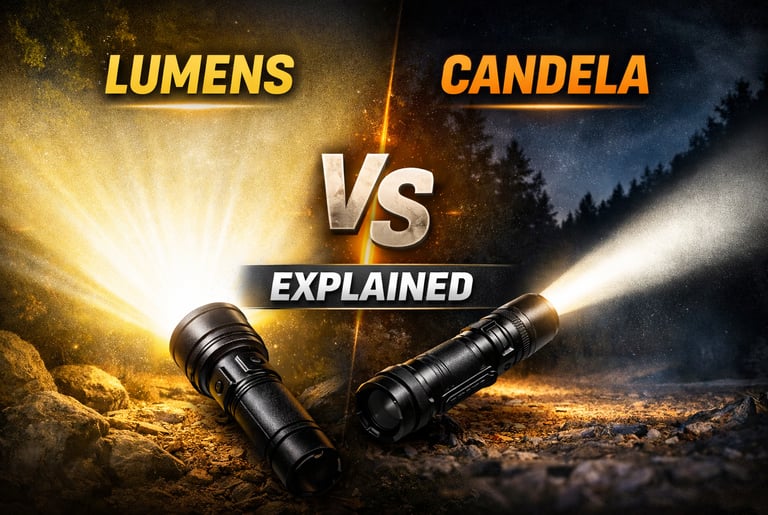
Lumens are essentially a measure of the total visible light output emitted by a flashlight. Imagine it as the sum of all photons reaching your eyes from the entire cone of light — from the bright hotspot at the center to the dimmer edges of the beam spread. The unit lumen (lm) quantifies luminous flux, which is the total amount of visible light energy emitted per second.
This measurement is typically conducted using an integrating sphere, a hollow sphere coated on the inside with a diffuse white reflective material. When a flashlight is activated inside this sphere, the total light is measured without regard to direction. This method gives an accurate figure for how much light your flashlight delivers overall, but it doesn’t tell you if that light is focused into a tight beam or spread out widely.
Why does this matter? Because a flashlight with a very high lumen count might create a pleasantly bright wash of light over a short distance, which is perfect for tasks like sorting items at home or illuminating a campsite. In contrast, if you need to see far ahead at night on a trail or spot something at a distance, overall brightness alone won’t cut it. When evaluating options across different carry setups, it helps to reference the broader EDC Flashlights category to understand how output translates into real-world use.
Understanding Candela: Spotlight Intensity and Beam Focus
Candela, in contrast, measures luminous intensity in a particular direction, essentially telling you how much light is concentrated within a specific angle of the beam — the hotspot. It is measured in candelas (cd), which represent candlepower or luminous intensity per steradian (a unit of angular spread).
This metric helps quantify how powerful and penetrative the beam is at the center, indicating how far the light can effectively reach. The focused nature of this measurement means that a flashlight with the same lumens but different candela can behave very differently. A high candela reading corresponds to a tight, intense beam that punches through darkness over long distances, much like a spotlight. Beam shape and hotspot intensity are also influenced by reflector and lens design, which is covered in more detail in flashlight beam types.
Manufacturers use candela values along with beam distance formulas — beam distance in meters approximately equals the square root of candela multiplied by 0.84 — to give an indication of how far the flashlight shines.
How Lumens and Candela Work Together in Flashlight Performance
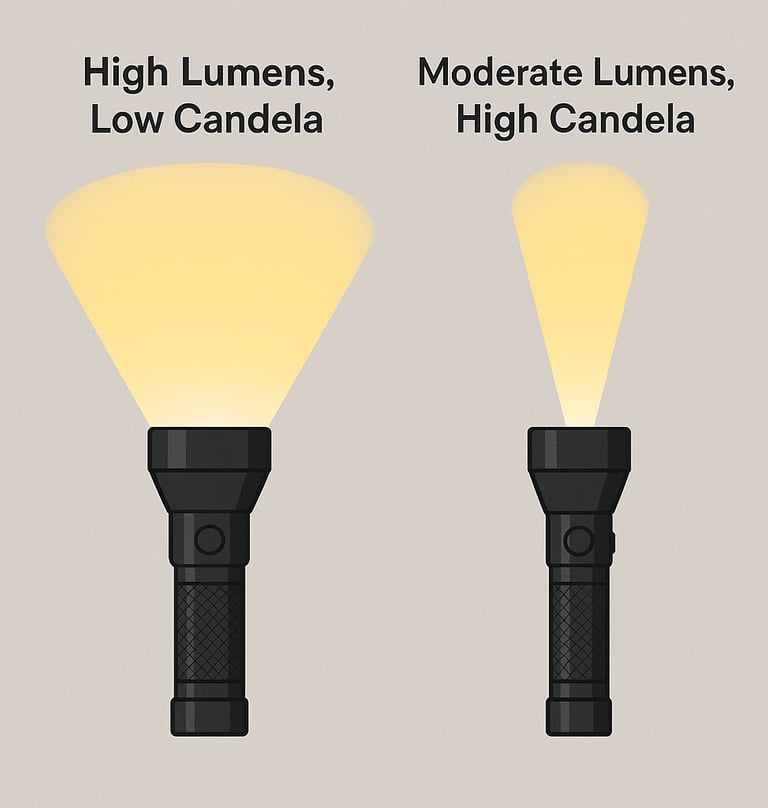
Lumens and candela complement each other but tell very different stories about flashlight performance. Lumens relate to how much total light is emitted overall, while candela focuses on how that light is concentrated along the beam axis.
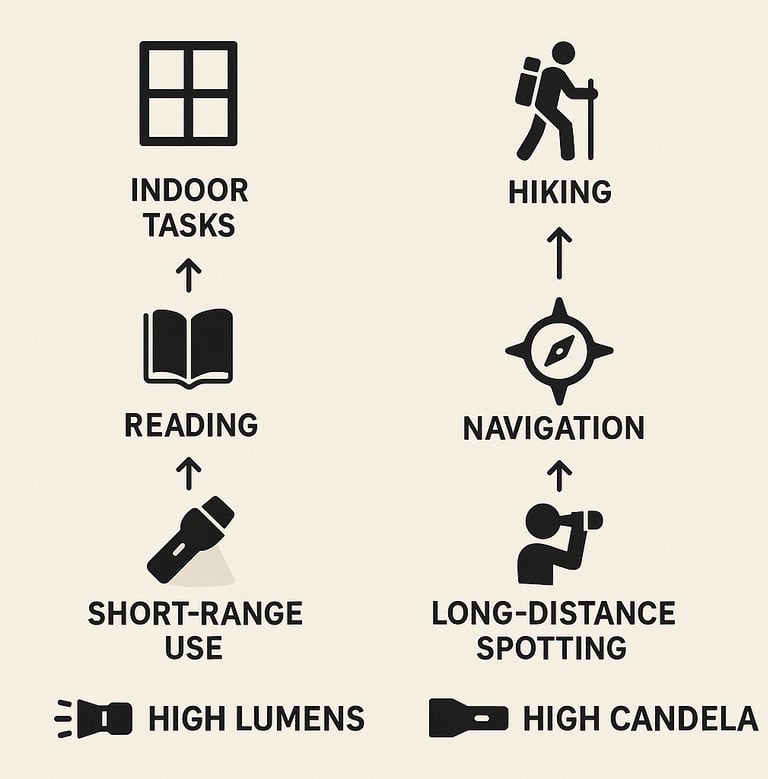
For example, a flashlight designed for general utility might produce around 300 lumens spread evenly across a wide beam pattern, providing comfortable, sufficient illumination for indoor or close-range tasks. On the other hand, a flashlight with 300 lumens but optimized optics can achieve a much higher candela rating by concentrating that same light into a narrower hotspot. This yields a smaller area illuminated but greater reach, perfect for navigating trails or finding distant markers.
Understanding this interplay helps explain why a high lumen value alone can be misleading. Without a well-engineered reflector or lens system to control beam focus, much of the light escapes in broad spill, diluting beam intensity and reducing effective distance.
Real-World Examples: When to Use High Lumens vs High Candela Flashlights
Suppose your everyday carry routine primarily involves work around the house, reading printed materials during power outages, or short-range tasks like finding keys in a bag. Here, lumens are the main metric to consider. A flashlight with moderate lumens (200 to 400 lm) and low to moderate candela gives broad, comfortable illumination without intense hotspots that cause eye strain.
If you spend time outdoors hiking after sunset or navigating large, dark areas, candela gains importance. Flashlights with high candela (several thousand candela or more) focus their output to produce a bright, tight beam that reaches farther and cuts through darkness. This doesn’t require an excessively high lumen count, but rather optical precision to direct light efficiently. Many of these higher-performance options show up in curated lists like best edc flashlights when comparing real-world output versus specs.
In rescue or work environments requiring general area illumination with minimal shadows, a balanced combination of lumens and candela helps maintain enough brightness while avoiding glare or overly narrow beams.
Common Misunderstandings Around Flashlight Brightness Metrics
One frequent mistake is assuming lumens alone dictate how far a flashlight beam reaches. This overlooks beam pattern and intensity. A flashlight scattering 1000 lumens broadly will not reach as far as one delivering 500 lumens tightly focused with high candela.
Another confusion is interpreting candela as total brightness rather than beam concentration. Candela measures intensity in a direction, but it doesn’t account for how much ambient light floods the surrounding area.
Some buyers rely exclusively on manufacturer specs, which can sometimes inflate lumen numbers without corresponding optical efficiency. Others fail to consider their actual use case, purchasing flashy high-lumen lights where a moderate output with good beam control would be more practical.
How to Choose the Right Flashlight Based on Lumens and Candela
To pick the best flashlight, start by thinking about your most frequent use scenarios. For close-range, general tasks in controlled environments, prioritize lumens and choose a model offering even beam spread. This translates into less eye fatigue and better color rendering over a wide area.
For outdoors, navigation, or spotting and signaling at distances, shine a light on candela ratings to evaluate beam intensity and throw. Optics play a big role here; reflectors and lenses that focus beams efficiently also improve battery life by delivering usable light where it’s needed. Power source also plays a role in sustained output, which is why understanding edc flashlight battery types can help match performance with runtime expectations.
Most versatile everyday carry flashlights aim to strike a balance, providing enough lumens for flood illumination and moderate candela for reasonable reach. If your budget and preferences allow, consult user-generated beam shots and reviews alongside official specs to get a practical feel for performance.
Technical Details: How Lumens and Candela Are Measured
Lumens are measured with standardized equipment like an integrating sphere under ANSI/NEMA FL1 protocols to ensure consistency. This metric captures the total diffuse light emitted by the LED or bulb.
Candela measurement relies on photometers reading the intensity directly in the beam’s hottest spot or narrow cone angle. This requires precise optical setups and calibrations, as beam shape and focus vary widely between models.
Beam distance calculations extrapolate from candela with controlling assumptions, so actual performance can deviate with environmental factors like fog, rain, or obstacles. Understanding these nuances helps consumers appreciate the complexity behind a seemingly simple brightness number.
Common Mistakes When Evaluating Flashlight Brightness
Ignoring the difference between lumens and candela often leads to selecting a flashlight that doesn’t suit your needs. Assuming a higher lumen count means better performance in every scenario is an oversimplification that misses the role of beam focus and optics.
Confusing candela as a total brightness metric neglects the directional nature of light intensity. Flashlights with high candela but very low lumens can produce irritatingly bright yet dim overall illumination.
Other mistakes include buying based only on advertised numbers without seeing beam profiles or reviews, and not considering use environments where dust, rain, or terrain might affect light usability.
Lastly, some flashlights boost lumen output but with inefficient reflectors that disperse light, resulting in weak effective illumination and frustrating real-world experience.
FAQs About Lumens, Candela, and Flashlight Brightness
What is the difference between lumens and candela in flashlights?
Lumens measure total emitted visible light, reflecting overall brightness, while candela measures luminous intensity in a specific direction, indicating beam focus and throw distance.
How do lumens and candela affect flashlight performance in everyday use?
Lumens determine how bright a flashlight appears in general, useful for area lighting, while candela affects how far and focused the light beam reaches, crucial for spotting distant objects.
Which metric should I prioritize when choosing an EDC flashlight?
It depends on your primary use: prioritize lumens for broad, close-range tasks and candela for focused, long-distance illumination.
Can a flashlight have high lumens but low candela? What does that mean?
Yes; this means the flashlight emits a lot of light overall but spreads it widely without focusing, resulting in brightness nearby but little reach.
How do manufacturers measure lumens and candela for flashlights?
Lumens are measured using an integrating sphere that totals all light emitted; candela is measured with directional photometers accounting for intensity in the beam's hotspot.
Is a higher candela rating always better for all flashlight tasks?
Not necessarily. Higher candela means a tighter, more intense beam, which is great for distance but less useful for close-range, wide-area illumination.
How do lumens and candela influence battery life and runtime?
Higher lumens usually demand more power, shortening runtime, but beam focus (candela) can improve perceived brightness efficiency without increasing output, helping conserve battery.
What typical lumen and candela ranges are suitable for daily carry flashlights?
EDC flashlights generally range from 200 to 600 lumens with candela values from a few hundred up to several thousand, balancing flood and throw for versatile performance.
Practical Conclusion
In the world of everyday carry flashlights, lumens and candela aren’t just numbers to glance over; they represent distinct aspects of light output that dictate real-world functionality. Lumens give you a sense of overall brightness, vital for tasks needing broad, consistent illumination. Candela tells you how focused the beam is—essential for reaching far distances and spotting details in the dark.
Recognizing the difference between these metrics, and how they relate to your intended uses, leads to smarter, more tailored choices. Rather than chasing the brightest flashlight on paper, consider how the beam behaves, what tasks you’ll use it for, and where you need the light to go. This approach minimizes disappointment and maximizes the practical benefits of your EDC gear, making your flashlight a reliable partner rather than a confusing gadget.
With a clear grasp of lumens versus candela, you’ll handle brightness specs like a pro—knowing not just what they mean, but how they actually translate into performance where it counts.

Contact@TheBuzzHQ.com
© 2026 EDCBuzz. All rights reserved.
EDCBuzz
Master everyday carry systems with clarity and precision. Built for real environments and practical use.
For educational purposes only.
General Inquiries: