
What Is A Chronograph Watch?
Discover what a chronograph watch is, how it works, and its practical features to enhance your everyday carry with accurate time measurement.
EDC WATCHES
The EDCBuzz Editorial Team - Led by AJ “Buzz” Eichman
6/28/20268 min read
A chronograph watch stands apart from your typical timepiece because it integrates an additional layer of function beyond telling the time. At its core, a chronograph pairs standard watch capabilities with stopwatch functionality, allowing you to measure and track elapsed time accurately. This blend of features transforms the watch from merely a device that keeps time into one that can assist with timing workouts, cooking durations, or any sort of interval measurement within your daily activities.
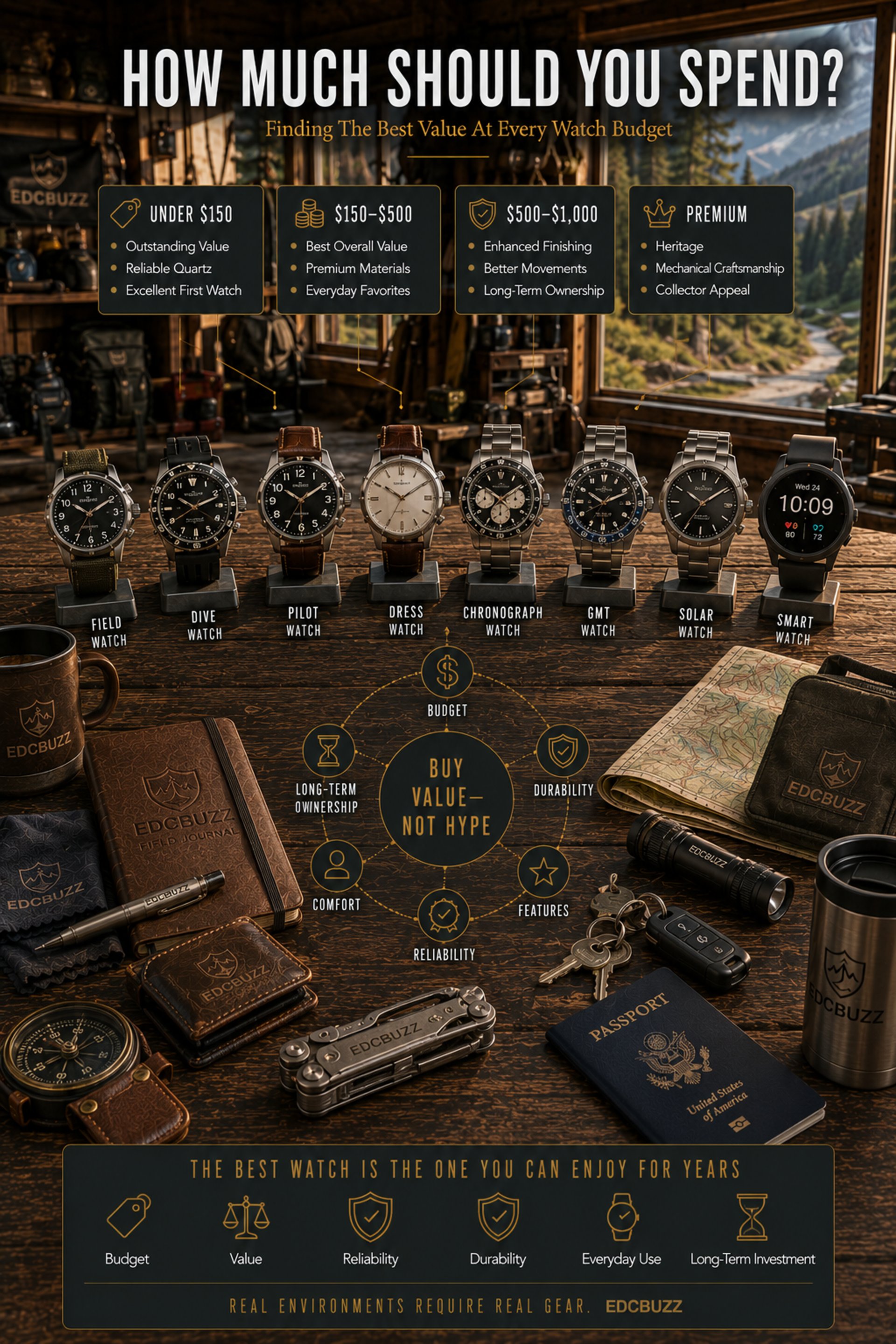
If you're exploring different watch styles for everyday carry, our EDC Watches guide covers the major watch categories and helps you decide whether a chronograph belongs in your collection.
Understanding how a chronograph watch works and what features it offers can significantly enhance how you use it as part of your everyday carry (EDC) gear.
Quick Verdict
A chronograph watch combines regular timekeeping with stopwatch functionality, making it more versatile for practical timing tasks.
Mechanical chronographs offer traditional craftsmanship and intricate engineering but require attentive maintenance and careful use.
Digital chronographs provide easier operation, additional timing features, and often better affordability.
Familiarity with the chronograph’s pushers and sub-dials is essential to using the stopwatch function correctly and preserving the watch’s longevity.
What Is a Chronograph Watch? Definition and Overview
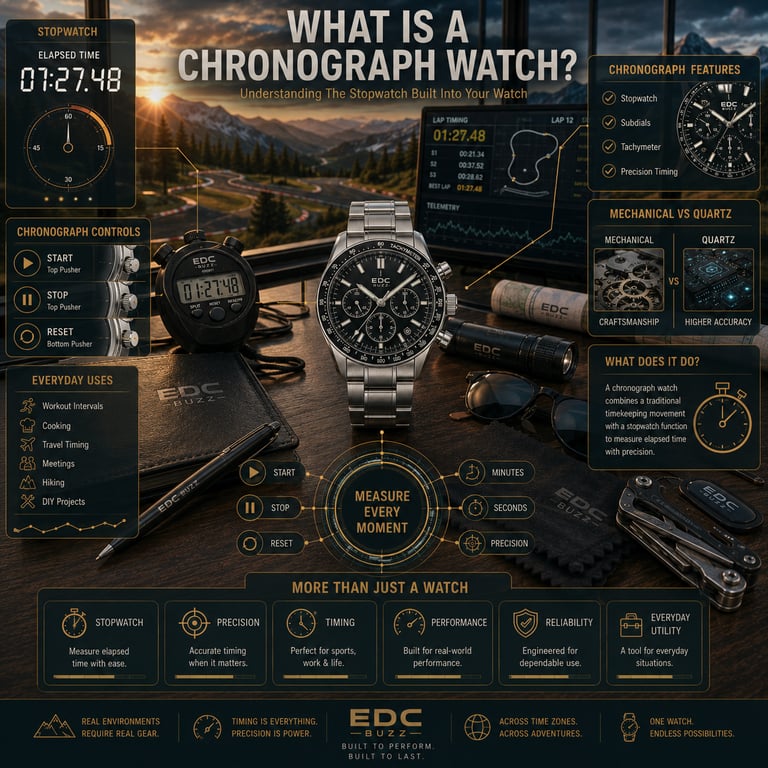
The term “chronograph” may evoke images of complex dials and numerous buttons, but at its simplest, a chronograph watch is a specialized timepiece that features a built-in stopwatch function. Unlike a regular watch, which typically displays only the current hour, minute, and sometimes seconds, a chronograph includes additional controls — usually in the form of pushers on the watch case — that activate, pause, and reset a timer independent from the main timekeeping function.
What sets a chronograph apart is its ability to help you measure elapsed time with some degree of precision. The watch face typically includes sub-dials or “registers” dedicated to the stopwatch, often displaying seconds, minutes, and in some cases hours. This layered time recording can be invaluable for anyone who needs to monitor intervals in everyday scenarios. These features don’t just make the watch more complex; they demonstrate a blend of mechanical or electronic engineering designed for practical timing. If you're looking for recommendations, our Best Chronograph Watches guide showcases excellent options across several budgets.
How Does a Chronograph Watch Work? Understanding Its Mechanism
Breaking down what happens inside a chronograph watch reveals why it’s an interesting piece of technology. Mechanical chronographs operate through a network of gears and levers that engage when you press the stopwatch buttons. The first pusher generally starts and stops the timing function, while the second resets the stopwatch hand back to zero.
When you hit the start pusher on a mechanical chronograph, it triggers a coupling mechanism that physically connects the stopwatch hand to the main gear train, causing the hand to sweep around the dial and record elapsed time. This mechanical interaction makes the chronograph function feel very tactile but also requires precision engineering and occasional maintenance to ensure parts don’t wear out or slip.
Digital chronographs, by contrast, use quartz movements paired with electronic displays — typically LCD or LED — to count elapsed time. These watches rely on battery power and electronic circuits rather than mechanical components. The stopwatch function in digital chronographs often offers more features, like lap timing, alarms, and split times, with pushers that control those functions with minimal physical force. The trade-off is the lack of the traditional craftsmanship and tactile feedback offered by mechanical chronographs.
Types of Chronograph Watches: Mechanical vs. Digital
There are two dominant categories of chronographs: mechanical and digital. Each offers distinct advantages depending on what you value most in a watch.
Mechanical chronograph watches are prized for their intricate craftsmanship and the tangible, almost architectural way their mechanisms work. These watches often appeal to watch enthusiasts who appreciate the complexity of gear trains, column wheels, or cam-based levers that coordinate the stopwatch function. While beautiful and satisfying to operate, mechanical chronographs tend to be bulkier and require periodic servicing to maintain accuracy and smooth operation. They may also come with a higher price point reflective of their engineering and manufacturing effort.
Digital chronographs approach timing from a more utilitarian standpoint. Utilizing quartz timekeeping and digital displays, these watches offer stopwatch functions with enhanced ease of use and often additional features such as countdown timers or multiple lap memory. They're typically slimmer and more affordable. The downside is that they require battery replacements and lack the traditional analog charm and mechanical engineering experience of a mechanical variant. If you're deciding between movement types, Quartz or Automatic: Which Is Better for Everyday Carry? provides a useful comparison.
Common Features and Watch Complications in Chronographs
Chronograph watches often incorporate other watch complications that add extra layers of function and utility. Sub-dials are the hallmark, providing continuous seconds readouts or stopwatch tracking for minutes and even hours. The presence of these smaller dials allows you to read elapsed time without confusing the stopwatch hands with the main timekeeping hands.
Another common companion to chronographs is the tachymeter scale, an etched ring running around the dial’s outer edge or bezel. It measures speed based on elapsed time over a fixed distance, providing an additional analytical tool, especially for activities like cycling or driving. While valuable for some, the tachymeter is not a stopwatch feature but complements the chronograph by enabling real-world calculations.
Materials also affect how a chronograph performs in everyday conditions. Stainless steel cases provide durability against knocks and scratches, while sapphire crystal faces offer greater resistance to scrapes compared to mineral glass. These choices matter, especially if you plan to carry your chronograph watch daily in various environments. How To Read Watch Specifications Before Buying explains these specifications in greater detail.
Practical Everyday Uses of Chronograph Watches
One of the more interesting aspects of a chronograph watch is how its stopwatch function fits into plenty of ordinary activities. For example, timing cooking or baking intervals becomes straightforward with the push of a button, ensuring precision without needing to glance at a separate digital timer. In fitness contexts, you can track workout sets, running laps, or rest periods efficiently.
Beyond personal tasks, chronographs have utility in professional settings. You might use the stopwatch to track meeting durations or breaks, keeping your schedule on point without resorting to phone timers. For DIY projects, measuring how long certain steps or glue drying times last can be done without disruption.
Outdoors, a chronograph can help you record elapsed hiking or cycling times, useful for pacing or evaluating performance over different terrain segments. Having the ability to time these intervals accurately, straight from your watch, adds a layer of convenience and data collection that purely aesthetic watches lack.
How to Operate and Maintain a Chronograph Watch
Operating a chronograph watch is generally straightforward but requires understanding your specific model’s controls. Most mechanical versions have two pushers: the top pusher starts and stops the stopwatch, while the bottom resets it. It’s important not to reset the chronograph while it’s running, as that can strain the mechanical parts and lead to premature wear.
Digital chronographs are usually even simpler, with pushers that cycle through start, stop, reset, and other functions like lap timing or alarms. Manuals will provide critical guidance on button functions and sequencing, but the digital setup tends to be more intuitive for new users.
Maintenance differs drastically between mechanical and digital chronographs. Mechanical watches often need servicing every few years to clean and lubricate their delicate gears and levers. This upkeep preserves accuracy and avoids the buildup of friction that could jar the movement’s timing. How Often Should You Service Your Watch? offers additional guidance on keeping mechanical watches running smoothly.
Digital chronographs require less bulky maintenance beyond battery replacement. However, battery life affects stopwatch performance, so ignoring power shutdowns risks losing functionality when you need it most.
Choosing the Right Chronograph Watch for Your EDC
Selecting a chronograph suitable for everyday carry depends on your priorities and how you intend to use the watch. If you appreciate traditional watchmaking and don’t mind occasional servicing, a mechanical chronograph can be a rewarding addition. Look for models with robust materials like stainless steel cases and sapphire crystals to handle daily wear.
For practicality and ease of use, especially if you want added stopwatch features like lap times or alarms, digital chronographs are compelling. They tend to be lighter, more affordable, and simple to operate — ideal if you want a reliable timing tool without the fuss of mechanical care.
Be aware of size and weight, as chronographs can add bulk to your wrist compared to basic watches. If you plan to wear your watch all day, comfort and usability should factor into your choice. Finally, familiarize yourself with the chronograph function on a prospective watch before buying to ensure it matches your skill level and timing needs. Common Watch Mistakes New Buyers Make highlights several purchasing mistakes worth avoiding.
Common Mistakes When Using Chronograph Watches
It’s easy to get tripped up by misusing chronograph features, so understanding common mistakes is helpful to avoid frustration or damage. One frequent error is confusing the chronograph stopwatch hands with the main hour and minute hands. This can lead to misreading the current time or elapsed time.
Starting or stopping the stopwatch incorrectly—or more critically, forgetting to reset it before the next timing session—can interfere with accurate measurement. Resetting while the stopwatch is running can also damage mechanical components.
Another common pitfall lies in expecting all chronographs to maintain the same precision. Mechanical chronographs typically have limits on timing accuracy compared to quartz-based versions, so understanding these differences manages expectations.
Failing to maintain mechanical chronographs with regular servicing leads to mechanical degradation or performance drop-offs over time. Neglecting to check battery life in digital chronographs can cause untimely stopwatch failures.
Finally, conflating chronograph functionality with other watch complications like tachymeters or timers without understanding their distinct purposes can result in misuse or confusion.
Frequently Asked Questions About Chronographs
What is the difference between a chronograph and a regular watch?
A regular watch only indicates the current time, while a chronograph watch adds a separate stopwatch function to measure elapsed time.
How does a chronograph watch work?
Mechanical chronographs operate via gears and levers activated by pushers on the case; digital chronographs use quartz movements and electronic displays controlled by buttons.
What are the main types of chronograph watches?
The two principal types are mechanical chronographs featuring intricate manual or automatic movements, and digital chronographs relying on electronic circuits and displays.
Can a chronograph be used for everyday tasks or only sports?
Chronographs are versatile and useful for everyday activities such as cooking, work timing, or outdoor pursuits — not limited to sports.
How do I operate the stopwatch function on a chronograph watch?
Push the top pusher to start and stop timing, and the bottom pusher to reset — but only after stopping it. Digital versions vary but usually follow similar start/stop/reset controls.
Are mechanical chronograph watches better than digital ones?
It depends on preference; mechanical versions boast craftsmanship and tactile operation, while digital ones offer ease of use, affordability, and additional features.
What maintenance is needed for a mechanical chronograph?
Regular servicing every few years to clean and lubricate the movement helps maintain performance and longevity.
Do chronograph watches add a lot of weight or bulk to everyday carry?
Chronographs often have larger cases and thicker profiles than simple watches, which may add weight and wrist presence; size and comfort should be considered when choosing one.
Conclusion
The chronograph watch embodies more than a blend of timekeeping and stopwatch functions; it represents a thoughtful integration of mechanical or electronic technology designed to enhance how you measure and manage intervals in daily life. Whether you lean toward the tradition and complexity of a mechanical chronograph or opt for the user-friendly features of a digital model, understanding how these watches function allows you to make informed decisions tailored to your practical needs.
If you're considering whether a chronograph is worth adding to your collection, Is An Expensive Watch Worth It? explores how to balance features, quality, and value before making a purchase.
By considering the trade-offs in operation, maintenance, accuracy, and materials, you can select a chronograph that fits seamlessly into your everyday carry — not just as a stylish accessory, but as a precise and reliable timing tool for everyday use.
Contact@TheBuzzHQ.com
© 2026 EDCBuzz. All rights reserved.
EDCBuzz
Master everyday carry systems with clarity and precision. Built for real environments and practical use.
For educational purposes only.
General Inquiries: