

How To Read Watch Specifications Before Buying
Learn how to read watch specifications clearly, from movement type to water resistance, ensuring your watch fits your lifestyle and needs perfectly.
EDC WATCHES
The EDCBuzz Editorial Team - Led by AJ “Buzz” Eichman
6/28/20268 min read
When you’re standing in front of a watch—whether it’s in a store display or scrolling through online listings—it can feel like decrypting a foreign language. The watch specifications, or watch specs as some call them, are packed with technical terms and numbers that don’t always make immediate sense. But understanding those specs isn’t just about impressing yourself or others with watch knowledge. It’s a crucial step to making sure the watch you pick actually suits how you live, what you need from it, and how durable or reliable it will be over time.
Watch specifications cover a spectrum of features: from the type of movement powering the timekeeping to the materials protecting the dial, to how much water pressure the watch can handle. These details aren’t arbitrary. Each one influences how the watch performs, how it should be maintained, and how it wears throughout its life. Before comparing individual models, our EDC Watches pillar provides a complete overview of the major watch types, movements, and buying considerations that every buyer should understand.
Quick Verdict
Movement type defines accuracy and maintenance commitment.
Water resistance ratings indicate true limits on exposure, not just marketing numbers.
Case and crystal materials impact durability, weight, and scratch resistance.
Complications should be chosen based on meaningful everyday use, not novelty.
Size and weight directly affect comfort and wearability in daily contexts.
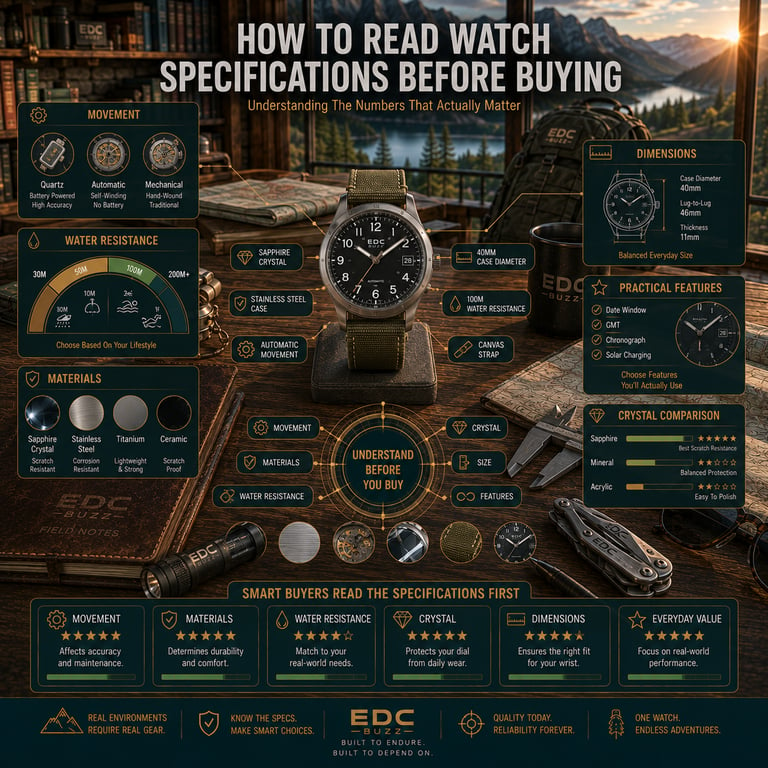
Understanding Watch Movements: Quartz vs. Automatic vs. Mechanical
The driving force behind a watch—a.k.a. its movement—determines a handful of key performance traits: accuracy, maintenance, and how you interact with the watch daily. Broadly, movements fall into three camps: quartz, automatic, and mechanical.
Quartz movements are powered by a battery that energizes a quartz crystal oscillator. This technology is fundamentally designed for precision timekeeping with minimal fuss. The crystal vibrates at a consistent frequency, which the circuitry translates into highly accurate time measurement. Quartz watches generally drift by only a few seconds per month, which is exceptional compared to other types. Because the movement relies on a simple power source and fewer moving parts, maintenance is minimal, mainly depending on battery replacement every few years. The trade-off here is that quartz watches tend to lack the mechanical complexity and feel that some collectors appreciate. If movement accuracy is one of your biggest concerns, Automatic or Quartz: Accuracy In Real Life compares how these technologies perform outside the spec sheet.
Automatic watches utilize the wearer’s wrist movement to wind a mechanical spring inside. This means accuracy depends on the quality of the mechanism and consistent wearing or manual winding. The mechanical complexity involved in an automatic movement introduces more variation in precision, typically a few seconds per day of deviation. On the plus side, these watches don’t need battery swaps and embody traditional watchmaking craftsmanship. However, they require periodic servicing (often every 3-5 years) to maintain performance. Expect a smoother sweeping second hand from automatics, unlike the ticking of quartz.
True mechanical watches are manually wound using the crown, absent any battery or automatic winding rotor. They share many traits with automatics—precision variations, maintenance needs, and intricate craftsmanship—but demand more active engagement from the wearer.
Decoding Water Resistance Ratings for Practical Use
Water resistance is one of those specs that often causes confusion because the numbers listed don’t translate directly to real-world usage scenarios. You’ll see ratings expressed in ATM (atmospheres), meters, or sometimes in feet, but these refer to static pressure tests, not the practical depths you can take the watch.
For example, a 3 ATM or 30-meter rating means the watch can withstand the pressure equivalent to being submerged 30 meters deep in a lab setting. But actual conditions like movement in water, temperature changes, and aging seals reduce this capability. In practical terms, a 30-meter rating is enough for accidental splashes or brief rain exposure but not swimming or showering.
A 5 ATM or 50-meter rating allows for light swimming but not extended submersion or diving. Watches rated at 10 ATM (100 meters) and above generally handle swimming, snorkeling, and surface water sports well. For actual diving, you want 20 ATM (200 meters) or a designated dive watch certified under ISO standards. If these ratings still seem confusing, Do You Need A 200M Water Resistant Watch? explains which levels actually make sense for everyday carry.
Knowing these distinctions matters because overestimating water resistance can lead to moisture damage. When considering watch specs explained, always clarify what your daily exposure entails—whether it’s washing hands frequently, swimming often, or occasional water encounters—and pick a rating that aligns with those habits.
Materials Matter: Cases, Crystals, and Bands Explained
What your watch is made of influences how it wears, ages, and even feels on your wrist. The case material, crystal (the transparent covering over the dial), and band type all bring trade-offs in durability, weight, and resistance to scratches or corrosion.
Stainless steel is the most common case material due to its balanced toughness and corrosion resistance. It’s heavy enough to feel substantial but not so weighty as to be uncomfortable. Steel resists dings and water damage well, making it a great everyday choice. However, it can show scratches over time, especially polished finishes.
Titanium cases offer an interesting alternative to steel by being significantly lighter while maintaining comparable strength and corrosion resistance. The lower weight makes titanium appealing for those who wear their watches many hours daily or engage in outdoor activities where weight matters. The downside is that some titanium alloys scratch more easily, though these scratches tend to be less noticeable due to the metal’s matte finish.
Ceramic cases and bezel inserts are prized for their scratch resistance and ability to retain looks over time. Ceramic doesn’t fade or corrode, but it’s more brittle than metal, so it can chip or crack under sharp impact. The cool textures and colors of ceramic add to its appeal, but watch buyers should know they carry different durability trade-offs.
When it comes to crystals, you have three main options: acrylic, mineral, and sapphire. Acrylic is lightweight and shatter-resistant but scratches fairly easily and often. Mineral glass provides better scratch resistance than acrylic but can chip. Sapphire crystal sets the gold standard, delivering exceptional scratch resistance so your watch face stays crisp for years. The trade-off with sapphire is its brittleness; it can crack or shatter upon hard impact.
Complications are often what dial up the mechanical complexity and functionality of a watch beyond simply telling time. Common examples include chronographs for timing events, date windows, GMT functions for tracking multiple time zones, and power reserve indicators revealing how much winding energy remains.
While complications can add practical value depending on your lifestyle, they often introduce additional maintenance needs since the watch’s internal mechanism becomes more intricate. For instance, chronographs have extra levers and parts that can require service for smooth operation. Similarly, GMT complications are useful if you travel frequently or coordinate with different time zones, but might be unnecessary if you mostly stay local.
Here the key is matching complications to real-world use rather than collecting them for show. If your work or hobbies don’t require a stopwatch or track day, a chronograph complication adds mechanical weight without adding practical benefit.
Sizing Up: How to Read Watch Dimensions for Comfort
Watch size is more than just a number on a spec sheet; it directly affects how comfortable and balanced a watch feels on your wrist over extended wear. Key measurements to focus on include case diameter, case thickness, and lug-to-lug length (the distance from one strap attachment point to the other).
Case diameter often gets the most attention, but ignoring lug-to-lug length can lead to awkward wear. A watch with a 40mm diameter but elongated lugs may extend too far over a smaller wrist, making it feel bulky or prone to shifting during activity.
Thickness matters for how snug the watch sits under sleeves or rests against your skin. Thicker watches stand out more and can interfere with cuffed clothing, while thinner ones slip in easily but may sacrifice some durability or housing for complications.
Weight plays into comfort as well; heavier watches can feel more substantial but lead to fatigue during long wear, especially for active users. If you're unsure how these measurements translate to your wrist, What Watch Case Size Fits Your Wrist? walks through choosing the right dimensions for long-term comfort.
Understanding these size specs in relation to your wrist circumference gives you a tangible sense of how the watch might wear daily. This is especially important for EDC watches, which demand a balance of presence, durability, and continuous comfort.
Common Mistakes When Reading Watch Specifications
When buyers jump straight to brand image or design aesthetics without unpacking specifications, they often make choices that lead to frustration down the line. A significant yet common mistake is assuming water resistance means dive readiness—failing to check the exact rating and understand its practical limits can cause water damage unexpectedly.
It’s also easy to overlook the differences between quartz and automatic movements, particularly concerning maintenance. Quartz watches require battery changes but generally less service overall, while automatics or mechanical watches need regular winding and servicing that some buyers underestimate.
Another slip-up is ignoring the durability differences in crystal types. Buyers who don’t prioritize sapphire clarity might end up with scratched-in mineral or acrylic crystals requiring early replacement.
Misjudging watch size and weight compared to wrist size is another pitfall that diminishes wearability. This can turn what should be a comfortable daily companion into a watch that feels awkward or cumbersome.
Finally, conflating fashion features or look with functional specifications leads to buying watches that may appeal visually but don’t actually perform well in the user’s specific environment or needs. Comparing Best GMT Watches with Best Chronograph Watches is a good example of how choosing features that match your lifestyle is more important than simply buying the most feature-packed watch.
Frequently Asked Questions
What does water resistance rating actually mean?
Water resistance ratings reflect pressure levels the watch case can withstand during static lab tests, not the actual depth or duration you can wear the watch underwater. Real-world exposure varied by activity, so it’s essential to match rating to intended use.
How do quartz and automatic movements differ?
Quartz movements use a battery and quartz crystal oscillator for high accuracy and low maintenance. Automatic movements rely on wrist motion to wind springs mechanically. Automatics usually require more servicing and fluctuate more in accuracy.
Which case material is best for everyday carry?
Stainless steel is standard for durability and corrosion resistance, suitable for daily wear. Titanium is an excellent option if weight is a concern, offering lighter feel and solid toughness.
What are watch complications and why do they matter?
Complications are additional mechanical features beyond basic timekeeping, such as chronographs or GMT functions. They expand watch utility but add mechanical complexity, affecting price and maintenance.
How to interpret watch size measurements?
Focus on the diameter, lug-to-lug length, and thickness to gauge how the watch will sit and feel on your wrist. These measurements together give a clearer picture than diameter alone.
Does a sapphire crystal make a watch more durable?
Sapphire crystals offer superior scratch resistance compared to mineral or acrylic but can be more brittle and prone to chipping or breaking on impact.
Are all chronographs useful for daily tasks?
Not necessarily. Chronographs add timing functions but may be unnecessary unless you regularly use a stopwatch feature. Consider your practical needs before selecting this complication.
How to decide what watch features are necessary for my needs?
Look at your daily activities, usual environments, and maintenance willingness. Prioritize features like water resistance or complications only if they align with those routines, avoiding unnecessary mechanical complexity.
Conclusion
Reading watch specifications might seem like wading through technical jargon, but breaking them down reveals a clear roadmap to understanding what you are really getting. Each spec, from movement type to case material to water resistance, informs the watch’s performance, durability, and how smoothly it fits into your routine. Recognizing trade-offs—for example, between quartz accuracy and automatic craftsmanship, or between titanium weight and ceramic fragility—helps set realistic expectations.
Armed with this knowledge, buying a watch transforms from guessing to a measured choice. You’ll know how each feature contributes to the watch’s function and lifespan, allowing you to pick a timepiece tailored to your lifestyle, environmental demands, and comfort preferences. Understanding watch specifications isn't just about reading labels—it’s about decoding how the watch will live with you, day by day.
Contact@TheBuzzHQ.com
© 2026 EDCBuzz. All rights reserved.
EDCBuzz
Master everyday carry systems with clarity and precision. Built for real environments and practical use.
For educational purposes only.
General Inquiries: