

Quartz or Automatic: Which Is Better for Everyday Carry?
Discover which everyday carry watch suits you better: the accurate, low-maintenance quartz watch or the mechanically charming automatic watch.
EDC WATCHES
The EDCBuzz Editorial Team - Led by AJ “Buzz” Eichman
6/28/20267 min read
When it comes to picking an everyday carry watch, the debate between quartz and automatic movements inevitably surfaces. Both watch types have their staunch supporters, but the best fit really depends on how you live with the watch day in and day out. After spending weeks with both, I’ve come to appreciate that the choice isn’t just about what looks good on your wrist or what sounds cool. It’s about how the watch performs once the newness wears off, how much maintenance it demands, and how it fits into daily use — including the little annoyances and unexpected perks that only time reveals.
If you want a watch you can grab and go, that stays accurate without much fuss, quartz probably sounds like your best bet. But if you’re the kind of person who enjoys a bit of mechanical charm and doesn’t mind winding or wearing your watch regularly, an automatic could be your companion. I’ve carried both types through different tasks, from office hours to weekend projects, and here’s what stands out after putting in the real miles. For a complete overview of everyday carry timepieces, start with EDC Watches.
Quick Verdict
Quartz watches offer consistent accuracy with minimal maintenance, making them great for straightforward daily wear.
Automatic watches bring mechanical craftsmanship and a traditional feel but call for regular wear or winding and occasional servicing.
Durability depends more on case and crystal materials than movement type, though quartz mechanisms handle shocks better.
Personal preference for hassle-free accuracy or mechanical heritage usually determines the optimal everyday carry watch.
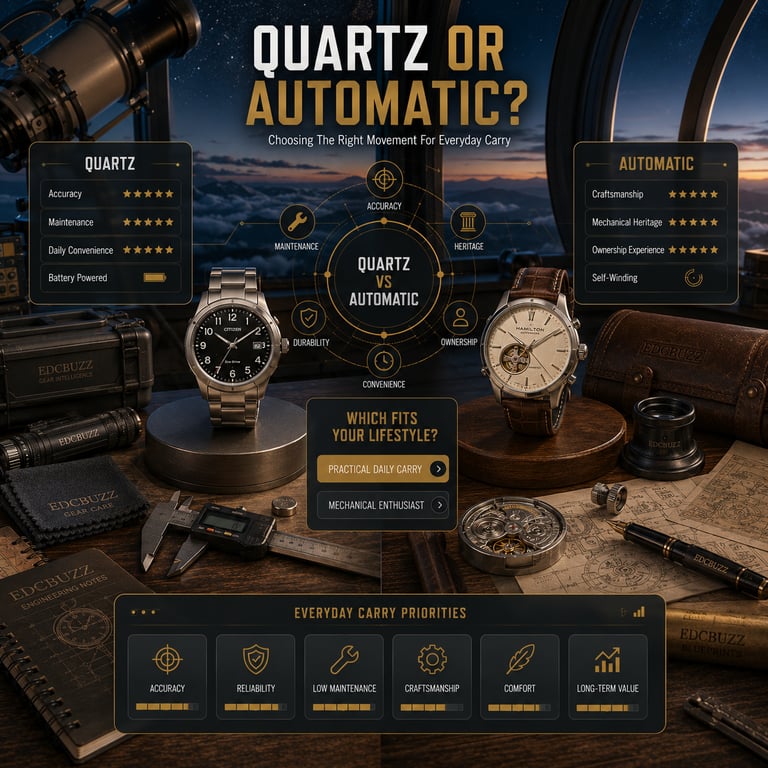
How Quartz Watches Work: Mechanism and Benefits
Quartz watches run on a pretty clever principle. Inside, a tiny quartz crystal oscillates electronically at a precise frequency when powered by a small battery. This allows the watch to keep time with impressive accuracy because the vibrations are super consistent. The upshot is quartz watches generally lose or gain just seconds per month — far better than your average mechanical automatic that can drift by several seconds a day if not maintained properly.
One of the strongest advantages of quartz for everyday carry is its low maintenance demands. Aside from changing the battery every year or two, there’s very little you need to worry about. No winding necessary, no daily movement required to keep it ticking. That peace of mind is a significant factor if you want your watch to be reliably ready without extra thought. If you're comparing movement types before buying, the Watch Buying Guide covers the key considerations.
The pocket feel of a quartz watch tends to be light, too. Because the movement is compact and often integrated into sleek cases, it often disappears in your pocket rather than announcing its presence. After a full day, you’re unlikely to notice any grip fatigue or weight pull, which counts when you’re carrying other EDC items like knives or flashlights.
How Automatic Watches Work: Mechanism and Appeal
Automatic watches take a distinctly different route. These are mechanical timepieces powered by the movement of your wrist. Inside, a rotor swings with your natural motions, winding a mainspring that drives the gears. There’s an undeniable charm in wearing a watch that’s part machine, part art, meticulously assembled to tick without batteries.
After several weeks carrying an automatic watch, you get a feel for the slight weight differences compared to quartz models. The heavier movement and thicker cases often mean the watch is more present in your pocket or on your wrist. It’s a trade-off that some find reassuring — it reminds you you’re wearing something with history and craftsmanship. Others may find it mildly fatiguing after extended use, especially if layered with heavier carry items.
There’s also the matter of keeping the watch wound. If you skip wearing it for a day or two, you might find yourself resetting the time and date. It’s a quirk that seasoned automatic wearers accept but newcomers often underestimate. Regular winding or daily wear becomes part of the routine, adding a small but deliberate maintenance step.
Accuracy Comparison Between Quartz and Automatic Watches
If accuracy is your priority, quartz watches generally lead the pack. Their electronic heartbeat keeps time within ±15 to ±30 seconds per month, which in everyday terms is close enough to perfect for most users. Automatic watches, on the other hand, tend to vary more widely, often running ±5 to ±20 seconds per day depending on model and condition.
This variance isn’t a flaw but an inherent quality of mechanical watchmaking. For many automatic enthusiasts, the slight deviation is part of the charm, a reminder of the delicate engineering inside. Still, if you need your watch to be spot on, like when you’re scheduling tight meetings or coordinating projects, quartz has a clear practical advantage. For a more detailed breakdown, How Accurate Are Quartz Watches? and How Accurate Are Automatic Watches? explain what to expect in real-world use.
Maintenance and Durability for EDC Usage
Maintenance is one of those things people tend to overlook when eyeing automatic watches. They make fantastic daily wear companions — when you keep up with the upkeep. Automatic movements typically require servicing every three to five years to maintain smooth performance and accuracy. If neglected, the precision can degrade, and repairs can get pricey.
Quartz watches, conversely, demand far less attention. Battery swaps every 1-3 years are about as involved as it gets. Other than that, they’re good to go. For an everyday carry watch, that low-maintenance factor translates to convenience — you won’t find yourself off the beaten path with a broken timepiece because you forgot to wind it or service it.
Durability is mostly down to watch case and crystal materials rather than the movement inside. Whether a watch is quartz or automatic, a stainless steel or titanium case paired with a sapphire crystal improves scratch resistance and shock absorption. Quartz’s movement is somewhat more resistant to shocks and impacts since it lacks delicate gears and springs that can be jarred out of alignment easily. On the flip side, automatic watches might require a little gentler handling to avoid mechanical issues over time. If long-term durability is your priority, The Most Durable Watch Materials Explained provides additional guidance.
User Scenarios: Who Should Choose Quartz or Automatic?
If your daily routine leans on ease and accuracy — like office work, frequent travel, or manual tasks — quartz watches fit naturally. They won’t demand winding or extensive maintenance, and that reliability is a solid comfort. They’re also usually lighter, which matters if you carry several other items and want to keep your pocket load manageable. If you're looking for dependable recommendations, the Best EDC Watches page highlights excellent quartz and automatic choices across a range of budgets.
Automatic watches find their sweet spot with enthusiasts who appreciate the artistry behind mechanical timepieces and don’t mind investing a little time each day or week to keep them running. They work well for casual wear and formal settings where style and tradition shine, but might be less suited for rugged or high-vibration tasks where shock sensitivity comes into play.
Cost and Value Considerations
Generally speaking, quartz watches come in at a lower price point, making them accessible for everyday carry buyers who want solid performance without breaking the bank. Automatic watches tend to cost more, reflecting the complexity and craftsmanship involved. But that higher price often includes a sense of pride and enjoyment in ownership that can make the investment worthwhile.
Both watch types can offer fantastic quality, depending on brand and materials. Remember, a well-built quartz watch is a better daily companion than a cheaply made automatic, and the reverse holds true as well. If you're deciding how much to invest, How Much Should You Spend On An EDC Watch? walks through the value found at different price ranges.
Common Mistakes
One common mistake is assuming automatic watches are always less accurate without considering the model and servicing history. High-end automatics can be quite precise if maintained properly. Conversely, neglecting the required maintenance will erode performance quickly.
Another frequent oversight is expecting an automatic watch to keep running without regular wear or winding. If you left yours sitting in a drawer for days, don’t be surprised when it stops and needs resetting.
Battery changes for quartz watches are sometimes overlooked, leading to unexpected downtime when the watch dies. Replacing batteries timely is a simple habit that keeps things moving.
Finally, many forget that case and crystal materials significantly affect durability. A quartz watch with cheap materials won’t outlast a well-built automatic with stainless steel and sapphire crystal despite the differing movements. Comparing options like Tissot PRC 100 Solar vs Bulova Aerojet Open Heart (Solar Watch vs Automatic Watch) also demonstrates how materials and movement both influence long-term value.
Frequently Asked Questions
Which is more accurate: quartz or automatic watch?
Quartz watches generally offer superior accuracy, typically varying by seconds per month, compared to automatic watches that can vary by seconds per day.
How often should I service an automatic watch?
Most automatics benefit from servicing every three to five years to maintain accuracy and mechanical health.
Can a quartz watch last as long as an automatic watch?
Yes, quartz watches can last many years with proper battery changes and care, though they may lack the mechanical longevity some automatics enjoy with servicing.
Is an automatic watch practical for everyday carry?
It can be if you’re comfortable with regular wear or winding and occasional servicing, but quartz watches require less ongoing attention.
Do quartz watches require battery changes?
Yes, batteries typically last between 1 to 3 years depending on the model and usage patterns.
What factors affect watch durability aside from movement type?
Case materials like stainless steel or titanium and crystal types such as sapphire play major roles in scratch resistance and overall toughness.
Are automatic watches more expensive than quartz watches?
Generally, yes, due to the complexity of mechanical movements and craftsmanship involved.
How does wearing an automatic watch daily affect its performance?
Regular wear keeps the mainspring wound and helps maintain accuracy, reducing the need for manual winding.
Final Thoughts: Matching Watch Type to Your Everyday Needs
Choosing between quartz and automatic watches for everyday carry boils down to your lifestyle and what you value in a watch. Quartz shines with its reliable accuracy, low upkeep, and lightweight design. If you want a watch that’s ready whenever you are, with little thought and fuss, it’s a sensible choice.
Automatic watches reward those who appreciate the traditional watchmaking craft and don’t mind a bit of daily care. They bring character to the wrist, heavier presence in the pocket, and more maintenance responsibility. The Watch Ownership Guide is a helpful resource for understanding long-term care and servicing.
But with that comes a unique connection to timekeeping history and subtle mechanical artistry.
So next time you’re weighing a quartz watch versus an automatic watch for everyday carry, think beyond the specs and marketing. Consider how each will feel at the end of a long day, how much effort you want to invest, and which nuances will truly matter to you in your daily routine. And if you find yourself needing a watch that quietly fades into your carry without a fuss, quartz usually holds the edge — plus it won’t remind you like the heavier one does when you forget it’s there until you sit down.
Contact@TheBuzzHQ.com
© 2026 EDCBuzz. All rights reserved.
EDCBuzz
Master everyday carry systems with clarity and precision. Built for real environments and practical use.
For educational purposes only.
General Inquiries: