
Is an Expensive Watch Worth It? Breaking Down the Value
Explore the value of an expensive watch by understanding its materials, brand prestige, features, and real-world usability in everyday carry.
EDC WATCHES
The EDCBuzz Editorial Team - Led by AJ “Buzz” Eichman
6/28/20268 min read
When you start poking around the world of watches, it doesn’t take long before you bump into the big question: Is an expensive watch worth it? It's easy to get dazzled by the glint of sapphire crystals or the allure of intricate mechanical movements, but the real test comes after the novelty fades and you’re staring at that watch after a full day tucked into your wrist. What does it actually bring to the table beyond the shiny price tag?
This article digs into the nuts and bolts of expensive watches — looking at their engineering, the quality of the materials, the weight and feel after weeks of wear, as well as how brand prestige and watch features factor into the equation. If you’re wondering whether to splurge or save, read on. You’ll get the ground-level insight you need to decide if luxury is just eye candy or a practical, long-term companion. For a broader look at every style and movement available, our EDC Watches pillar is a great place to start.
Quick Verdict
Expensive watches tend to deliver superior materials, kickstarting with sapphire crystals and robust metals that resist wear and scratches more confidently than typical budget options.
Brand prestige can add value, but it’s a subjective layer that won’t affect how the watch feels or performs day-to-day.
For real-world carry, durability, water resistance, and maintenance costs often become the deciding factors. These watches aren’t just for show, but they do come with upkeep.
Not every flashy complication translates to practical use. Sometimes what looks cool ends up gathering dust in the watch box.
What Defines an Expensive Watch?
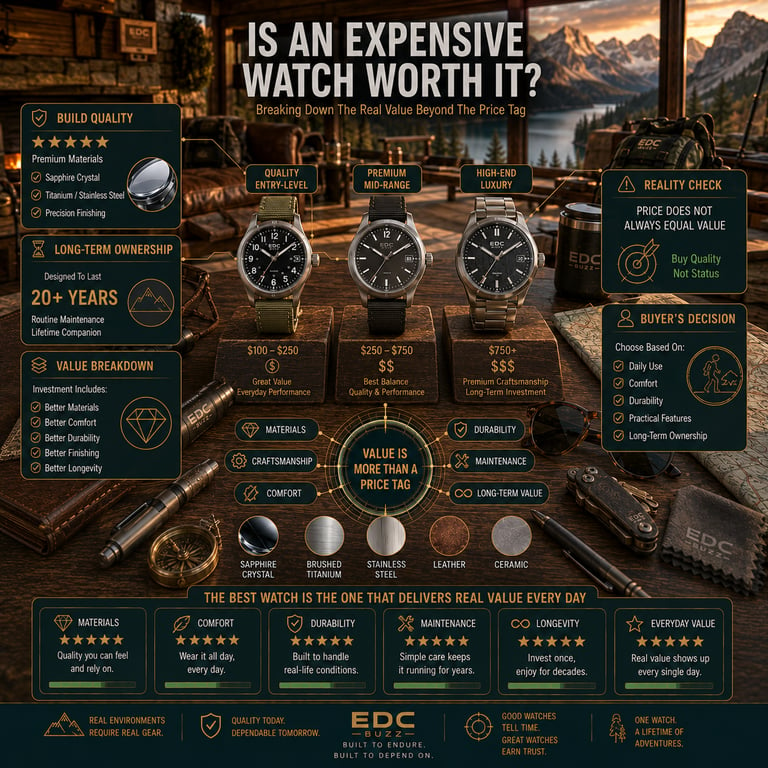
Let’s flatten the hype for a moment. Expensive watches generally mix high craftsmanship with premium materials and often, a complex mechanical heart. Whereas a $100 watch might run on a simple quartz movement and mineral glass face, pricier models bring in mechanical or automatic movements that require artful assembly and regular servicing. Materials leap from plain steel to titanium, ceramic, or precious metals. The crystal protecting the dial is usually sapphire, a mark of serious scratch resistance, compared to mineral or acrylic glass found in lower-priced watches.
But here’s the kicker: what makes one expensive watch worth it and another less so depends largely on factors beyond the sticker. The engineering precision affects timekeeping accuracy, while the finishing details dictate visual appeal and tactile smoothness — think brushing and polishing around edges, which you notice subconsciously every time you glance at your wrist. These are the quiet details that stick after the first wow factor wears off. If you're still deciding what features deserve your money, our What Watch Features Actually Matter For Everyday Carry? guide separates useful upgrades from luxury extras.
Materials and Build Quality: What You Get for the Price
Sapphire crystal glass is a staple in this realm. It resists scratches so well that even keys or coins in the pocket don’t stand a chance of ruining the face. I’ve carried watches with sapphire for months, and after a couple of accidental knocks, the glass stayed flawless. Contrast that with cheaper mineral glass, which can show fine scratches within weeks of daily use — not the look you want when the watch is meant to get smarter with age.
Metals also matter. Stainless steel is durable and classic, but it’s heavier and shows scratches over time. Titanium offers a sweet middle ground—lighter on the wrist, which helps when you wear your watch all day (you start noticing that extra weight after a few hours). Ceramic watches stand out for their scratch resistance and smooth finish, but be warned: ceramic is more brittle. Drop it, and it might crack, unlike metal that dents or scratches instead.
The build isn’t just about what you see but also how the watch wears and feels through repetitive motions. Lugs that press into your wrist too much, a crown that sticks out and catches on shirt cuffs, or a band that pinches hair all become apparent after weeks. Expensive watches tend to pay closer attention to these small discomforts, but no model is flawless. If you're comparing crystal materials specifically, Are Sapphire Crystals Worth It? dives much deeper into their real-world advantages.
The Role of Brand Prestige in Watch Value
There’s no escaping prestige when discussing pricey watches. Brand history, their innovation legacy, and cultural perception form a kind of currency. Names like Rolex, Omega, Patek Philippe, and Audemars Piguet carry not just weight on your wrist but status in the collecting world. This prestige can influence resale value or make your watch a conversation piece, but it’s mostly invisible in practical daily wear.
I’ve met plenty of folks who swear by a brand’s particular vibe, and that’s not unwarranted. These companies invest heavily in ensuring not just precision but also exclusivity and design language you won’t find elsewhere. Yet, for someone whose main concern is using the watch as a daily tool, a lesser-known brand baked with solid engineering might serve better—and often at a friendlier maintenance cost.
Key Features and Complications to Consider
Luxury watches often flaunt “complications” — features that go beyond telling time. Chronographs, moon phases, GMT functions, power reserve indicators: all fascinating and mechanically impressive features. But after a few months, you’ll realize many of these do little in terms of daily usefulness depending on your lifestyle.
Take a chronograph. Handy if you time laps or cooking, but for most office or casual wear, it’s a niche feature that doesn’t justify paying thousands extra. Moon phase indicators are beautiful on paper but rarely consulted, serving more as aesthetic conversation starters. And don’t forget, added complications mean more moving parts to maintain, increasing servicing frequency and cost. If you're unsure which functions are actually worth paying for, our Watch Types Guide explains how different watch styles and complications fit different lifestyles.
Durability and Everyday Usability
A watch’s lustre can fade fast if it doesn’t survive the rigors of daily carry. Water resistance is a critical factor here. Just because a watch says "water-resistant" doesn’t mean you can dive into the pool or shower with it on without risking damage. Luxury watches vary widely in ratings, and it’s worth matching the water resistance to your lifestyle realistically.
After weeks of everyday use, a well-built luxury watch should feel secure without pinching, heavy without being a ballast, and resilient enough to shrug off daily bumps. In practice, these watches settle into daily use easily, which is where craftsmanship counts. A poorly designed clasp that opens unexpectedly or a crown that digs into the wrist can turn an expensive piece into a pocket jewelry piece rather than a tool you actually wear. For buyers wanting premium durability without overspending, our Best Pilot Watches guide highlights several rugged everyday options.
Maintenance and Long-Term Costs
Here’s something that doesn’t get talked about enough when considering an expensive watch: maintenance. Mechanical watches, unlike quartz, require servicing every few years—cleaning, oiling, checking seals, ensuring accuracy. This usually isn’t cheap, so factor it in as a sort of ongoing investment if you want your watch performing well for decades.
Battery replacements for quartz watches are cheap and quick, but with mechanical automatics, it’s an artisan’s job every few years. Many brands have proprietary technologies and parts, which mean service centers or authorized dealers are practically a must, and service turnaround times are not exactly sprint-speed. Learning How To Make Your Watch Last 20 Years can also help reduce unnecessary wear and maximize the value of your investment.
Is It Worth the Investment? Resale and Collectability
Investment potential is a noisy topic. Some luxury watches do retain or even increase their value if well-maintained, especially limited editions or iconic models from marquee brands. For others, resale value can drop significantly after purchase, much like a new car.
If you buy a watch solely hoping to flip it later, be ready for a steep learning curve on market trends, authenticity checks, and condition preservation. Remember, the thrill of owning a watch rarely stems only from numbers on a ledger. Comparing traditional craftsmanship with modern technology in Garmin Fenix 8 vs Victorinox Journey 1884 (Smartwatch vs Traditional Watch) provides another perspective on long-term value beyond resale alone.
Common Buyer Mistakes to Avoid
Many jump into luxury watches expecting that higher price always equals better wear for daily use. That is not always the case. Some models are built more for show or occasional formal wear and don’t hold up to rugged daily conditions.
Overvaluing brand name while brushing off the quality of materials, movement, and comfort leads to regret. Likewise, ignoring maintenance costs creates surprise expenses. Finally, a mismatch between watch features and lifestyle means you might end up with a fancy tool you don’t actually use—kind of like buying a Swiss Army knife and realizing you only need a screwdriver. Before committing to a purchase, it's also worth reading How Much Should You Spend On An EDC Watch? to determine a realistic budget.
Making Your Decision: What to Consider Before Buying
Think beyond the initial excitement. What do you want from the watch: a durable daily companion, a status symbol, an heirloom, or a hobbyist’s mechanical marvel? Factor in budget—not just the purchase price but ongoing care. Consider your lifestyle: will you be at a desk, outdoors, or at formal dinners?
Try carrying the watch for a few days if possible. Notice how it feels entering and exiting pockets, under cuffs, and even when you type or write. It’s the small discomforts you ignore at first that add up after repeat wear.
If long-term ownership matters more than luxury branding alone, comparing Tissot PRC 100 Solar vs Bulova Aerojet Open Heart (Solar Watch vs Automatic Watch) can help illustrate how movement choice, maintenance, and everyday practicality influence overall value.
FAQ
What makes an expensive watch more valuable than a cheaper one?
The combination of superior materials, craftsmanship, mechanical complexity, brand heritage, and durable design all play roles. Cheaper watches often cut corners in one or more of these areas.
Are luxury watches durable enough for everyday carry?
Many are, especially those designed with robust materials and water resistance in mind. However, not all expensive watches focus on daily ruggedness; some prioritize style or collectability.
Do expensive watches require special maintenance?
Yes. Mechanical and automatic watches require regular servicing every 3-5 years to keep them running accurately and to maintain water resistance seals.
Can an expensive watch be a good investment?
Potentially, if you pick iconic models from well-known brands and maintain them well. However, resale values vary widely and are not guaranteed.
What practical features justify the price of luxury watches?
Sapphire crystal glass, durable metals like titanium, precise mechanical movements, and water resistance often justify the higher costs for daily users.
How do materials affect the longevity of a watch?
Materials like sapphire crystal and titanium enhance scratch resistance and durability, directly impacting how the watch ages with regular use.
Is brand prestige an important factor in watch value?
Brand prestige can influence perceived and resale value, but its importance varies depending on personal preference and market demand.
What mistakes should I avoid when buying a high-end watch?
Avoid assuming all expensive watches suit your lifestyle, neglecting maintenance costs, overvaluing brand names without inspecting quality, and choosing features you won’t use.
Conclusion
So, is an expensive watch worth it? The honest answer is: it depends on what you want from the piece after the initial excitement settles. Expensive watches often deliver on material quality, engineering, and prestige, but they also bring ongoing maintenance commitments and a need to match features to real-life usage.
If you’re after a durable, comfortable watch that can handle daily wear while standing out just enough, spending more can definitely pay off—but only if you pick one that fits your lifestyle and expectations. Otherwise, you might find yourself with a costly desk ornament, or worse, a watch that finds a permanent home in your drawer.
After all, a watch is meant to tell time, but the best ones tell stories — worn quietly, reliably, and without fuss over years of everyday journeys. And that, more than just the price tag, is where true value lies.
Contact@TheBuzzHQ.com
© 2026 EDCBuzz. All rights reserved.
EDCBuzz
Master everyday carry systems with clarity and precision. Built for real environments and practical use.
For educational purposes only.
General Inquiries: