

Are Sapphire Crystals Worth It?
Explore whether sapphire crystals justify their cost by offering superior scratch resistance and clarity for your everyday carry watch.
EDC WATCHES
The EDCBuzz Editorial Team - Led by AJ “Buzz” Eichman
6/28/20268 min read
When choosing a watch, one often overlooked but critical component is the material protecting the dial — the watch crystal. Among the options available, sapphire crystals tend to stand out, mainly for their reputed scratch resistance and clarity. But does this premium material justify the extra cost compared to more common alternatives like mineral glass? Understanding the characteristics of sapphire crystals and how they compare to other watch crystal materials helps clarify whether the investment makes practical sense for your everyday carry watch. If you're shopping for Best Dive Watches, it's also worth understanding how crystal materials affect long-term durability before making your decision. For a broader overview of everyday carry timepieces, explore our EDC Watches guide.
Quick Verdict
• Sapphire crystals offer outstanding scratch resistance, maintaining a flawless clear surface through extended daily wear.
• Mineral glass is more affordable and slightly more impact-resistant but less durable against scratches and chips.
• Sapphire’s hardness improves long-term appearance but comes with increased brittleness, making it susceptible to cracks from strong impacts.
• Choosing sapphire crystals primarily benefits those who prioritize scratch-free clarity and longevity and can accommodate the higher cost and careful handling.
What Are Watch Crystals and Why They Matter
Watch crystals serve as the transparent shield, protecting the dial and internal components from environmental elements like dust, moisture, and physical abrasion. Their composition directly influences how well the watch withstands everyday hazards and preserves its visual appeal over time. A crystal’s qualities impact not only its durability but also optical clarity, glare, and how the watch performs in diverse lighting conditions. Given that the crystal is one of the most exposed watch components, selecting the proper material is fundamental to balanced performance.
In practical terms, the crystal ultimately contributes to both the watch’s functional resilience and aesthetic longevity. The better the material resists scratches and damage, the fewer distractions the wearer faces while reading time. This is especially significant for EDC watches expected to endure a variety of environments and frequent contact with surfaces. If you're still deciding what characteristics matter most, our guide on What Watch Features Actually Matter For Everyday Carry? can help prioritize the features worth paying for.
Material Differences: Sapphire vs Mineral vs Acrylic
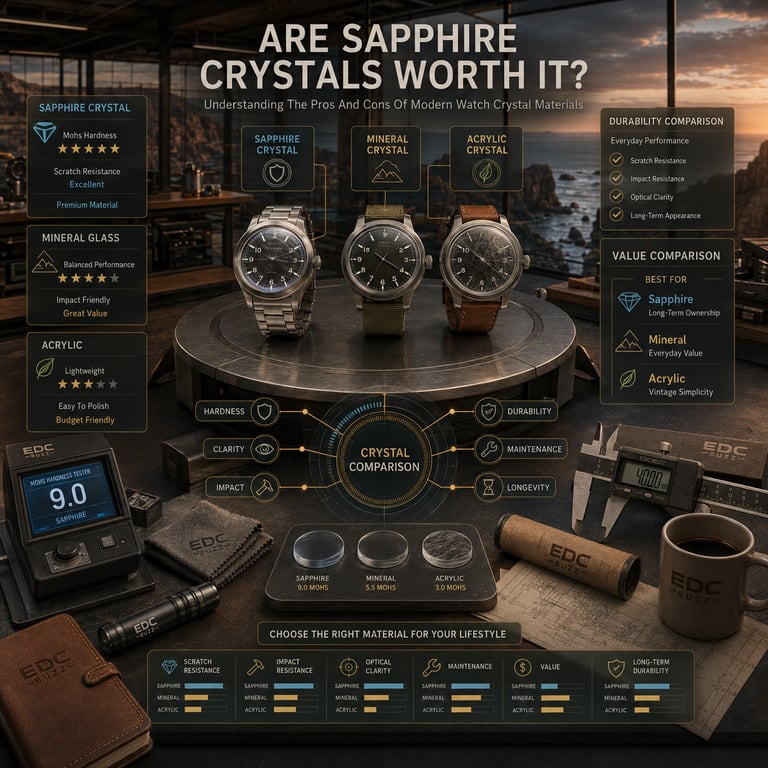
Watch crystals generally fall into three categories: acrylic (plastic), mineral glass, and sapphire. Acrylic, once common, is very impact-resistant and affordable but scratches easily and lacks optical brilliance. Today, mineral glass and sapphire dominate consumer watches, providing the main comparison in terms of performance and value.
Mineral glass is created by chemically treating regular glass to improve its hardness and scratch resistance, typically rating around 5-6 on the Mohs scale. It offers a balanced compromise between cost, scratch resistance, and impact tolerance. Mineral glass is less likely to shatter on impact compared to sapphire but more prone to accumulating fine scratches over time, which can dull the watch’s visibility and aesthetics.
Sapphire crystals use synthetic sapphire — crystallized aluminum oxide created under high temperature, with a hardness rating of 9 out of 10 on the Mohs scale. This places sapphire just below diamond (10) for scratch resistance, making it exceptionally difficult for most everyday materials to leave marks. The manufacturing complexity and rarity of sapphire elevate its cost substantially above mineral glass.
While sapphire excels in scratch resistance and optical clarity, its increased hardness comes with reduced toughness. Simply put, it resists surface damage exceptionally well but is more brittle and susceptible to cracking or shattering if struck with heavy force at certain angles. Mineral glass is softer but can absorb shock slightly better without fracturing, providing a different durability dynamic. For a complete breakdown of specifications beyond crystal materials, see How To Read Watch Specifications Before Buying.
Scratch Resistance and Durability Comparison
The starkest and most commonly cited advantage of sapphire crystals is their near-immunity to scratching from everyday objects such as keys, coins, or desk edges. This is fundamental for preserving the clean, transparent quality of the watch face. Over months and years, a scratched crystal can mar legibility and diminish the wearer’s satisfaction.
Mineral glass, with roughly half the hardness of sapphire, can quickly show micro-scratches that diffuse light and degrade the overall look. While these scratches may be polished out in some cases, the process risks altering the surface and often isn’t practical for routine upkeep.
Durability presents a more nuanced trade-off. Sapphire’s rigidity makes it more brittle — it can shatter or chip from a hard impact, such as a heavy knock against rock or metal. Mineral glass’s lower hardness allows for some bending before fracturing, which can translate into fewer catastrophic failures under blunt force. Nonetheless, both materials outperform acrylic in resisting impact-related damage.
Thus, sapphire is ideal if your primary concern is avoiding surface scratches in relatively controlled everyday environments. Mineral glass might be preferable if the watch sees rougher treatment involving shocks or impacts, where the risk of shattering sapphire rises. If you're comparing overall construction quality, The Most Durable Watch Materials Explained explores how crystal materials fit alongside cases, bezels, and straps.
Cost Considerations and Value for Money
Sapphire crystals are typically several times more expensive than mineral glass when factoring in material and manufacturing costs. The high temperature crystallization required for sapphire, plus the necessity for precise cutting and polishing, contribute to this cost.
For budget-conscious buyers or those whose watches are mainly exposed to low-risk environments, mineral glass delivers a sensible balance of durability and affordability. The reduced upfront investment can be repurposed toward other watch features such as the movement or case material.
However, if the watch is expected to serve as a long-term daily companion and maintaining aesthetic integrity is paramount, sapphire’s higher price point often translates to better value. By resisting scratches that mineral glass would accumulate, sapphire cuts down on the need for crystal replacements, refinishing, or early watch upgrades. Buyers considering premium everyday watches may also want to browse our Best Smartwatches guide to compare how modern watches approach durability differently.
Practical Use Cases: Who Benefits Most from Sapphire?
Sapphire crystals find their strength in scenarios where watch appearance and longevity outweigh initial price. For instance, collectors and watch enthusiasts who frequently wear their pieces desire consistent optical clarity and minimal wear marks. Similarly, outdoor enthusiasts and professionals whose watches face a mix of urban and nature environments appreciate sapphire’s ability to resist scratches from contact with abrasive surfaces like sand or metal gear.
Those working in settings with frequent incidental bumps or knocks — such as labs, workshops, or offices — benefit from sapphire-maintained visibility over years without routine polishing or crystal changes. Conversely, casual wearers who mostly keep their watches in low-risk environments may find mineral glass sufficiently durable and more economical. If you're deciding between digital and traditional options, our Garmin Fenix 8 vs Victorinox Journey 1884 (Smartwatch vs Traditional Watch) comparison highlights how durability priorities differ between the two.
Maintenance Tips for Sapphire and Other Crystals
While sapphire crystals are famed for their scratch resistance, they still require reasonable care to maintain their optical quality. Routine cleaning is the simplest but often overlooked step. Using a microfiber cloth with mild soap and water removes oils, fingerprints, and minor dirt that can obscure legibility.
For anti-reflective-coated sapphire crystals, special attention should be paid to avoid harsh chemicals or abrasive materials, which can degrade coatings and increase glare. Non-coated sapphire may show more reflections but avoids coating wear issues.
Mineral glass crystals, being softer, need more cautious handling to prevent scratches. If minor scratches accumulate, professional polishing can restore clarity, but this process is not recommended to be frequent as it can thin the glass. In all cases, avoiding direct blows, drops, or rough treatment helps extend crystal life. Proper long-term care is covered in more detail in our Watch Ownership Guide.
Common Myths and Misconceptions about Sapphire Crystals
One widespread misconception is that sapphire crystals are unbreakable. While their hardness means surface scratches are rare, sapphire can and does crack or shatter if struck hard enough or at the wrong angle. This brittleness is often surprising to those expecting complete invulnerability.
Another common error is equating scratch resistance with shatter resistance. These qualities stem from different material properties — hardness versus toughness — and a crystal can excel in one while performing modestly in the other.
People also sometimes overlook ongoing maintenance, assuming sapphire’s toughness eliminates the need to clean or care for the watch face. Dirt, oils, and smudges still impact clarity regardless of crystal material.
Finally, cost is often underestimated as a practical consideration. Buyers should weigh whether the premium for sapphire crystal meaningfully enhances their watch use case before committing. Avoiding Common Watch Mistakes New Buyers Make can also help ensure you're paying for features that genuinely match your needs.
Should You Upgrade Your Watch Crystal?
For watches originally fitted with mineral glass, upgrading to sapphire is possible but depends on the watch model and crystal mounting system. This upgrade can improve scratch resistance and long-term visual appeal, albeit at a cost typically less than buying a new watch.
Before choosing an upgrade, consider the expected use environment and how much you value scratch-free clarity. Also, check compatibility and service costs with the manufacturer or a reputable watchmaker. If you're evaluating whether a premium watch is worth the extra investment overall, compare these considerations with Is An Expensive Watch Worth It?
Frequently Asked Questions
What makes sapphire crystals more scratch resistant than mineral glass?
Sapphire crystals possess a Mohs hardness of 9, significantly higher than mineral glass’s 5-6. This hardness stems from their synthetic aluminum oxide composition, enabling them to resist surface abrasion from most everyday materials that would scratch softer glass.
Are sapphire watch crystals shatterproof?
No, sapphire crystals are not shatterproof. Despite their surface hardness, they are more brittle than mineral glass and can crack or shatter if subjected to a strong impact or sharp blow.
How much more expensive are sapphire crystals compared to mineral glass?
Sapphire crystals typically cost several times more to produce than mineral glass due to more complex manufacturing processes, material costs, and precision finishing.
Does sapphire crystal require special care or maintenance?
Routine cleaning with a microfiber cloth and mild soap-and-water is advisable. If the crystal has an anti-reflective coating, avoid abrasive cleaners that can damage the coating layer.
Can I upgrade my watch crystal from mineral glass to sapphire?
Many watches support upgrades, but this depends on the watch’s design and crystal mounting. Consulting a watchmaker or the brand manufacturer ensures compatibility and proper installation.
How does the clarity of sapphire compare to other watch crystals?
Sapphire offers excellent optical clarity and often includes anti-reflective coatings to minimize glare, resulting in superior dial legibility compared to mineral glass and acrylic.
Are there different grades or qualities of sapphire crystals?
Yes, sapphire crystals vary in quality based on factors like crystal purity, thickness, curvature, and coating treatments, all influencing performance and cost.
What are the best watch use cases for sapphire crystals?
Sapphire is well-suited for everyday carry watches requiring scratch-free clarity, outdoor activity watches exposed to rough environments, and collector pieces where preservation of aesthetics is key.
Conclusion
Delving into watch crystal materials reveals a nuanced balance between hardness, toughness, cost, and practical use. Sapphire crystals excel at maintaining a pristine, scratch-free surface, a feature that delivers clear visual benefits and extends watch appearance over time. However, this robustness comes with increased brittleness and a higher price tag.
Those prioritizing long-term clarity, prepared for careful handling, and willing to invest upfront will find sapphire crystals a worthwhile upgrade for their watches. Conversely, if budget constraints or impact resilience take precedence, mineral glass remains a capable and cost-effective option.
Understanding these material properties empowers you to make an informed choice aligned with your everyday watch use, protecting one of the most visible and vulnerable parts of your EDC gear. In this way, appreciating the science behind the crystal clarifies the value proposition beyond mere marketing claims, equipping you to pick the best watch crystal for your needs.
Contact@TheBuzzHQ.com
© 2026 EDCBuzz. All rights reserved.
EDCBuzz
Master everyday carry systems with clarity and precision. Built for real environments and practical use.
For educational purposes only.
General Inquiries: