
Are Open-Ear Headphones Better for Everyday Carry?
Discover how open-ear headphones enhance everyday carry with comfort, situational awareness, and practicality balanced against sound quality compromises.
EDC AUDIO
The EDCBuzz Editorial Team - Led by AJ “Buzz” Eichman
6/18/20267 min read
If you’ve ever wrestled with in-ear buds that nag at your ear canal after an hour or lugged bulky over-ear cans that turn your commute into a sauna, you might be intrigued by open-ear headphones. These audio devices skip the earbuds and cups and instead rest comfortably outside or near your ear, using bone conduction or ambient sound channels to deliver audio. But does that translate into a better everyday carry (EDC) experience? Having worn and relied on a few pairs of open-ear headphones for weeks on end, I’ve come to appreciate what they do well — and where they stumble by comparison. If you're exploring the broader world of EDC Audio, situational awareness should be one of your primary considerations.
Quick Verdict
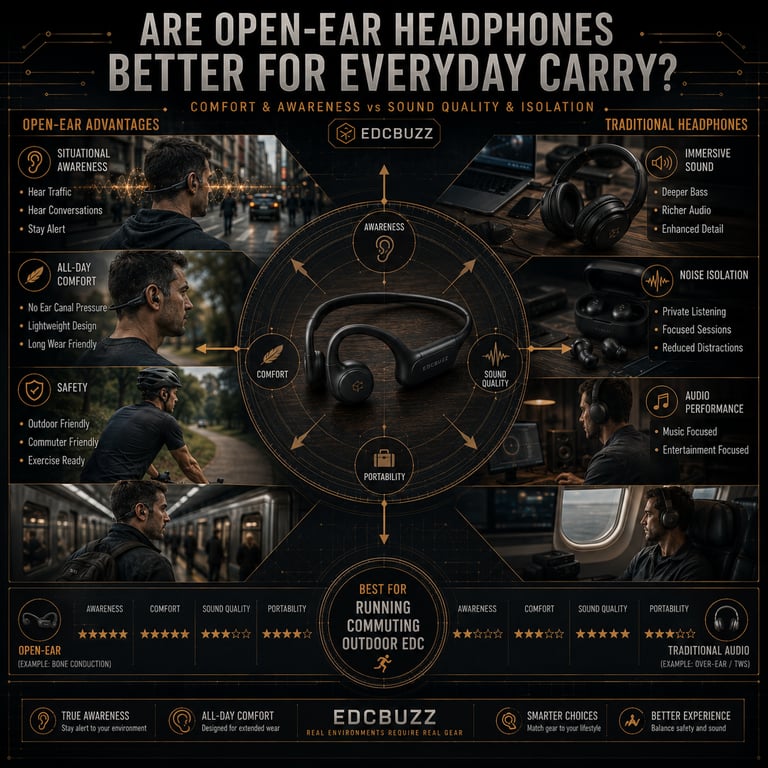
Open-ear headphones excel at delivering situational awareness, letting you stay tuned to your surroundings without sacrificing audio entirely.
Comfort is a standout, especially over longer stretches when the usual ear fatigue from in-ear buds kicks in.
Sound quality generally lags behind traditional headphones, with less bass and overall volume.
Battery life and durability vary, but most EDC-ready open-ear models keep pace with daily demands and offer sweat resistance.
They’re particularly well suited for outdoor, active lifestyles but might leave audiophiles wanting more in quieter, focused listening sessions.
How Open-Ear Headphones Work
Unlike traditional headphones that either seal off or cover your ears, open-ear headphones keep your ear canals free. Most rely on bone conduction technology, which transmits sound vibrations via your cheekbones directly to your inner ear, bypassing the eardrum altogether. Others use small transducers to project ambient sound near your ear without plugging it or covering it. For a deeper technical comparison, see Bone Conduction vs Open-Ear Air Conduction Headphones.
This design allows you to listen to music, podcasts, or calls without entirely shutting out the world around you. For everyday carry, this means your ears aren’t battling isolation or pressure, and you can maintain awareness — important, especially in busy urban environments or during outdoor activities where being alert is more than just good sense.
Comfort and Usability in Daily Carry
After several weeks of steady use, comfort is where open-ear headphones truly shine. When you’re carting around your gear from dawn until dusk, small hassles multiply fast. Unlike in-ear buds that after a couple of hours remind you that your ear canal isn’t really a fan of foreign objects, open-ear sets are notably more forgiving. This is one reason many users feel Why Comfort Matters More Than Sound Quality for EDC.
The frames are usually lightweight and flexible, designed to rest lightly around or over your ears without pinching or pressing. While they’re not exactly invisible in your pocket, most models fold up or come with compact cases. That weight on your person becomes easy to forget by midday — a hallmark of good EDC design.
Usability extends beyond just comfort, too. Controls on many models are straightforward: one button to play and pause, another to skip tracks, and volume toggles that don’t have you fumbling with complicated combos. Bluetooth pairing stays reliable, and the ability to take calls hands-free without jammed-in ear tips feels like a genuine convenience once you get used to it.
Situational Awareness and Safety Benefits
Situational awareness is what separates open-ear headphones from the traditional runners, commuters, and cubicle warriors. By design, your ears are left open to environmental sounds — traffic, chatter, announcements, and the occasional rogue pigeon. This is crucial for anyone carrying headphones while navigating city streets, bike lanes, or walking paths. You can hear a car horn or a friend calling your name without needing to stop and yank an earbud out. The topic is explored further in Situational Awareness and EDC Audio.
It’s not just about safety. Sometimes you want to stay connected to the world, especially when your day blends work and play. The subtle hum of an office, ambient chatter in a cafe, or birdsong on a trail can coexist with your music or podcast when using open-ear designs.
Sound Quality Comparison
Here’s where open-ear headphones show their limitations. Don’t expect the booming bass or deep immersion that over-ear headphones deliver, or the crisp isolation you get with in-ear buds. Because these designs don’t seal around or inside the ear canal, sound often leaks out and ambient noise leaks in. If you're debating options, Earbuds vs Headphones for EDC is worth considering.
Music can feel thinner, less punchy, and at times you’ll find yourself nudging the volume a notch higher, which occasionally leads to audio distortion. Bone conduction units, in particular, sometimes impart a hollow or metallic tinge, especially with complex tracks.
That said, some open-ear headphones are surprisingly balanced, especially on mids and highs, which makes spoken word content and podcasts very listenable. It’s a trade-off: you gain comfort and awareness at the expense of full-bodied audio.
Durability and Battery Life Considerations
Most quality open-ear headphones designed for everyday carry recognize that they’re going to be exposed to more than just your sofa. Sweat-resistant coatings, flexible frames, and water-resilient designs are increasingly standard so you can confidently take them for a jog or endure a spill. Many of the top options appear in Best EDC Waterproof Bone Conduction Headphones.
Battery life varies but typically lands between six to ten hours — enough to get through most workdays, commutes, or extended outdoor sessions. Charging often happens with USB-C or proprietary docks and is relatively quick. If battery endurance is important, see How Much Battery Life Do You Really Need for EDC Audio?
After living with several models, battery life performance tends to align with promises, and the durable build means these headphones shrug off day-to-day knocks better than expected. Although it’s always smart to avoid the classic carry mistake of forgetting them until you sit down — nothing “disappears” faster from your ear than a hard landing.
Who Should Consider Open-Ear Headphones?
Not all ears or daily routines are created equal. Open-ear headphones make the most sense if you:
Spend time outdoors or in environments where hearing ambient noise is vital.
Encounter safety-critical scenarios like urban commuting or cycling.
Suffer from ear discomfort with regular in-ear buds.
Prefer a lightweight, non-intrusive audio solution for hands-free calls or light media.
Value comfort and practicality over maximum audio fidelity.
On the flip side, if your day demands focused, private listening—say, grinding through music production or in noisy offices where you want sound isolation—you might find these headphones less satisfactory.
Common Mistakes to Avoid When Choosing Open-Ear Headphones
Just because open-ear headphones are novel doesn’t mean every pair does what you need.
First, don’t assume open-ear means the same sound quality as your trusty in-ear buds. If strong bass or detailed soundstage is a must, temper expectations.
Next, consider your environment. A deafening gym might drown out bone conduction units, while a quiet trail or office suits them better.
Check battery life claims closely and be realistic about your usage. Those six to ten hours on paper drop if you crank volume trying to compensate for ambient noise.
Fit matters. Even though these things don’t go inside your ear canal, how they wrap and rest will affect comfort during extended wear.
Lastly, verify weather and sweat resistance if outdoor activity is a key use case. Not every open-ear model is ready for a surprise shower or intense workout. Understanding Water Resistance for Earbuds can help when evaluating durability claims.
Top Open-Ear Headphones for Everyday Carry
Among the growing selection, some open-ear headphones edge out the rest for EDC. Models like the Aftershokz Aeropex have won praise for their lightweight frame, solid battery life, and decent sound. Others might prioritize ruggedness or style, so matching features to your lifestyle pays off. Many buyers start with guides such as Best EDC Open Ear Headphones.
If you don’t mind a little compromise on sound in exchange for comfort and safety, these are worth looking at. The trick is to avoid novelty purchases and lean towards tested, reviewed gear with proven wearability and customer support.
FAQ
How do open-ear headphones work compared to traditional headphones?
Open-ear headphones use technologies like bone conduction or ambient sound projection near the ear to transmit audio without blocking the ear canal. Traditional headphones deliver sound into or over your ears, typically isolating you from external noises.
Are open-ear headphones safe for use in busy outdoor environments?
Yes, their design allows awareness of surrounding sounds, enhancing safety during activities like walking, cycling, or commuting, where detecting environmental cues is crucial.
What are the best open-ear headphones for everyday carry?
While “best” depends on your priorities, models like Aftershokz Aeropex are often recommended for balancing comfort, durability, and sound quality tailored to daily use.
Do open-ear headphones offer good battery life for daily use?
Most open-ear headphones provide between six to ten hours of playback, sufficient for a full workday or extended workout, with convenient charging options.
Can open-ear headphones match the sound quality of in-ear or over-ear models?
Not quite. Open-ear designs generally sacrifice bass and full sound immersion for comfort and situational awareness, making them less suitable for audiophiles.
Are open-ear headphones comfortable for all-day wear?
Yes, their lightweight and non-intrusive fit reduces ear canal pressure and soreness common with traditional buds, making them comfortable for extended use.
What should I consider when buying open-ear headphones as part of my EDC?
Focus on comfort, sound performance for your use scenarios, battery life, durability (especially sweat and water resistance), and environmental awareness needs.
How do open-ear headphones perform in terms of durability and weather resistance?
Most quality EDC-targeted models feature sweat and water resistance with rugged frames built to handle regular daily activity, but specifications vary by brand and model.
Conclusion
Open-ear headphones won’t replace your trusty earbuds or over-ear cans for everyone, but they carve out a strong niche in everyday carry. After spending several weeks testing, what stands out is the comfort of leaving your ear canal alone and the reassurance of staying connected to your environment without missing your podcast or call.
They work especially well if your daily rhythm includes outdoor runs, city commutes, or multitasking chores at home. The trade-offs in sound quality and subtle volume limitations are worth the benefits of situational awareness and comfort for many users.
So if your idea of the best EDC headphones includes being tuned in both to your playlist and your surroundings, open-ear designs deserve a close look. Just don’t expect them to deliver concert hall audio—they’re more like quality background music for your day’s practical soundtrack. And if the worst that happens is your headphones “disappear” in your pocket until you sit on them, well, that’s just part of the carry adventure.

Contact@TheBuzzHQ.com
© 2026 EDCBuzz. All rights reserved.
EDCBuzz
Master everyday carry systems with clarity and precision. Built for real environments and practical use.
For educational purposes only.
General Inquiries: