
Noise Canceling vs Passive Isolation
Explore how noise canceling and passive isolation work to improve your EDC experience and find the best ear protection for your daily needs.
EDC AUDIO
The EDCBuzz Editorial Team - Led by AJ “Buzz” Eichman
6/18/20268 min read
In the realm of everyday carry (EDC) gear, understanding how noise canceling and passive isolation technologies function is crucial for selecting ear protection that fits your daily needs. Both approaches aim to reduce unwanted sound, yet they operate through fundamentally different principles with distinct implications for comfort, effectiveness, and practicality.
Whether you face the hum of traffic on your commute, the chatter of an open office, or the sharp interruptions of outdoor noise, knowing how these technologies work helps you optimize your personal sound environment. This isn’t just about tuning out distractions—it’s about managing your auditory experience efficiently and reliably throughout your day. Before diving deeper, it's worth understanding the broader role of EDC Audio and how these technologies fit into a complete everyday carry audio setup.
Quick Verdict
Noise canceling (active noise cancellation) electronically reduces consistent, low-frequency background noise like engine hums and air conditioning.
Passive isolation relies on physical barriers that block sound waves, excelling at muffling sudden, high-frequency noises such as sharp voices or slamming doors.
Active noise cancellation requires power, introducing constraints in battery life and potential minor discomfort, whereas passive isolation functions without batteries, offering simplicity and reliability.
Comfort and fit critically influence both technologies’ effectiveness, making seal quality paramount for achieving the intended noise reduction.
What Is Noise Canceling? How Active Noise Cancellation Works
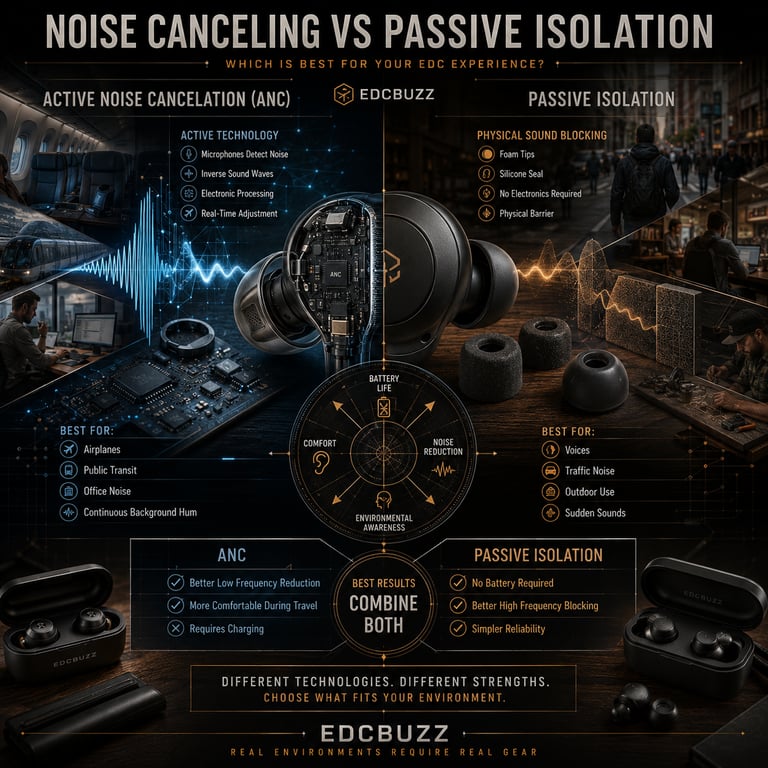
Active noise cancellation (ANC), widely referred to as noise canceling, hinges on an electronic feedback system designed to counteract ambient sound. The core mechanism involves tiny microphones picking up external noise, particularly the steady, low-frequency hums prevalent in common urban environments—think airplane cabins or air conditioning units.
This captured audio is processed through circuitry that generates an inverse sound wave, essentially a mirror wave of the unwanted noise. When this inverse wave combines with the ambient sound, they interfere destructively, partially or significantly canceling each other out before reaching your ears.
This process demands precise synchronization and real-time computation. While it sounds straightforward, achieving effective ANC is a nuanced engineering challenge. The electronic components needed for this technology add weight, cost, and a dependency on power sources such as batteries or rechargeable units.
The benefit, however, lies in reducing persistent background noises that passive materials often struggle to block, especially those with lower frequencies where sound waves are long and penetrating. Yet, ANC is less effective at handling sudden or sharp noises, which tend to be higher frequency and erratic.
Many of today's Best Premium EDC Earbuds use advanced ANC systems to deliver impressive performance in travel, office, and commuting environments.
Understanding Passive Isolation: Physical Sound Blocking Explained
Passive isolation takes an entirely different approach. Instead of electronically manipulating sound waves, it physically prevents sound from reaching the ear canal. This is accomplished by creating a tight seal using materials such as dense silicone, foam, or specialized plastics that absorb or reflect sound energy.
These materials work across a broad frequency spectrum and, crucially, physically stop sound waves rather than cancel them out.
The key to effective passive isolation lies in fit and material density. A well-fitted earplug or snug earmuff that completely seals off the ear canal prevents sound leakage and significantly reduces noise infiltration.
This method excels when confronted with unpredictable, sharp noises like sudden voices, door slams, or outdoor environmental sounds. Another advantage is its independence from power—no batteries, no electronic failures, just mechanical sound blocking.
However, there’s a trade-off. Complete isolation can reduce environmental awareness, potentially muffling important sounds you might want to hear, such as announcements or alarms.
This is one reason many users eventually compare passive isolation solutions with Best EDC Open Ear Headphones, which prioritize awareness over maximum isolation.
Key Differences Between Noise Canceling and Passive Isolation
Comparing these two noise reduction strategies, it’s clear that they address somewhat complementary aspects of sound suppression.
Noise canceling focuses mostly on continuous, low-frequency noise environments, actively dampening sounds that passive materials would only partially block. Passive isolation physically blocks a wider range of frequencies but relies entirely on how well the seal fits your ear.
From an engineering standpoint, ANC adds complexity with its microphones, processing chips, and power requirements. This complexity enables dynamic noise reduction but also introduces points of failure—dead batteries or electronics issues can leave you without protection.
Passive isolation’s simplicity makes it highly reliable and low maintenance.
Moreover, noise canceling technology can sometimes cause a subtle sensation of pressure in the ears, often described as a mild discomfort or a feeling of “ear suction.” This effect stems from the phase inversion of sound waves and the constant operation of electronic components creating a non-natural sound field.
Passive isolation, by contrast, might feel physically intrusive if the earplugs or ear cups are too tight or heavy but doesn’t induce that specific sensation. If comfort is one of your biggest concerns, see Why Comfort Matters More Than Sound Quality for EDC.
Pros and Cons of Each Technology for Everyday Carry
Implementing these technologies in everyday carry gear necessitates considering performance trade-offs along with comfort and usability metrics.
Noise Canceling Pros
Superior at smoothing out consistent, low-frequency background noises.
Adjustable through software and firmware, allowing for customizable noise profiles.
Often integrated into earbud or headphone designs combining passive sealing with active cancellation for layered noise protection.
Noise Canceling Cons
Requires power sources; limited battery life can impact all-day use.
Can introduce slight sound artifacts or pressure feelings due to the electronic processing.
More costly due to the electronics and engineering involved.
Passive Isolation Pros
Works without power, making it ready whenever you are.
Excellent at blocking a wide frequency range, especially sudden, high-frequency noises.
More affordable options available with high-quality materials.
Simple, dependable—few points of failure.
Passive Isolation Cons
Effectiveness hinges heavily on comfort and seal quality.
Can overly isolate, reducing important environmental awareness.
Doesn’t actively reduce low-frequency noise as effectively as ANC.
The tradeoff between runtime and advanced features often becomes apparent when comparing Battery Life vs Sound Quality in modern audio gear.
Typical Use Cases and Environments for Each Type of Ear Protection
Selecting between noise canceling and passive isolation technologies depends strongly on the contexts in which you intend to wear them.
For commuting on trains or airplanes where drone-like engine noise predominates, noise canceling earbuds or headphones provide tangible fatigue relief by targeting those constant sounds.
Many models featured in Best EDC Earbuds excel in these scenarios because they combine portability with effective ANC systems.
In contrast, for outdoor use—such as running or walking where you might encounter sudden honks, shouts, or other abrupt noises—passive isolation earplugs with a secure fit deliver better protection against sharp spikes in noise.
In office or home work environments where keyboard clicks, conversation murmurs, and HVAC noise converge, a hybrid approach often works best—headphones that combine passive sealing with ANC algorithms result in more comprehensive noise reduction.
Users evaluating awareness-focused listening options may also benefit from reading Are Open-Ear Headphones Better for Everyday Carry?
Common Misconceptions and Mistakes When Choosing Noise Reduction Gear
A frequent error is assuming that active noise canceling technology blocks all sound. It’s important to understand that ANC targets specific, mostly low-frequency noise bands and is not a total silencer.
Loud or high-frequency sounds like voice peaks or alarms will often penetrate ANC devices if the passive seal is poor.
Another common mistake is neglecting the fit of the earplugs or ear cups, which leans heavily on passive isolation. Even the most advanced ANC won’t perform well if external sound leaks through an imperfect seal.
Comfort is often overlooked as well—devices that feel awkward or painful discourage prolonged use and reduce effectiveness in practice.
Battery management is another critical factor for ANC users. Forgetting to charge your noise canceling earbuds or headphones can render your expensive gear no more effective than typical earphones.
Passive isolation, by contrast, lets you avoid this worry altogether.
How to Choose the Right Ear Protection for Your Daily Lifestyle
Choosing between noise canceling and passive isolation technologies is essentially about identifying which aspects of noise reduction matter most to your routine and weighing those against practical factors like cost and comfort.
If you often find yourself in environments with a steady background drone—public transit, airplanes, or HVAC-heavy offices—active noise canceling will likely enhance your comfort and focus significantly.
On the other hand, if your day involves variable or sudden loud noises, physical barriers provided by passive isolation will deliver more consistent protection without reliance on power.
For maximum noise reduction, consider gear that integrates both technologies.
If you're trying to match your audio gear to your environment, How to Choose EDC Audio for Your Daily Environment offers a practical framework for making that decision.
Upgrade Considerations and Combining Both Technologies
Many modern ear protection solutions blend passive isolation and active noise cancellation to offer optimal results.
Good ANC gear depends on an effective passive seal to maximize its impact. Without that seal, the electronic cancellation can’t fully compensate for physical sound leakage.
This synergy is why most top-tier noise canceling earbuds and headphones are designed for a snug, comfortable fit that physically blocks external noise and electronically cancels out residual low-frequency sound.
If you’re considering an upgrade, look at how these technologies are balanced in the design and how battery life aligns with your typical day.
A useful real-world example can be found in Sony LinkBuds vs Shokz OpenFit Pro (Earbuds vs Bone Conduction), where awareness, isolation, and listening experience take very different approaches.
Devices offering multiple noise profiles or adjustable ANC levels allow more personalized control, making them adaptable for varied environments.
Ultimately, a well-chosen combination can deliver a noise reduction experience well beyond the capability of either technology alone.
Common Questions About Noise Canceling and Passive Isolation
What is the difference between noise canceling and passive isolation?
Noise canceling uses electronic processing to reduce low-frequency noise by generating inverse sound waves, while passive isolation physically blocks sound with materials and sealing techniques.
Which type of noise reduction is better for everyday carry use?
It depends on your environment: noise canceling is preferable for consistent low-frequency sounds, and passive isolation excels at blocking sudden, sharp noises and works without batteries.
Can I use both noise canceling and passive isolation together?
Yes. In fact, effective noise canceling devices depend on a good passive seal to maximize noise reduction.
How do battery requirements affect noise canceling devices for daily use?
ANC devices require charging, and battery life varies widely. If long, uninterrupted use is critical, consider battery capacity and charging convenience.
Are noise canceling headphones or earplugs better for work environments?
For open office or noisy indoor workspaces, noise canceling headphones combining ANC and passive isolation often provide the best balance of comfort and noise reduction.
What materials offer the best passive isolation in earplugs?
Dense foam and silicone materials are popular for their flexibility and sound blocking properties.
Does active noise cancellation work for all types of noise?
No. ANC is most effective against steady, low-frequency sounds and less effective against sudden or high-frequency noises.
How do I choose the right ear protection for my daily activities?
Consider your typical noise environment, comfort preferences, battery requirements, and desired level of environmental awareness.
Conclusion
When it comes to integrating noise canceling and passive isolation into your everyday carry setup, there’s no universal winner—each technology fulfills a distinct niche with clear benefits and limitations.
Active noise cancellation brings a sophisticated electronic layer to reduce persistent background hums but requires power and an effective physical seal to work optimally.
Passive isolation’s straightforward, power-free approach excels in blocking a broad range of sudden, high-frequency sounds and offers reliable, maintenance-free performance.
Understanding how these technologies work, where they succeed, and their inherent compromises enables you to tailor your ear protection choices intelligently. Whether your daily routine leans toward noisy commutes, focused office work, or variable outdoor environments, informed decisions about noise canceling versus passive isolation gear will help protect your hearing, improve comfort, and enhance your overall EDC experience.

Contact@TheBuzzHQ.com
© 2026 EDCBuzz. All rights reserved.
EDCBuzz
Master everyday carry systems with clarity and precision. Built for real environments and practical use.
For educational purposes only.
General Inquiries: