
Battery Life vs Sound Quality
Explore how to balance battery life and sound quality in your everyday carry audio devices for optimal listening and device performance.
EDC AUDIO
The EDCBuzz Editorial Team - Led by AJ “Buzz” Eichman
6/18/20267 min read
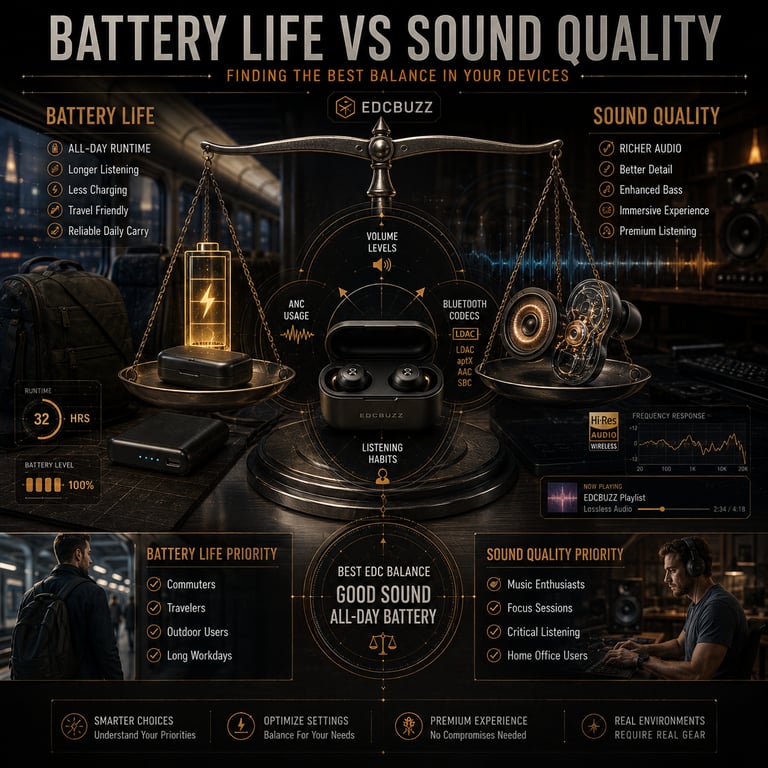
In the realm of everyday carry audio devices—wireless earbuds, headphones, Bluetooth speakers—there exists a fundamental tension between two key performance metrics: battery life and sound quality. This balance isn’t just about choosing one feature over the other, but understanding how they interact and influence the overall user experience. Higher fidelity sound typically demands more power-intensive hardware and processing, while conserving battery often means dialing back audio output or smartly managing energy consumption. By breaking down these dynamics, you can make more informed decisions about which devices fit your lifestyle and listening habits.
For anyone building an audio-focused carry setup, understanding the role of EDC Audio helps put these trade-offs into context before selecting specific devices.
Quick Verdict
Achieving excellent sound clarity on portable devices often requires compromises in battery duration due to increased power demands.
Advanced audio codecs and efficient amplifier designs can improve sound fidelity without drastically cutting into runtime.
Features like active noise cancellation offer tangible listening benefits but come at a cost to battery longevity.
User habits and device settings significantly impact both battery performance and audio output quality.
Understanding Battery Life and Its Impact on Device Performance
At its core, battery life in audio devices determines how long you can use them between charges—a crucial metric when you rely on these gadgets daily. Battery capacity, measured in milliampere-hours (mAh), sets the upper limit on playback time, but the real-world runtime depends heavily on how the device uses that energy. For instance, wireless earbuds with tiny batteries might quote anywhere from 4 to 10 hours of playback, but these numbers can fluctuate considerably based on volume levels, wireless connectivity stability, codec choice, and additional features.
Battery management circuits in devices work to optimize power delivery, balancing continuous playback and standby modes to extend usage. However, every augmentation comes at a price. Digital signal processing (DSP) algorithms for sound enhancement, Bluetooth radio activity, and amplifier operation all consume energy. Even materials used in speaker diaphragms and housing affect how efficiently the device converts electrical energy into sound, impacting overall battery drain.
Many models featured in Best EDC Earbuds showcase this balancing act between portability, performance, and battery longevity.
What Determines Sound Quality in Portable Audio Devices?
Sound quality is multifaceted, including clarity, frequency response, distortion levels, and spatial characteristics. In portable audio gear, this depends on the interaction between drivers (the speakers themselves), amplifiers, digital-to-analog converters (DACs), and Bluetooth audio codecs.
Driver design influences how accurately sound is reproduced across bass, midrange, and treble frequencies. Amplifier class and efficiency also dictate how clean and powerful the audio output is without wasting energy or introducing distortion. The choice of Bluetooth codecs—such as aptX Adaptive, LDAC, or AAC—balances compression and data transfer rates to optimize clarity while considering power consumption.
Moreover, device materials and acoustic chamber design impact resonance and sound staging, shaping the listening experience. For example, premium diaphragm materials can provide better acoustic performance but might increase weight or manufacturing cost.
Many of the products found in Best Premium EDC Earbuds justify their higher cost through improvements in these exact areas.
Trade-offs: How Sound Quality Affects Battery Duration
While it would be ideal to enjoy perfect sound and endless battery life, the realities of portable device design enforce trade-offs. Higher fidelity audio generally requires more complex amplification and decoding, which pulls more current from the battery. For example, using high-bitrate codecs like LDAC at maximum quality may improve sound clarity but shorten playback time compared to more efficient codecs or lower bitrates.
Similarly, increasing volume levels boosts power consumption due to the need for stronger amplification. Features such as active noise cancellation (ANC), which use microphones to cancel ambient noise actively, add further processing demands. ANC can drastically improve listening comfort in noisy environments but may reduce battery endurance by 20 to 40 percent depending on implementation.
For a deeper look at ANC-related trade-offs, see Noise Canceling vs Passive Isolation.
Conversely, devices optimized for maximum battery life often simplify or limit audio processing. This may mean lower maximum volume, more compression, or less advanced codecs. Such trade-offs aren’t inherently bad—they reflect prioritizing all-day usability over premium sound fidelity.
Technical Innovations That Improve Both Battery Life and Sound Clarity
Recent advances in both hardware and software have made it possible to mitigate some traditional compromises between battery life and sound quality. For starters, newer Bluetooth codecs like aptX Adaptive dynamically adjust bitrate based on environmental conditions, maintaining high sound clarity while conserving battery when full data throughput isn’t necessary.
Efficiency gains in amplifier design, especially class D amplifiers, allow devices to achieve powerful, high-quality audio without excessive energy loss. These amplifiers switch transistors rapidly to reduce heat buildup and power consumption, which translates to longer battery life.
On the battery side, improvements in power management integrated circuits allow more precise energy distribution, switching off non-essential functions when inactive or adjusting power allocation during peak listening moments. Some devices also employ quick charging technology or user-replaceable batteries, addressing concerns with battery depletion in the long term.
Some of the latest products in Best EDC Earbuds Under $150 benefit from these improvements, bringing better efficiency to more affordable price points.
Practical Tips for Optimizing Battery Life Without Compromising Sound
Understanding the interplay of device settings and features can help users find balance without sacrificing one area for the other unnecessarily. For example, lowering volume slightly can extend battery life significantly while minimally impacting listening enjoyment. Similarly, selecting efficient codecs or auto-adjusting sound profiles can improve energy consumption.
Switching off features like ANC when not in noisy environments conserves battery. Many devices include power-saving modes or auto-off timers, which prevent idle battery drain but might introduce short pauses when resuming playback. Users should experiment with these options to match their usage patterns.
Regularly updating device firmware can bring optimizations in both battery management and audio processing, as manufacturers frequently improve efficiency through software.
If you're trying to maximize runtime during daily use, How Much Battery Life Do You Really Need for EDC Audio? helps put real-world expectations into perspective.
Choosing the Right Device Based on Your Usage Needs
The best choice between battery life and sound quality depends heavily on individual use cases. For daily commuters who rely on wireless earbuds for extended periods, prioritizing longer battery life with moderate sound clarity and selective ANC usage is often wise. For office or home use where power is readily available, opting for headphones with superior sound fidelity and active noise cancellation—with less concern for battery runtime—may provide better value.
For outdoor activities like hiking, rugged devices with robust battery life and moderate sound quality balance endurance and practicality, acknowledging ambient noise conditions where absolute fidelity matters less. Meanwhile, wired headphones remain an exceptional option to avoid battery trade-offs entirely, delivering consistent sound quality but at the expense of mobility and convenience.
Matching your device to your environment is often more important than chasing specs. That's exactly what How to Choose EDC Audio for Your Daily Environment explores in greater detail.
Common Mistakes
A frequent misconception is assuming higher-priced devices automatically excel equally in battery life and sound quality. Price often reflects feature sets, brand, or design rather than absolute performance balance. Overlooking codec settings or device firmware also leads to suboptimal experiences, where users don’t utilize the most efficient or highest-quality modes available.
Additionally, many neglect the impact of real-world use factors like preferred volume levels or ambient noise, which can drastically influence battery drain and audio perception. Expecting compact EDC devices to reproduce studio-quality sound without any effect on battery life misunderstands the engineering trade-offs involved.
Buyers should also avoid overlooking overall feature sets, which is discussed in Best Features to Look for in EDC Earbuds.
FAQ
How does battery size impact sound quality in portable audio devices?
Battery size sets the potential maximum runtime but does not directly influence sound quality. However, smaller batteries may limit the device's power delivery capacity, indirectly restricting amplifier performance or maximum volume, which can affect perceived sound quality.
What sound codecs offer the best balance of clarity and battery efficiency?
Codecs like aptX Adaptive and AAC strike a balance by providing high audio fidelity with moderate power consumption. LDAC offers excellent sound clarity at the cost of greater battery drain, especially at top bitrates.
Does turning on features like ANC significantly reduce battery life?
Yes, ANC requires constant audio processing and microphone input, which increases power usage. Depending on the device, ANC can shorten battery runtimes by 20 to 40 percent.
How can I optimize my device settings to improve battery life without losing too much sound quality?
Using power-saving codecs, reducing volume levels moderately, disabling ANC when unnecessary, and enabling auto-off features can extend battery life with minimal impact on audio experience.
Are there specific headphones or earbuds known for excellent battery and sound quality balance?
Devices employing efficient codecs, class D amplifiers, and offering user-replaceable batteries or fast charging typically provide the best trade-offs, but choices depend on individual models and brands.
Is wired audio better for battery life and sound quality in everyday carry?
Wired headphones bypass battery concerns entirely and deliver consistent sound quality, but they sacrifice wireless convenience and portability often desired in EDC setups.
What role does amplifier efficiency play in device battery performance?
Amplifier efficiency determines how much electrical power is converted into sound rather than heat. More efficient amplifiers use less battery for the same volume and sound quality, extending runtime noticeably.
How fast do devices with good sound quality recharge compared to others?
Devices incorporating fast charging technologies can recharge significant battery capacity in 15 to 30 minutes. However, devices emphasizing large batteries or high-fidelity components may require longer charging times overall.
Practical Conclusion
Balancing battery life against sound quality in everyday carry audio devices is an exercise in understanding engineering constraints and aligning them with your listening habits. There is no one-size-fits-all solution, but knowing the underlying factors—battery capacity, codec efficiency, amplifier design, and feature demands—empowers you to choose devices that perform well in your specific context.
Rather than chasing absolute maximums in either domain, aim for a harmonized compromise. Efficient codecs combined with moderate volume, conditional ANC use, and thoughtful power management extend battery life without severely impacting sound clarity. Likewise, prioritizing sound fidelity within reasonable battery limitations enhances enjoyment during focused listening sessions.
This approach unpacks the technical trade-offs to help you make decisions grounded in practical outcomes, not marketing promises. In the end, the best device is the one that fits seamlessly into your daily routine while delivering the right mix of endurance and audio performance.

Contact@TheBuzzHQ.com
© 2026 EDCBuzz. All rights reserved.
EDCBuzz
Master everyday carry systems with clarity and precision. Built for real environments and practical use.
For educational purposes only.
General Inquiries: