
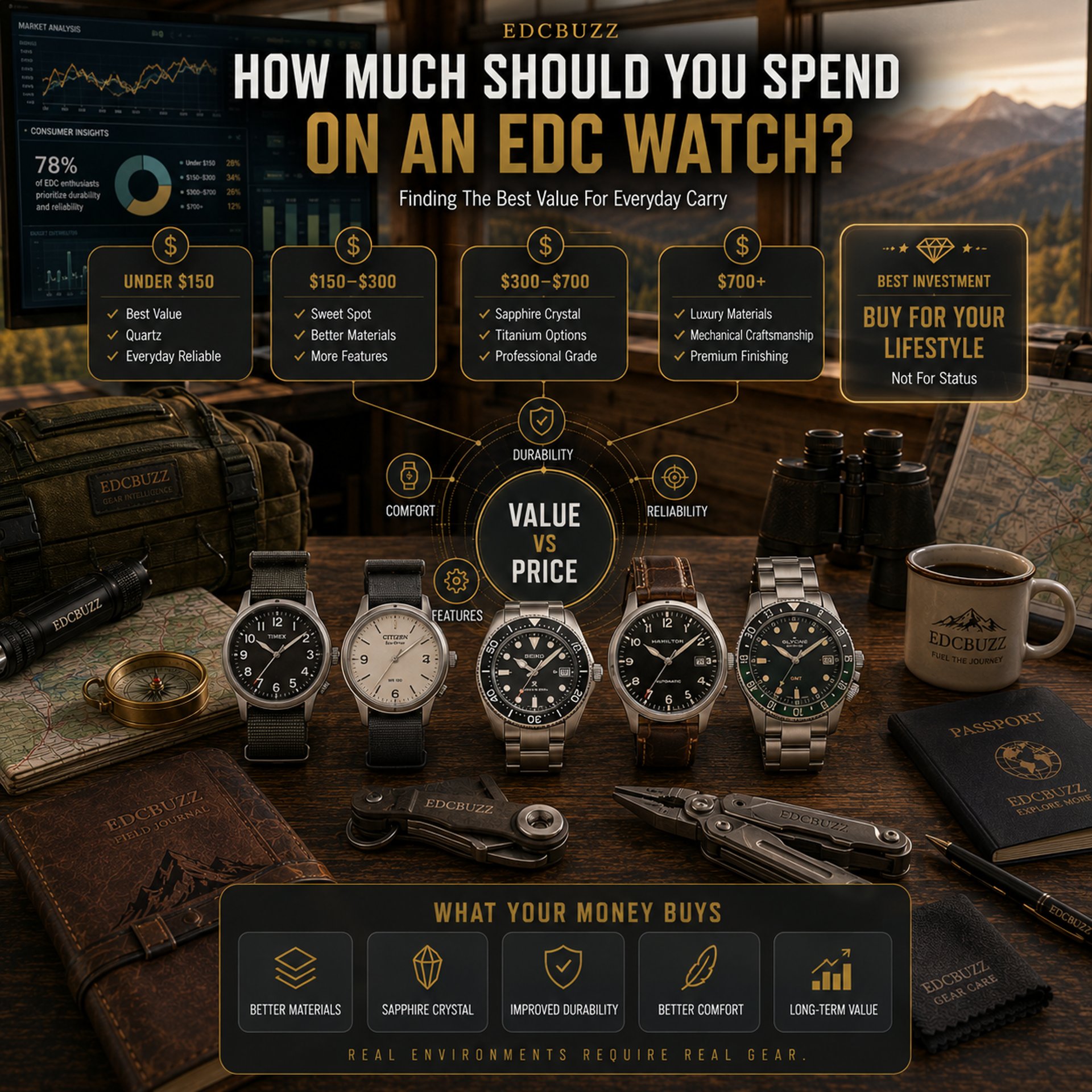
How Much Should You Spend On An EDC Watch?
Discover how much to spend on an EDC watch by balancing durability, features, and style for everyday reliable wear.
EDC WATCHES
The EDCBuzz Editorial Team - Led by AJ “Buzz” Eichman
6/28/20268 min read
Choosing an everyday carry (EDC) watch might sound straightforward, but once you start peeling back the layers, you realize it’s a balancing act between budget, features, and durability. The problem? Watches cover an enormous price spectrum. You can snag a solid, reliable timepiece for under a hundred bucks or splurge into luxury territory that makes your wallet wince. So how much should you really spend on an EDC watch—that trusty companion that should be durable, functional, and comfortable enough to wear day in and day out? Let’s unpack this with a field-tested perspective that goes beyond shiny marketing fluff and into what living with these watches actually feels like. If you're just getting started, EDC Watches provides a complete overview of everyday carry watch options.
Quick Verdict
Expect to spend based on how rugged and feature-packed you want your watch.
Durability materials like sapphire glass and titanium cases raise cost but keep your watch looking fresh.
Quartz movements often provide solid accuracy and value; mechanical ones have charm but tend to cost more.
Luxury EDC watches offer prestige, but basic, well-made watches can keep up just fine for daily use.

What Defines an Everyday Carry Watch?
To avoid sounding like Captain Obvious, an EDC watch isn’t just any watch you own—it’s the one you wear almost every day, regardless of task, environment, or mood. That means it’s got to handle the grind without complaining. It has to fit under your sleeve, not poke you in the wrist after hours, and feel just right whether you're heading to the office, the trail, or just mowing the lawn on a Sunday.
What really distinguishes an EDC watch is balance. It has to juggle durability, functionality, and trusty style without paying an arm and a leg. Sure, you want it to look good, but if the crown digs into your wrist after a few hours or the watch fogs up when it rains, that’s a problem. It’s less about being a status symbol and more about becoming your reliable timekeeper through all your daily tasks. The Watch Buying Guide can help narrow your priorities before you spend your money.
Key Features Affecting EDC Watch Price
Pricing is a puzzle made up of several key pieces, all of which directly impact how the watch performs and how long it might last in your daily routine.
Materials: High-grade stainless steel, titanium, and ceramic cases push the price up but provide better scratch and corrosion resistance. Less expensive watches might opt for coated metal or plastic cases, which cut weight and cost but can wear faster.
Crystal: The watch face crystal is where the saying “look but don’t touch” applies. Acrylic and mineral glass are budget-friendly and fairly durable but scratch more easily. Sapphire crystals cost more but resist scratches like a champ, keeping your dial pristine over time. If you're weighing those options, Are Sapphire Crystals Worth It? explores whether the added cost is justified.
Movement: Quartz movements, battery-powered and very accurate, serve most everyday needs well and keep costs down. Mechanical movements—automatic or hand-wound—are often pricier and appreciated for craftsmanship and tradition, but they typically need more care and are less precise day-to-day.
Water Resistance: Water resistance ratings have a reputation for being misunderstood. A watch rated for 50 meters resists splashes and brief swimming, but don’t expect to go diving with it. Higher water resistance adds to manufacturing complexity, and thus price.
Additional Features: Complications like alarms, chronographs (stopwatch functions), date windows, and lume (glow-in-the-dark hands and markers) improve functionality, but they tend to increase cost and sometimes power use. If those features are important to you, the Best Sport Watches page highlights several practical everyday options.
Materials and Durability Considerations
Since you’re likely to encounter everything from greasy kitchen counters to outdoor chores, durability ranks high on the list. Stainless steel cases are the most common, robust enough for daily knocks but can add a bit of heft after hours. Titanium cases feel noticeably lighter, wear better, and offer hypoallergenic benefits, though they often cost more.
Sapphire crystal is something you quickly appreciate after a few accidents that mineral glass or acrylic wouldn’t survive. I’ve found that watches with sapphire crystal continue to look new even after months of use, which is worth the premium if you want to avoid a face that looks like it’s been through a sandstorm. On the other hand, if your daily tasks are low-risk, an acrylic crystal might suffice—and it’s easier (and cheaper) to buff out scratches if you want to get fancy later.
Water resistance is another factor that influences price and durability. Most budget options handle casual exposure well, but if you spend time outdoors or sweat a lot, stepping up to models with at least 100m water resistance is wise. That’s the difference between a watch that quietly survives a rainstorm and one that might give up after a splash. For a deeper explanation of ratings, What Is Water Resistance On A Watch? covers what those numbers really mean.
Mechanical vs. Quartz Movements
This is a classic debate among watch enthusiasts, but with practical EDC in mind, it comes down to what suits your daily rhythm. Quartz watches are workhorses: accurate, low-maintenance, and usually more affordable. Their battery-powered movement means fewer headaches—no winding and no worrying about timing drift over the day.
Mechanical watches, meanwhile, carry a certain old-school charm. You get to engage with the watch through winding and appreciating the inner engineering. The catch? They’re generally more expensive and demand more attention. They can lose or gain seconds daily, and their parts may need servicing more often, which isn’t the best if you want something “set it and forget it” for everyday use.
After a couple of months with both types, quartz easily earns its place for straightforward dependability. Mechanical watches? They’re great if you want a bit of ritual in your day and don’t mind the extra care. If you want my honest opinion, quartz watches make more sense for an EDC that sees a fair bit of real-world wear. If you're comparing movement accuracy directly, Automatic or Quartz: Accuracy In Real Life provides a practical side-by-side look.
Affordable vs. Luxury EDC Watches: What You Get
Affordable watches pack in surprisingly good value these days, especially under $200. They often feature reliable quartz movements, stainless cases, and maybe a sapphire-coated crystal or enhanced lume. These watches do the time-telling job with no fuss and rarely complain. One minor downside? You might notice weight or finish quality isn’t quite up to luxury standards, but after a week or two, they settle nicely into daily carry. If you're shopping in this range, the Best Watches Under $150 page is a great starting point.
Luxury EDC watches, which can shoot into thousands of dollars, often deliver exceptional materials like solid titanium, all-sapphire crystals, and precision Swiss movements. They also offer stronger warranties and can be conversation starters. But—and it’s a big but—unless you want the prestige or the craftsmanship cachet, many of these features can be overkill for a strictly practical watch.
I spent some time with a high-end automatic watch while also carrying a reliable quartz sports watch. Both told time well, but the quartz felt lighter and less delicate. The automatic looked sharp but demanded more care and occasional wrist visits to keep ticking. Luxury is great if you love watches as pieces of art or status, but for everyday tasks, it might be like driving a race car to the grocery store. If you're debating value at different price points, Is An Expensive Watch Worth It? explores where spending more actually makes a difference.
How to Set Your EDC Watch Budget
Setting your budget comes down to balancing what you need against what you want—and what you’ll actually carry.
For casual daily use—desk job, errands, social events—a budget of $100 to $300 typically covers solid quartz watches with decent durability and style. Beyond that, you get incremental improvements in materials or some added complications, but functionally, you’re mostly covered.
If your daily environment includes more physical work, outdoor activities, or exposure to water and bumps, plan to spend at least $300 to $700. This range gets you tougher cases, sapphire crystal, and better water resistance.
For those who want a blend of ruggedness and refined craftsmanship, or additional features like mechanical movements and luxury finishes, $700 and up will put you in the luxury EDC watch territory.
Remember, the comfort of the watch on your wrist and how much you want to carry it every day matters just as much as its price and features. I found that watches under 45mm diameter and around 40-50g weight are about the sweet spot for wearing full workdays without noticing a nagging heaviness or awkward bulk. If you're unsure about sizing, How To Choose The Right Watch Size can help you find a better fit.
Common Buyer Mistakes to Avoid
Overspending on flashy features you won’t actually use is pretty common. For example, a watch with multiple chronographs, alarms, or exotic materials might sound appealing but turn into dead weight in your pocket or on your wrist.
Ignoring durability specs might result in a watch that looks great out of the box but wears prematurely. Skimping on scratch-resistant crystals or water resistance can ruin your good intentions.
Confusing luxury branding with practical performance is tricky. That $5,000 watch might wow at a party, but a $200 quartz can get the job done without fuss every day. Comparing models like Tissot PRC 100 Solar vs Bulova Aerojet Open Heart (Solar Watch vs Automatic Watch) can help illustrate where features—not branding—should drive your decision.
Comfort and size often get overlooked. A watch that looks impressive but pokes your wrist is less likely to see consistent wear. You want your EDC to become a natural extension of your outfit, not a clunky afterthought.
Finally, neglecting warranty and service options means you might shell out a ton if repairs are needed. Especially with luxury watches, check the support network to avoid frustration down the road.
Frequently Asked Questions
What is a reasonable budget for an everyday carry watch?
Most people find solid EDC watches in the $100-$300 range. This covers durable materials, reliable quartz movements, and practical features. A budget of $300-$700 adds better crystals, tougher cases, and limited mechanical options, while above $700 you step into luxury and craftsmanship.
How durable should my EDC watch be?
Think of your daily routine. If you’re desk-bound, light scratch resistance and splash-proof water resistance suffice. For tougher environments, look for sapphire crystals, stainless steel or titanium cases, and at least 100 meters water resistance.
Are expensive watches always better for EDC?
Not necessarily. Expensive watches bring superior craftsmanship and materials but might not offer practical advantages for daily wear. Affordably priced watches often provide ample durability and accuracy for everyday tasks.
What features are most important in an EDC watch?
Durability, accurate timekeeping, comfortable size, water resistance, and readable dials with lume are key. Extras like alarms or chronographs can help but aren’t essential for most users.
Is it better to buy a mechanical or quartz watch for everyday use?
Quartz watches are generally better for everyday use due to accuracy and low maintenance. Mechanical watches appeal more to enthusiasts who enjoy the craft and ritual but demand more care.
How do I balance style versus functionality in an EDC watch?
Look for clean, versatile designs that suit your daily environments while prioritizing comfort and durability. A watch that looks great isn’t useful if it’s uncomfortable or fragile.
Can a cheaper watch still be good for daily carry?
Absolutely. Many affordable watches deliver reliable timing, solid durability, and comfortable fit that stand up to daily wear and tear.
What materials are best for watch durability?
Stainless steel and titanium cases paired with sapphire crystals offer excellent scratch and impact resistance. Water resistance ratings should fit your lifestyle needs.
Final Thoughts: Finding the Best Value for Your Needs
After carrying a handful of watches through everyday challenges, comfort and consistent reliability stand out over flash or gimmicks. The best EDC watch is the one you feel comfortable putting on every morning without second thoughts. Spend smart by matching your watch’s durability and features to your daily routine. Quartz movements provide solid, fuss-free accuracy for most people, and investing in durable cases and crystal materials pays off over time. The Watch Ownership Guide offers additional advice for getting the most life from your investment.
If your budget stretches to luxury watches, enjoy the craftsmanship but don’t expect miracles when it comes to daily practicality. Remember, an EDC watch’s job isn’t just to impress; it’s to keep pace with your life, stay comfortable, and tick away quietly while you tackle your day. If you're weighing rugged everyday options, comparing Khaki Field vs Promaster Navihawk A-T (Field Watch vs Pilot Watch) can help you choose the style that best matches your routine. And if it makes the occasional dry dad joke while you’re at it—well, that’s just a bonus.
Contact@TheBuzzHQ.com
© 2026 EDCBuzz. All rights reserved.
EDCBuzz
Master everyday carry systems with clarity and precision. Built for real environments and practical use.
For educational purposes only.
General Inquiries: