

Do You Need A 200M Water Resistant Watch?
Explore the realities of a 200m water resistant watch and whether it's essential for your daily carry or just overkill for everyday use.
EDC WATCHES
The EDCBuzz Editorial Team - Led by AJ “Buzz” Eichman
6/28/20267 min read
When it comes to everyday carry watches, water resistance often stands out as a key feature. You’ve likely seen watches boasting “200M water resistant” stamped on their dials or cases, and you might wonder—do you really need that much depth rating? Is a 200M water resistant watch necessary for your daily routine, or are there better, more practical options out there?
The truth is, water resistance ratings can be a bit more complicated than just numbers on a watch face. Those numbers don’t translate directly to how deep you can safely dive or swim, and the average user doesn’t often take their watch hundreds of meters underwater. Having worn and tested several watches over the years (without ever forgetting one’s pocket presence—or accidentally using it as a coaster), I’ve learned that understanding what those ratings mean in reality can save you money, hassle, and pocket space. If you're still comparing everyday watch features, our EDC Watches guide covers the essentials to help you choose the right timepiece.
Let’s break down what a 200M water resistant watch really means, when it’s useful, and when it’s a bit of overkill.
Quick Verdict
A 200M water resistant watch can handle recreational diving and serious water sports, but it’s more than most users need for everyday tasks like hand washing or swimming pools.
For daily wear with occasional water exposure, 50M to 100M water resistance typically covers your bases while weighing less and often carrying better.
Water resistance isn’t permanent; seals wear out, so watches need occasional maintenance to keep their protective qualities.
Materials such as stainless steel or titanium cases and synthetic gaskets improve durability and water resistance longevity—you want your watch to be in the pool, not the repair shop.
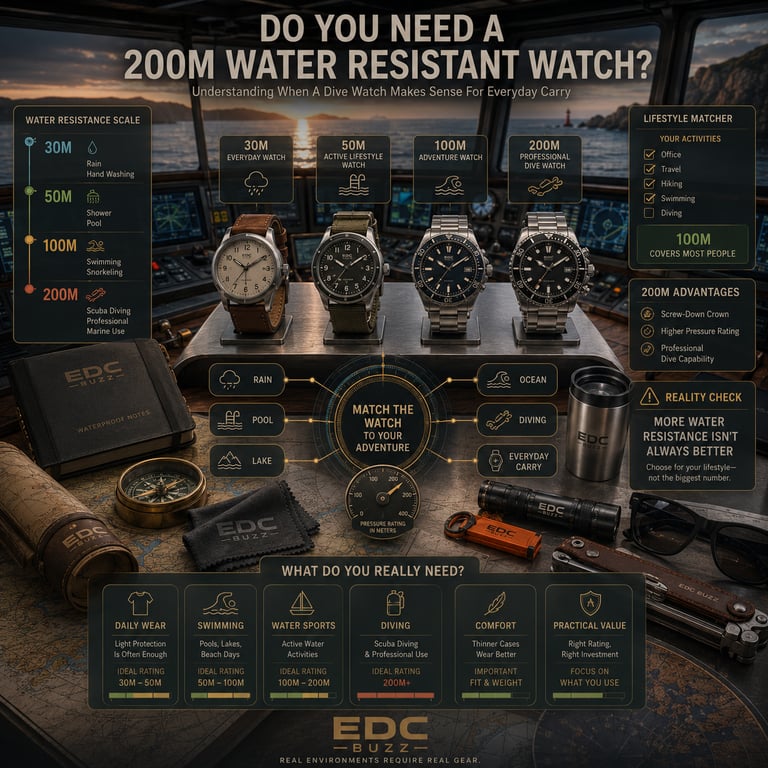
What Does 200M Water Resistance Actually Mean?
Seeing “200M” on a watch implies it can withstand the pressure at 200 meters below the water's surface. But—and here’s where it starts to get interesting—those tests happen under ideal, static lab conditions. The watch sits quietly in a tank, not being bumped against rocks or subjected to sudden temperature changes.
In practical terms, a 200M water resistant watch is designed for professional marine activity, serious surface water sports, and recreational scuba diving. It meets ISO 6425 certification for dive watches, which means it should perform reliably in those underwater environments.
For everyday users, though, it’s a bit like buying a four-wheel drive to drive to the grocery store. It’ll do the job—just probably more than you actually need. If you're unfamiliar with how these ratings are determined, What Is Water Resistance On A Watch? explains the testing process and what the numbers really mean.
Understanding Water Resistance Ratings and Testing
Water resistance ratings follow a standard system, but it’s easy to get tripped up by the numbers.
30M/3ATM: Splash resistant, okay for rain and hand washing but not swimming.
50M/5ATM: Suitable for light swimming and showering.
100M/10ATM: Good for swimming, snorkeling, and extended water exposure.
200M/20ATM: Built for recreational scuba diving and high-pressure water sports.
One detail often overlooked is that these ratings are measured in static conditions, not in real-life scenarios where wrist movement, water temperature shifts, and impact come into play. Being mindful of this helps manage expectations.
Many of the watches featured in our Best Dive Watches guide are rated to 200M or beyond because they're built specifically for demanding water environments.
Who Needs a 200M Water Resistant Watch?
If you spend considerable time in water—maybe recreational diving, snorkeling, or working around wet environments—a 200M water resistant watch is a sensible choice. It’s built to handle pressure, depth, and dynamic water exposure with greater reliability.
For the casual swimmer or someone who encounters water occasionally (rain, hand washing, pool dips), it may be overkill. A well-made 50M or 100M rated watch usually suffices, often coming with lighter weights and slimmer profiles. After a few days, the extra bulk of a 200M watch becomes noticeable—it’s not a dealbreaker but something you don’t forget about either.
If you're deciding between rugged outdoor watches and more versatile everyday models, our Best Sport Watches recommendations offer a good middle ground.
Common Misconceptions About Watch Water Resistance
It’s tempting to think a “200M” watch means you can dive exactly 200 meters deep without a hitch. That’s the first misunderstanding. Depth markings are nominal—they don’t consider real underwater conditions like movement or temperature fluctuations.
Another common mistake is assuming water resistance lasts forever. Those seals and gaskets degrade with time, exposure to chemicals like sunscreen or chlorine, and even shock. Regular maintenance—pressure tests and gasket replacement—keeps the seal intact and the watch trustworthy in wet conditions.
Some users also assume that a watch with water resistance automatically works for all water activities. If you need a proper dive watch, look for ISO certification along with the 200M rating. Many water resistant watches aren’t designed specifically for diving but for general water exposure.
Understanding Common Watch Mistakes New Buyers Make can also help you avoid paying for features that don't match your actual needs.
Materials and Construction That Affect Water Resistance
The quality of materials plays a big role in how a watch stands up to water over time.
Cases made from stainless steel or titanium usually offer better corrosion resistance and structural strength. Titanium tends to be lighter, which can soften the carry if you want a 200M watch that doesn’t announce itself every time you sit.
Synthetic seals and gaskets hold the key to maintaining water resistance by preventing moisture from slipping inside. Sapphire crystal is often used for the watch face—it resists scratches and helps maintain a tighter seal compared to mineral glass.
If you’re serious about reliability, screw-down crowns and case backs add another barrier against water infiltration. For more on how case materials, crystals, and other components compare, see The Most Durable Watch Materials Explained.
Maintenance Tips to Preserve Water Resistance
Most EDC users won’t think about water resistance beyond the rating printed on the dial, but maintaining that protection is essential for long-term reliability. Over time, seals dry out or degrade from exposure to sweat, chemicals, and temperature swings.
To keep your watch in top shape, it’s worth:
Having water resistance tested every 1-2 years, especially if you regularly expose the watch to water.
Replacing gaskets and seals as recommended by the manufacturer or after impact.
Avoiding sudden temperature changes—jumping into a cold pool with a hot watch on is less ideal for seals than you might think.
Taking care when using leather straps around water, even if the case is water resistant, as leather deteriorates quickly when wet.
Routine servicing is covered in greater detail in How Often Should You Service Your Watch?
Choosing the Right Water Resistant Watch for Your Lifestyle
Assessing what water resistance you actually need starts with an honest look at your daily routine and occasional activities.
If you’re mostly desk-bound or moderately outdoorsy, and your water exposure involves rain, hand washing, or occasional swimming, a 50M or 100M rated watch often hits the sweet spot. It offers peace of mind without unnecessary bulk.
If your lifestyle involves snorkeling, diving, or serious water sports, a 200M watch with proper ISO certification makes sense. It settles into daily use easily, which is usually where better designs start to stand out.
For those who never take their watch off, investing in quality materials and maintenance ensures longevity. After all, the last thing you want is a soggy surprise when you least expect it. If you're comparing dedicated dive models with more versatile field watches, our Seiko Prospex SRPE37 vs Timex Expedition Field Post (Dive Watch vs Field Watch) comparison highlights the strengths of each approach.
Common Mistakes to Avoid with Water Resistant Watches
Assuming a 200M rating means safe to dive 200 meters deep—it doesn’t.
Wearing low-rated (30M or less) watches for swimming or diving activities.
Ignoring regular maintenance, which lets seals fail and water slip in.
Confusing water resistance with waterproof—a watch can resist water, but no watch is truly waterproof.
Not checking for ISO certification if you expect to use your watch for diving.
Using leather or poor water-resistant straps for swimming, which degrade fast.
Forgetting sudden temperature changes and impacts can harm water resistance despite the rating.
FAQs About Water Resistant Watches
What does 200M water resistance really mean for everyday users?
A 200M water resistant watch can handle significant water exposure and recreational diving. For everyday users, this usually means the watch can survive most water-related activities without issue, but the rating isn’t a literal depth limit.
Can I swim or shower wearing a 200M water resistant watch?
Yes, a 200M water resistant watch can handle swimming and showering comfortably. Just keep in mind soap and shampoo exposure may affect the seals over time.
Is a 200M water resistant watch necessary for casual swimming or pool use?
Not really. Watches rated 50M or 100M are typically sufficient for swimming pools and casual water exposure. A 200M rating is more relevant for diving or intense water sports.
How often should I have my watch’s water resistance tested or maintained?
Every 1-2 years is a good rule of thumb, or sooner if your watch sees frequent water exposure or impacts. Regular gasket replacement helps maintain the seal.
Are all 200M water resistant watches suitable for diving?
No. Proper dive watches usually meet ISO 6425 standards beyond just the rating. Some 200M watches are built more for surface water sports than actual diving.
What materials help improve a watch's water resistance and durability?
Stainless steel or titanium cases, sapphire crystals, synthetic gaskets, and screw-down crowns are some key features for better water resistance and durability.
Can water resistance decline over time?
Absolutely. Gaskets dry out, seals wear, and exposure to water and chemicals gradually degrade water resistance, which is why maintenance is essential.
How do temperature changes affect my water resistant watch?
Sudden temperature changes can cause materials to expand and contract quickly, potentially compromising seals and allowing water ingress even if the watch holds a high rating.
Practical Conclusion
After spending time with watches across the water resistance spectrum, the most useful lesson is that bigger numbers don’t always mean better fit for your daily carry. A 200M water resistant watch is a solid tool for divers or those frequently in and under water, but it’s often more watch than the average person needs just to get through the day.
For everyday purposes, a quality 50M or 100M rated watch will carry you through showers, pool dips, and the rain without making you feel like you’re lugging a diving rig on your wrist. Plus, lighter watches tend to wear better over time—their presence fades into the background, which is usually what you want. Remember, water resistance ratings are a guide, not a guarantee, and only regular care will keep your watch ready for those unexpected splashes.
So next time you’re hunting for a watch that can handle water, think about what your day truly demands before going for the 200M badge. If you do decide to go deep, make sure you pick a timepiece that can take your adventures seriously—and keep up without making you feel like you’re carrying a boat anchor disguised as a watch. After all, the best gear is the one you barely notice—until you need it.

Contact@TheBuzzHQ.com
© 2026 EDCBuzz. All rights reserved.
EDCBuzz
Master everyday carry systems with clarity and precision. Built for real environments and practical use.
For educational purposes only.
General Inquiries: