
Why Flashlights Matter More Than Knives for Maintenance Work
Discover why flashlights for maintenance work outperform knives with better visibility, versatility, and hands-free features essential for repairs.
LOADOUTS
The EDCBuzz Editorial Team - Led by AJ “Buzz” Eichman
6/11/20267 min read
When it comes to everyday carry for maintenance work, knives often get a lot of hype as the go-to tool. And sure, a good knife is a reliable performer when you need to cut wires, strip insulation, or open packages. But after spending several weeks living with both in a practical maintenance setting, I’ve come to realize that flashlights deserve top billing for this kind of work. It’s not that knives aren’t useful—they are—but when it comes to the day-to-day grind of inspecting, diagnosing, and repairing equipment, flashlights simply deliver more consistent, practical value. You don’t often hear about inspection fails caused by a dull blade, but poor lighting? That’s a different story.
If you're building a work-focused carry setup, the EDC Loadouts Guide and EDC Loadout Builder by Budget can help prioritize the gear categories that have the biggest impact on daily maintenance work.
Quick Verdict
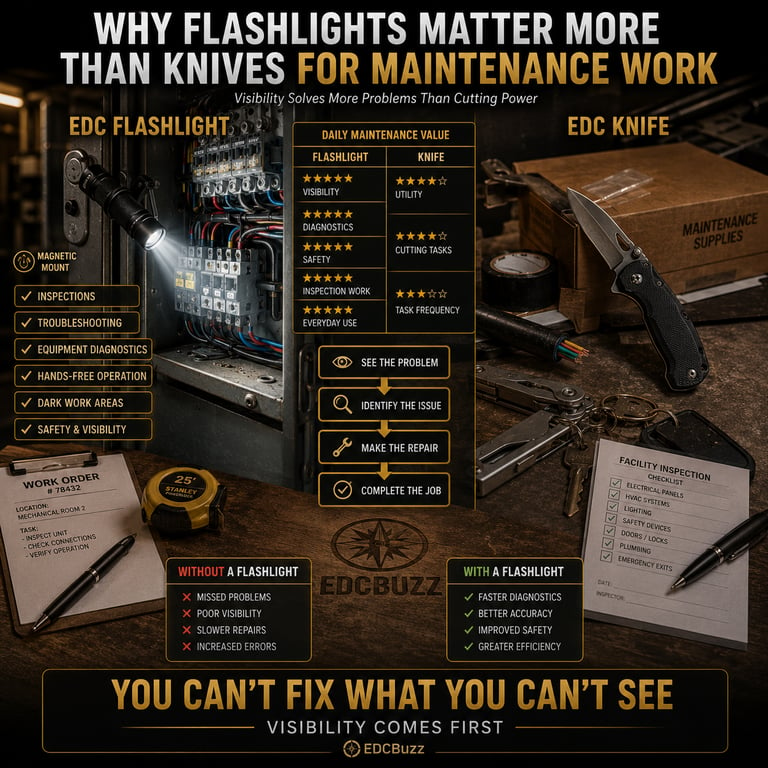
Flashlights dramatically improve visibility in dark or cramped spaces, which is critical for accurate maintenance work.
EDC flashlights designed for maintenance often include adjustable brightness and focus, allowing you to tailor the light to task-specific needs.
Hands-free features like magnetic bases or clip mounts make flashlights vastly more user-friendly during extended repairs.
While knives have limited utility mainly centered around cutting, flashlights serve as a versatile asset for inspection and troubleshooting in diverse conditions.
Why Visibility is Vital in Maintenance Tasks
I’ve found that maintenance work usually happens when natural light is either lacking or downright nonexistent. Whether you’re inside a cramped electrical panel, under a vehicle, or squeezed into an HVAC unit, being able to clearly see what you’re working on isn’t just a convenience—it’s a necessity. Shadows hide faults, misaligned parts, or fine wiring details that a flashlight can bring into sharp focus. Over time, relying on ambient light or the glow from your phone’s screen quickly becomes frustrating and inefficient.
Good lighting cuts mistakes and speeds up diagnosis, which is a win when you don’t want to be stuck fumbling around in the dark. Flashlights provide this clarity consistently, unlike knives, which simply don’t have an equivalent role in illumination.
The importance of role-specific gear selection is one reason Why Your Job Should Influence Your EDC Loadout remains one of the most important concepts for working professionals.
Comparing Utility: Flashlights vs. Knives in Maintenance
Knives, let’s not kid ourselves, are excellent cutting tools. They handle string, wire insulation, or packaging like champs. But after a few weeks of use, it became obvious just how limited their role is in the grand scheme. They won't help you spot a loose screw or see corrosion on a circuit board. They won’t hold your place or illuminate your hands when both are busy with tools.
Conversely, flashlights have a broader range of uses in maintenance. Beyond lighting up your workspace, many modern EDC flashlights offer features that directly benefit maintenance tasks. Adjustable brightness means you can dial down to a soft glow when dealing with delicate electrical components or ramp up to a bright, focused beam to peek deep inside machinery. Even better are flashlights with magnetic bases or side clips, which let you mount the light to metal surfaces or your belt, liberating your hands for screwdriver or wrench work.
These practical features make flashlights more than just “lights.” They become invaluable work partners that adapt to your environment. Meanwhile, knives remain firmly in their role as cutting aids.
For examples of complete maintenance-focused setups, compare the Best Budget Maintenance Tech EDC Loadout and Best Premium Maintenance Tech EDC Loadout.
Key Flashlight Features Beneficial for Maintenance Work
Coming into this, I expected any flashlight to do the trick, but several features quickly proved their worth beyond the obvious.
First, brightness matters—a lot. Maintenance environments are rarely floodlit. A flashlight with poor brightness or uneven beam quality can strain your eyes or miss details. I settled on lights with LED bulbs—reliable, bright, and energy-efficient. Having multiple brightness modes means I can conserve battery life when full power isn’t needed but still crank it up when working on more challenging tasks.
Next, focus adjustment is a small feature that pays dividends. Being able to switch between a wide floodlight and a concentrated spot means I’m not limited to one lighting style. For example, scanning a wide panel at once calls for flood mode, while inspecting a worn bearing requires a narrow, intense beam.
Durability also matters—these lights get tossed in tool bags and sometimes knocked off surfaces. I found flashlights made of anodized aluminum or tough polymers with water resistance ratings (think IPX4 and above) hold up to the occasional splash or drop. Rechargeable lithium-ion batteries proved a smart investment for daily use too; fewer battery swaps mean less downtime.
Finally, hands-free options—magnetic bases and sturdy clips—are a game changer. They let you angle the light where it needs to be and free up both hands, something a portable cutting tool can’t do.
Common Mistakes When Choosing and Using Maintenance Flashlights
There’s a surprising number of ways to get this wrong, even if picking a flashlight seems straightforward.
One common pitfall is relying on a basic flashlight or your phone’s light, ignoring the specific lighting needs for maintenance. Shine a 10-lumen keychain on an engine block and you’ll see what I mean—it’s hardly enough.
Some skip considering beam quality and focus, grabbing a bright but poorly distributed light that misses fine details or casts hard shadows. That’s where adjustable focus and multiple beam types make a huge difference.
Battery life also gets overlooked, with many opting for cheap batteries or non-rechargeable models. That’s a hassle, especially on long shifts or in situations where replacement cells aren’t handy. Choosing a flashlight with reliable, long-lasting power or rechargeability smooths out daily workflow remarkably.
Underestimating hands-free or mounting features is another oversight. Holding a flashlight while working can quickly lead to grip fatigue and frustration. Magnetic bases and clips are not just bells and whistles—they’re practical necessities you’ll appreciate by day two.
And finally, treating knives and flashlights as interchangeable is a mistake. They serve distinct roles; expecting a knife to illuminate or a flashlight to cut wires ignores what each tool was designed to do.
Many of these errors show up repeatedly in Most Common Maintenance Technician EDC Mistakes.
Real-World Examples of Flashlight Use in Maintenance
One example that sticks with me involved troubleshooting an air conditioning unit late into the afternoon, with no natural light to rely on. A flashlight clipped to my shirt shone a clear beam into the cramped interior, making wires and connectors visible without awkward hand-holding. The adjustable brightness allowed me to reduce glare on reflective surfaces, making it easier to identify a faulty relay.
Another scenario was under a vehicle with limited headroom. Using a flashlight with a magnetic base attached to the frame meant no juggling light and tools. I could focus on bolt removal without worry about the flashlight slipping or dimming unexpectedly.
In contrast, my trusted folding knife handled several wire cutting jobs and packaging tasks. Reliable as ever, but it never once helped me see a hidden wiring fault or illuminate a dark inspection pit.
These experiences reinforced how flashlights create the conditions for better, safer maintenance work, while knives remain solid but narrowly focused utilities.
How to Select the Right Flashlight for Your Maintenance EDC Kit
Choosing the right flashlight comes down to matching features to your specific maintenance environment and routine.
Start with brightness and beam quality. Look for LED lights with adjustable brightness modes reaching at least 100-200 lumens for versatile indoor and outdoor use. Make sure the beam is evenly distributed and, ideally, adjustable between spot and flood.
Durability should be non-negotiable. An anodized aluminum body or reinforced polymer will handle drops and scrapes typical on the job. Check the water resistance rating—IPX4 or higher means you’re safe against splashes and brief exposure.
Battery life needs thoughtful consideration. Rechargeable lithium-ion models may have a higher upfront cost but pay off quickly by reducing replacements and waste. Having USB charging options is a big plus for convenience.
Don’t overlook mounting features. Magnetic bases, side clips, or even collar mounts expand the ways you can position your light and keep your hands free. This is often where the difference between “just a flashlight” and “a maintenance tool” happens.
Lastly, pocket feel and weight matter more than many expect. You’ll carry this light daily, so it should settle comfortably without digging into your pocket or feeling like a brick. A balance between robustness and lightness is key.
For technicians building an entire carry system around practical field work, How Maintenance Techs Can Build an EDC Loadout Under $250 is a useful companion guide.
Frequently Asked Questions
Why Are Flashlights More Important Than Knives for Maintenance Work?
In a nutshell, flashlights are essential because lighting conditions in maintenance work are rarely ideal. They unlock visibility, improve safety, reduce errors, and increase efficiency. Knives, while useful for certain cutting tasks, don’t substitute for illumination. A flashlight’s capacity to reveal what's hidden in the shadows makes it indispensable.
What Features Should I Look for in a Maintenance Flashlight?
Focus on adjustable brightness and beam types (spot and flood), LED bulbs for brightness and efficiency, durable build materials like anodized aluminum, water resistance, long battery life (preferably rechargeable), and hands-free features such as magnetic bases or clips.
Can a Knife Replace a Flashlight in Maintenance Tasks?
No. Knives serve as cutting and utility tools, but they cannot provide visibility. Their roles complement rather than replace each other in maintenance work.
How Do Flashlight Beam Types Affect Maintenance Work?
Spot beams produce tight, focused light ideal for seeing details in confined spaces, while flood beams offer wide illumination for general area lighting. Having an adjustable flashlight lets you switch between modes to best suit the task.
Are Rechargeable Flashlights Better for Daily Maintenance Use?
Generally, yes. Rechargeable flashlights reduce ongoing battery costs, minimize downtime, and often come with convenient USB charging. However, ensure you have backup power options for extended use.
What Are Common Flashlight Materials That Withstand Maintenance Environments?
Anodized aluminum and impact-resistant polymers are popular for durability and resistance to drops, splashes, and occasional rough handling.
How Can I Maintain and Extend the Life of My EDC Flashlight?
Regularly clean contacts and threads, avoid dropping or exposure to excessive moisture beyond rated limits, recharge batteries before depletion, and replace worn-out parts such as O-rings or lenses as needed.
What’s the Ideal Brightness Level for a Maintenance Flashlight?
A range of 100 to 300 lumens is often ideal, providing enough brightness to illuminate dark areas clearly without excessive glare or draining the battery too fast.
Conclusion
Over weeks carrying both knives and flashlights through the rigors of maintenance work, the flashlight consistently proved itself the more versatile and indispensable tool. Knives retain their well-earned place as go-to cutters, but when it comes to seeing what’s broken, figuring out what’s wrong, or just getting the job done efficiently after the sun goes down, a quality maintenance flashlight carries the day.
If you want to build an EDC kit that actually makes your job easier and safer, investing in a durable, bright, thoughtfully designed flashlight is the smarter move. It’s the kind of tool that just quietly improves every task—kind of like a good dad joke, but without the eye rolls.

Contact@TheBuzzHQ.com
© 2026 EDCBuzz. All rights reserved.
EDCBuzz
Master everyday carry systems with clarity and precision. Built for real environments and practical use.
For educational purposes only.
General Inquiries: