

How Accurate Are Quartz Watches?
Explore quartz watch accuracy and discover how quartz movements deliver precise timekeeping with minimal maintenance and superior reliability.
EDC WATCHES
The EDCBuzz Editorial Team - Led by AJ “Buzz” Eichman
6/28/20267 min read
Quartz watches are a staple in everyday carry (EDC) gear, prized primarily for their reliable timekeeping with minimal fuss. But how accurate are quartz watches really? To understand their precision, we need to look beyond marketing claims and break down the technology that makes these watches tick — literally. By examining the quartz movement and comparing it to other watch types, we can get a clearer picture of what accuracy means in practical terms and why it matters for daily use.
If you're building an everyday carry collection, our EDC Watches guide provides an excellent overview of the different watch types and how quartz models fit into modern EDC.
Quick Verdict
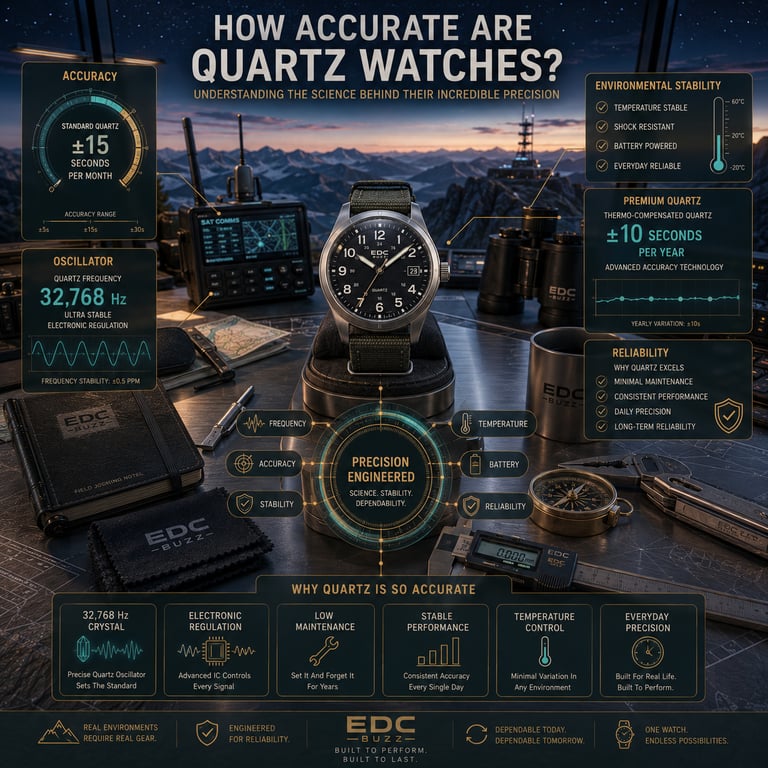
Quartz watches typically maintain time within ±15 seconds per month, significantly outperforming most mechanical watches.
Accuracy depends on several factors including crystal quality, temperature variations, and battery condition.
Advanced quartz movements with features like thermo-compensation can push accuracy to a few seconds per year.
Quartz watches require less maintenance and are generally more convenient for daily wear compared to mechanical options.

How Quartz Watches Work: The Science Behind the Precision
At the heart of every quartz watch lies a tiny quartz crystal that acts as an oscillator. When an electric current from the battery stimulates this crystal, it vibrates at a very stable frequency—usually 32,768 cycles per second (Hz). This frequency is carefully chosen because it’s a power of two, which allows the watch’s integrated circuit to divide the oscillations down to exactly one tick per second.
These consistent vibrations act like the steady heartbeat for the watch’s timekeeping mechanism. Because the frequency is so stable, the watch’s electronic circuitry can count the vibrations and generate precise timing signals that drive the stepper motor, which in turn moves the hands.
What matters here isn’t just how fast the crystal vibrates, but the uniformity of those vibrations under real-world conditions. This oscillator stability is what sets quartz watches apart from traditional mechanical watches, which rely on a balance wheel and spring, mechanisms much more susceptible to mechanical wear, gravity, and shock. If you're comparing technologies, Quartz or Automatic: Which Is Better for Everyday Carry? explains the practical differences between the two movement types.
Typical Accuracy Levels of Quartz Watches vs. Mechanical Watches
Most standard quartz watches deliver about ±15 seconds deviation per month. To put that in perspective, mechanical watches—even ones considered highly accurate—often vary by ±5 to 10 seconds a day, which boils down to about ±150 to 300 seconds per month. Quartz watches can realistically keep time with ten times better precision than typical mechanical watches.
While digital smartwatches rely on quartz movements, their time synchronization happens via network connections or Bluetooth, so their effective accuracy can be even higher by continuously adjusting to atomic time references. However, focusing strictly on the quartz movement itself provides a clear baseline for what a standalone quartz watch can achieve. For a direct comparison of real-world performance, see Automatic or Quartz: Accuracy In Real Life.
Factors Influencing Quartz Watch Accuracy in Real Life
The theoretical accuracy ratings become more nuanced once we consider real-life variables affecting quartz watch precision. The main factors are temperature, battery condition, and physical wear.
Temperature is one of the biggest variables. Quartz crystals expand and contract slightly as temperatures change, affecting the oscillation frequency. While the effect might be minuscule in lab conditions, outdoor environments or fluctuating daily temperatures can result in noticeable time gain or loss.
Battery voltage also plays an important role. As the battery discharges, the current fed to the oscillator can fluctuate, causing subtle changes in frequency. If the battery runs too low, the watch might slow down or even stop, underscoring the importance of timely replacements to maintain accuracy.
Mechanical shocks or heavy vibrations surprisingly have minimal impact on quartz watches due to their solid-state nature. The internal electronics and sealed construction protect the crystal oscillator better than the mechanical components inside traditional watches.
Advancements in Quartz Technology for Enhanced Precision
Not all quartz watches are created equal. Some high-end quartz models incorporate features designed explicitly to improve precision beyond the standard ±15 seconds per month.
Thermo-compensated quartz (TCXO) watches integrate temperature sensors that actively adjust the oscillator frequency based on the current temperature. This design reduces temperature-induced deviations dramatically, bringing accuracy down to about ±10 seconds per year. This level of precision rivals, and in some cases surpasses, many mechanical chronometers.
Other advanced quartz movements use higher frequency oscillators or multi-frequency crystals, along with improved integrated circuits, to refine the timekeeping signal further. These improvements typically come at a higher price but offer stability and reliability unmatched by most entry-level quartz watches. If you're looking for recommendations, our Best Watches Under $150 guide includes several excellent quartz options that offer outstanding value.
Common Misconceptions About Quartz Watch Accuracy
One frequent mistake buyers make is assuming all quartz watches have the same level of accuracy. The quality of the movement, the manufacturing standards, and additional features like thermo-compensation all influence how precise a quartz watch will be.
Neglecting battery maintenance is another common issue. A fading battery reduces voltage and can cause the watch to run slow or sporadically stop. Swapping batteries at recommended intervals ensures consistent timekeeping.
Some users expect quartz watches to be perfectly accurate without any measurable variance. While quartz is certainly more precise than mechanical, everyday quartz watches still exhibit minor time drift due to physical and environmental factors.
Additionally, it’s important not to confuse quartz watch accuracy with mechanical watch precision. Mechanical watches often advertise certified chronometer status with tolerances measured in seconds per day, but by inherent design, they cannot compete with the electronic stability of quartz oscillators. Common Watch Mistakes New Buyers Make highlights several misconceptions that often catch first-time buyers by surprise.
Maintaining Your Quartz Watch for Optimal Timekeeping
Maintenance for quartz watches is minimal, but certain practices help sustain accuracy. Regular battery replacement is the simplest yet most vital upkeep task. Most batteries last between one to three years depending on the movement and usage.
Keeping the watch clean and avoiding exposure to extreme temperatures or magnetic fields will also help preserve the integrity of the quartz movement.
Professional servicing is required less frequently than on mechanical watches because quartz movements have fewer moving parts and rely on electronic regulation. However, seals and gaskets can degrade over time, affecting water resistance, so periodic checks are recommended if you use your watch around water regularly. Following the advice in Watch Ownership Guide will help maximize the lifespan of any everyday carry watch.
Quartz Watch Accuracy Compared to Other Timekeeping Devices
When comparing quartz watches with other popular timekeeping devices, the advantages and limitations become clearer. Mechanical watches, as discussed, have wide accuracy tolerances due to their complex moving parts.
Digital smartwatches leverage quartz oscillators but enhance accuracy through continuous syncing with atomic clocks over GPS or internet connections. This means their displayed time is typically more precise, but it also depends on external connectivity. The Garmin Fenix 8 vs Victorinox Journey 1884 (Smartwatch vs Traditional Watch) comparison explores these differences in greater depth.
Atomic clocks integrated into some wristwatches are considered the gold standard, automatically correcting the time and offer perfect accuracy. These devices use radio signals from atomic timekeeping facilities to bind the clock to an absolute reference.
For most everyday users, however, well-maintained quartz watches strike the optimal balance—accurate enough for practical daily use without the constant need for syncing or battery replacements associated with smartwatches.
Common Mistakes
Assuming uniform accuracy across all quartz watches without factoring in movement quality and design.
Ignoring battery health, which can reveal itself as slower running time or stoppages.
Expecting quartz precision to be flawless in every condition; minor deviations are normal.
Confusing quartz watch accuracy with mechanical watch precision metrics and tolerances.
Overestimating the impact of shocks and motions which generally have limited effects on quartz oscillators.
Frequently Asked Questions
How accurate are standard quartz watches compared to mechanical watches?
Standard quartz watches are significantly more accurate, typically deviating by about ±15 seconds per month, whereas mechanical watches often vary ±5 to 10 seconds daily.
What factors can affect the accuracy of a quartz watch?
Temperature fluctuations, battery voltage changes, quality of the quartz crystal, and physical wear are primary factors influencing accuracy.
Do temperature changes impact quartz watch precision?
Yes, temperature affects the quartz crystal’s oscillation frequency, causing time deviations, though thermo-compensated quartz watches minimize this impact.
How often should I change the battery in my quartz watch to maintain accuracy?
Generally, batteries should be replaced every one to three years or as recommended by the manufacturer to prevent voltage drops impacting accuracy.
Are high-end quartz watches more accurate than standard models?
Yes, watches with thermo-compensated movements or higher frequency oscillators can achieve accuracy figures in the range of ±10 seconds per year.
Can I calibrate or adjust a quartz watch if it runs fast or slow?
Most quartz watches cannot be manually calibrated; accuracy is set by the manufacturing process, though some high-end models allow limited adjustment.
How does quartz watch accuracy compare to smartwatch timekeeping?
Quartz watch accuracy is high but static; smartwatches can surpass this by regularly syncing time to atomic clock references.
What is thermo-compensated quartz and how does it improve precision?
Thermo-compensated quartz uses sensors and electronics to adjust the oscillator frequency in response to temperature changes, reducing timing errors significantly.
Conclusion
Quartz watch accuracy is a fascinating interplay between stable crystal oscillations, durable electronic regulation, and environmental factors that affect performance. Understanding how quartz movements work reveals why these watches tend to be far more precise than mechanical alternatives and why they remain a reliable choice for everyday carry.
The typical ±15 seconds per month tolerance of standard quartz watches balances precision with convenience, requiring less frequent servicing and delivering consistent performance for daily use. For those who demand even higher accuracy, advanced thermo-compensated quartz models and hybrid options offer near-atomic precision, though often at a higher cost.
If you're interested in premium quartz technology, Best EDC Watches includes several outstanding quartz-powered models that demonstrate just how capable modern movements have become.
In the end, knowing what affects quartz watch precision and how accuracy is measured empowers you to choose a watch well-suited to your needs—whether that means a durable, low-maintenance piece for work or something more specialized. Quartz watches continue to stand out as dependable timekeepers, quietly outperforming their mechanical cousins with elegant simplicity and scientific rigor.

Contact@TheBuzzHQ.com
© 2026 EDCBuzz. All rights reserved.
EDCBuzz
Master everyday carry systems with clarity and precision. Built for real environments and practical use.
For educational purposes only.
General Inquiries: