
Understanding Different Flashlight Beam Types and Their Uses
Explore key flashlight beam types and their uses to choose the perfect light for your everyday carry needs with clear insights on beam distance and intensity.
EDC FLASHLIGHTS
The EDCBuzz Editorial Team - Led by AJ “Buzz” Eichman
4/2/20268 min read
When we think about everyday carry flashlights, a key element that often gets overlooked is the flashlight beam type. The beam pattern—how the light is shaped and projected—plays a crucial role in how effectively a flashlight performs for specific tasks. Far from mere brightness ratings, the way a flashlight directs its light affects everything from the distance you can see to how evenly an area is illuminated. Whether you’re navigating a dark trail, working on home repairs, or just walking to your car at night, understanding flashlight beam types will inform a practical choice that suits your daily needs.
In this article, we’ll unpack the common flashlight beam patterns: spot beams, flood beams, and adjustable beams. We’ll investigate how each beam type works mechanically, what kind of lighting result it produces, and what practical environments each is best suited for. Along the way, I’ll explain how factors like beam distance and intensity tie into beam design and why selecting the right beam pattern is often more important than chasing maximum brightness alone.
Quick Verdict
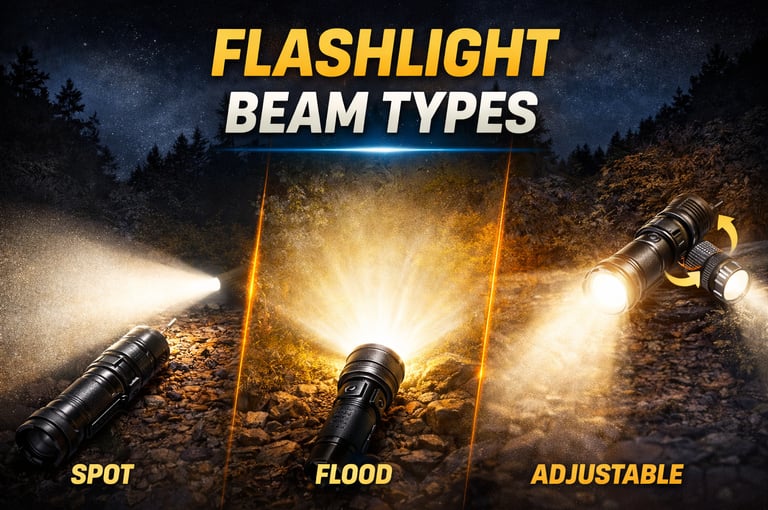
Spot beams concentrate light into a narrow, intense circle, ideal for long-distance visibility and pinpointing specific targets.
Flood beams create a wide, even spread of light suitable for close-range viewing and broad area illumination.
Adjustable beam flashlights combine spot and flood functions, offering flexibility for varied lighting needs.
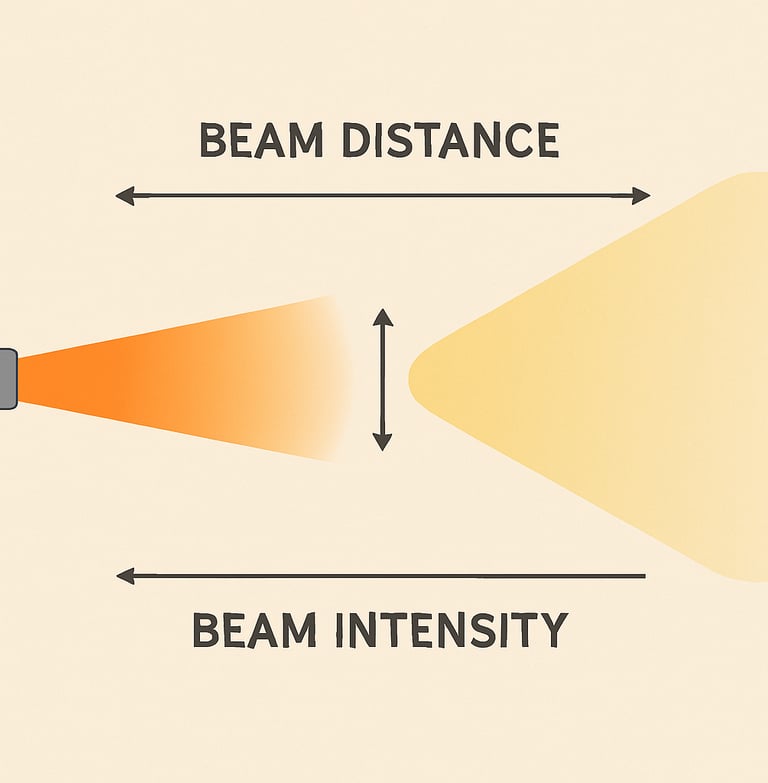
Beam distance and intensity have an inverse relationship: a focused beam travels farther but covers less area, while a wide beam illuminates a broader space more softly.
What Are Flashlight Beam Types?
At the core, flashlight beam types are defined by how the reflector and lens shape the emitted light. The reflector—the reflective surface behind the LED—can be deep and narrow or shallow and wide, which in turn directs light differently. The lens may either focus the beam into a tight point or diffuse it for a softer spread.
The main three categories here are spot, flood, and adjustable beams. Spot beams use a deep reflector paired with a narrow lens, which crunches the LED’s output into a concentrated, intense pillar of light. This pattern excels at delivering long-range illumination, much like a flashlight’s “searchlight” mode. In contrast, flood beams take a shallow reflector and usually a diffusing lens to stretch light broadly, bathing nearby areas in a softer, even glow. For a broader breakdown of how these designs fit into everyday use, it helps to explore the full EDC Flashlights category.
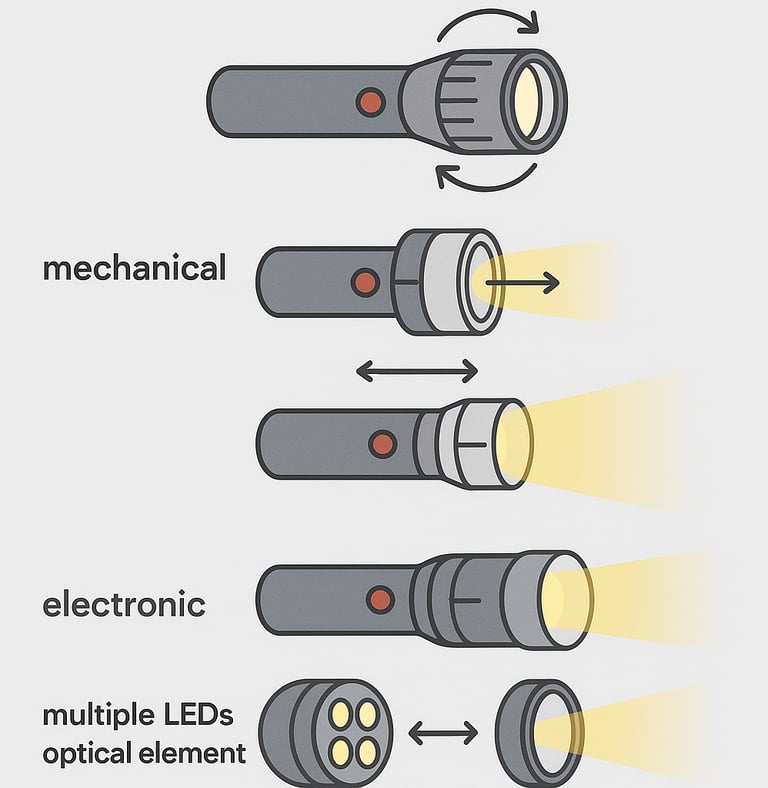
Adjustable beams blend these approaches. They either mechanically shift the reflector or lens, or electronically control the beam shape, letting the user toggle between spot and flood—or even mix the two—to adapt lighting to specific environments.
Differences Between Spot and Flood Beams
The physical design difference between spot and flood beams is deceptively simple but has significant effects on how you use a flashlight. Spot beams prioritize beam distance and intensity by narrowing light to a tight circle. This makes objects far away more visible, which is critical if you need to identify details down a trail or across a dark yard. Performance differences like these become even clearer when comparing real-world models such as Nitecore EDC37 vs Olight Seeker 4 Pro.
But that advantage comes with a trade-off. Because all the light is compressed into a small area, the beam doesn’t cover much ground nearby, and its edges are typically sharply defined with less ambient light. This can be a drawback in confined spaces or when you need situational awareness across a wide field.
Flood beams invert this trade-off. By casting a wide beam, they simplify tasks that require broad illumination, like illuminating a workbench, a campsite, or the interior of a room. The intensity per unit area is lower than with spot beams, but the beam’s more diffuse and even distribution reduces harsh shadows and eye strain.
So between these two, it’s not about one being categorically better. Instead, it’s understanding which beam characteristic—distance and intensity versus width and uniformity—aligns with your typical use case.
Adjustable and Zoomable Flashlight Beams Explained
Adjustable beam flashlights aim to give you flexibility by combining spot and flood beams within a single device. There are a few mechanical methods to achieve this switch. Some flashlights feature rotating bezels or sliding collars that physically move the LED relative to the reflector, altering the beam shape. Others rely on electronically controlled optics or multiple LEDs embedded in different reflector zones to simulate different beam patterns.
The practical impact here is straightforward: carrying one tool that adapts to various lighting demands. Early flashlights required either a dedicated floodlight or spotlight; today’s adjustable designs let you switch from a long-distance focused beam for outdoor trekking to a broad flood beam for campsite setup without swapping devices. Many versatile models designed this way show up in curated lists like best edc flashlight under 100 for balancing performance and flexibility.
Understandably, adjustable beams add mechanical complexity, which can influence durability and cost. However, for users whose scenarios vary—think commuter by day, weekend camper by night—a versatile beam outweighs the marginal trade-offs.
How Beam Distance and Intensity Affect Performance
Beam distance is typically rated by measuring the lux—the light intensity per unit area—at a set distance from the flashlight. A beam that focuses light into a tight circle records higher lux levels at distance, indicating greater intensity and reach. Conversely, broad flood beams have a much lower lux reading at the same distance since the light disperses over a wider zone.
Beam intensity directly influences visibility and eye comfort. A highly intense spot beam makes distant details sharp but can cause glare if shone too close to the eyes. Meanwhile, a softer flood beam breeds better situational awareness by evenly lighting a peripheral field without harsh hotspots. These performance differences are also closely tied to output metrics discussed in lumens vs candela explained.
Interestingly, this inverse relationship means you rarely get top performance in both beam distance and width from the same beam pattern. Some flashlights, however, solve this with a combined or adjustable beam, delivering a strong spotlight without sacrificing floodlight benefits.
Choosing the Right Beam Type for Everyday Carry
EDC flashlights must balance several often conflicting priorities: compact size, weight, battery efficiency, and practical beam output. The beam type you choose should reflect your daily environments and tasks.
If your typical use involves walking or cycling in urban environments where you need to see farther ahead, a focused spot beam is invaluable. It lets you identify obstacles or street signs before you reach them. Conversely, if your primary task entails close-range illumination—fixing something in your car, reading, or navigating indoors—a flood beam’s wide light is preferable.
Adjustable beam flashlights are a standout choice for those who need versatility without carrying multiple devices. Consider how often you actually switch between beam types to justify the added complexity. Smaller options that still provide useful beam control can often be found in lists like best keychain flashlights for ultra-compact carry.
Materials and Lens Designs Impacting Beam Quality
Beyond reflector shape, the materials used for the flashlight’s body and lens also affect beam performance and durability. Anodized aluminum bodies offer robustness without added weight, which is important for pocketability and all-day carry comfort. Toughened glass or optical-grade polymer lenses minimize light distortion while resisting scratches that degrade beam clarity over time.
LED technology itself matters too. Modern LEDs provide high lumen output with efficient power consumption, but their directional emission needs to be managed carefully through optics. A poorly designed lens or reflector can cause uneven beam hotspots or reduce effective throw distance, regardless of theoretical brightness. Higher-end models with refined optics often appear in collections like best high end edc flashlights where beam quality becomes a priority.
Common Mistakes When Selecting Flashlight Beams
One common misstep is focusing exclusively on max brightness or lumens without considering how the beam is shaped. High brightness doesn’t automatically translate to better visibility—if that brightness is spread too thinly or scattered broadly, it may not serve your practical needs.
Another error is assuming every flashlight’s beam quality is similar when looking only at specs. Beam pattern, intensity consistency, and lens design all influence how comfortable and useful a flashlight feels in real use.
Neglecting adjustable or zoomable beam options in favor of a single beam type can also limit versatility. Some users discover later that a rigid spot beam is too narrow for general use, while a flood-only beam lacks long-range illumination.
Additionally, many buyers overlook how size and weight impact everyday carry practicality. A flashlight with a perfect beam but bulky dimensions may see little actual use simply because it’s inconvenient.
Finally, ignoring beam intensity uniformity invites eye strain, especially during detail-oriented tasks. Even illumination with gradual edges reduces fatigue compared to sharply cut beams containing hot centers and dark fringes.
FAQs About Flashlight Beam Types and Uses
What are the main types of flashlight beam patterns?
The primary beam types include spot beams, which are narrow and intense for distance; flood beams, which are wide and even for close range; and adjustable beams that combine features of both through mechanical or electronic means.
How do I choose between a spotlight and a floodlight for everyday carry?
Consider your typical use: spot beams excel at long-distance illumination, helpful for walking or cycling at night. Flood beams suit close-range tasks like repairing or reading by providing even, broad light. Adjustable beams work well if you need both in one device.
What is beam distance and how does it affect flashlight performance?
Beam distance measures how far the light effectively reaches, often gauged by lux intensity at a set range. A longer beam distance means you can see farther but usually with a narrower beam; shorter distances indicate wider spread but less reach.
Are adjustable beam flashlights useful for all outdoor activities?
Adjustable beams add versatility, especially for activities like camping where both broad area and focused trail lighting are important. However, their mechanical complexity can affect durability, so consider your environment and handling needs.
What technical features influence flashlight beam quality?
Beam quality depends on LED performance, reflector shape, lens design, and materials like anodized aluminum and toughened glass. Uniformity of light distribution and absence of distortion are also critical.
Can I improve my flashlight beam with accessories or lens adjustments?
Certain accessories like diffusers or filters can alter beam characteristics, softening or coloring the light. However, fundamental beam shape is mostly governed by internal optics, and external mods may reduce efficiency or clarity.
What battery types best complement different flashlight beams?
High-drain lithium-ion batteries pair well with intense spot beams due to their power demands, while flood beams with lower intensity can be effectively powered by AA or AAA alkaline or rechargeable batteries, depending on design.
How does beam intensity affect visibility in various conditions?
High-intensity beams offer clear detail and long reach in open or outdoor conditions but can cause glare or discomfort indoors or when lighting reflective surfaces. Softer beams reduce eye strain and provide broader awareness in confined spaces.
Practical Conclusion
Every flashlight beam type serves a purpose shaped by its optical design, and understanding these nuances is key to choosing the right light for your everyday carry needs. Rather than chasing the highest lumen numbers, it’s more beneficial to assess how beam distance, intensity, and pattern align with your tasks—whether that’s illuminating a campsite, spotting a curb at night, or lighting your workspace.
Spot beams bring focused power for long-distance clarity, flood beams offer gentle widespread illumination for close quarters, and adjustable beams provide a balanced hybrid solution. Keep in mind the physical trade-offs in size and complexity that come with beam adjustment and never discount the importance of quality materials and optics in maintaining beam integrity.
By grounding your choice in the technical realities of flashlight beam types, you gain a tool that fits seamlessly into your daily routine, offers reliable lighting performance, and minimizes strain—making every carry more thoughtful and efficient.

Contact@TheBuzzHQ.com
© 2026 EDCBuzz. All rights reserved.
EDCBuzz
Master everyday carry systems with clarity and precision. Built for real environments and practical use.
For educational purposes only.
General Inquiries: