
Assisted vs Manual EDC Knives: Which Is Better?
Explore the pros and cons of assisted EDC knives versus manual opening knives to find out which fits your daily carry needs best.
EDC KNIVES
The EDCBuzz Editorial Team - Led by AJ “Buzz” Eichman
5/8/20267 min read
When it comes to everyday carry knives, the debate between assisted opening knives and manual opening knives is as persistent as trying to find your keys in a cluttered pocket. Both have their merits, and both have quirks that only show after a few weeks of daily use. Assisted EDC knives use built-in spring mechanisms to help the blade snap out faster once you start opening them, while manual knives demand a bit more effort—though they reward with simplicity and control.
If you’ve spent much time exploring different EDC Knives, you’ve probably noticed pretty quickly that opening style changes the overall carry experience more than most people expect.
If you’re on the fence about which type fits your daily routine better, this comparison will walk you through the real-world experience, not just specs and marketing speak.
Quick Verdict
Assisted knives provide faster one-handed deployment, great for quick tasks where speed matters.
Manual knives shine in durability and ease of maintenance due to simpler mechanisms.
Legality varies for assisted knives, so make sure your choice plays by your local rules.
Both types depend heavily on good ergonomics and materials—no spring can fix a lousy handle.
Picking assisted or manual mostly boils down to personal preference, daily use habits, and comfort.
How Assisted Opening Knives Work
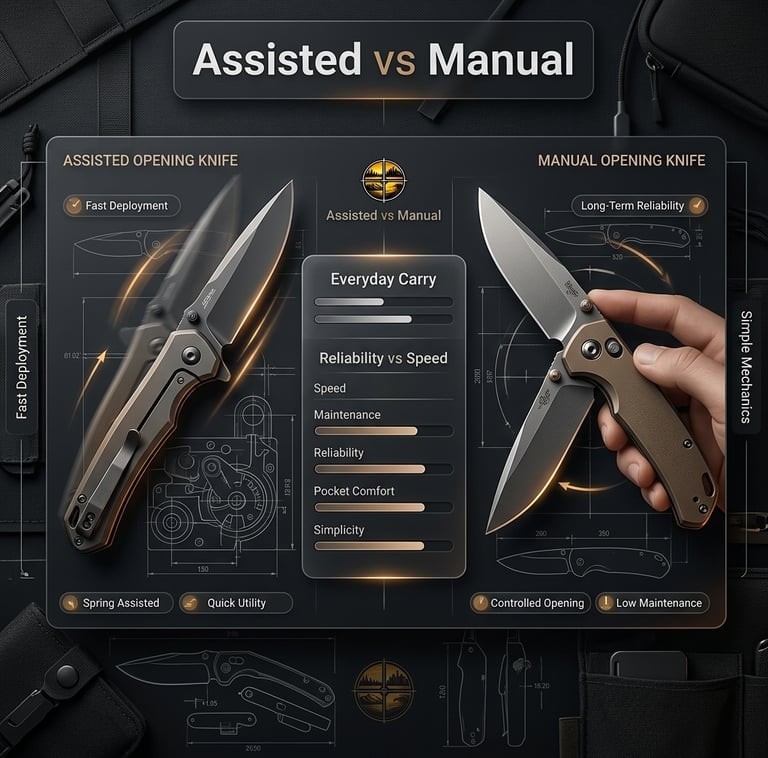
Assisted opening knives contain a spring inside the handle that kicks in after you manually push the blade partway open. Once you reach a certain point, the spring finishes the job with a quick, almost effortless flick. It’s a neat system designed to blend the control of manual opening with a dash of mechanical velocity.
After a few days, the speed of assisted knives does stand out, especially when you’re juggling packages, cords, or snacks and can pop your blade open with one hand without much thought. The action is smooth but decisive, which often becomes a convenience more than a novelty. You notice that it reduces finger strain, especially if you’re opening the knife frequently during the day.
Knives like the ones featured in Kershaw Link vs Buck 250 Saunter really highlight how assisted opening changes the feel of everyday carry compared to more traditional manual designs.
However, the mechanism adds some complexity and a few more moving parts that tend to attract grit. Regular cleaning and lubrication become part of the routine if you want to keep that slick opening. Skip maintenance, and the spring can stiffen or feel sluggish, turning what was once a slick gadget into a stubborn doorstop.
How Manual Opening Knives Function
Manual knives rely on straightforward mechanics. You control the blade completely from start to finish, whether using a thumb stud, flipper tab, or nail nick. The simplicity means no springs, no extra parts—just your thumb or finger and a blade.
Over time, the direct hand-to-blade connection gives you a level of control you won’t get with assisted knives. Opening feels more precise and deliberate, perfect for those moments where a smooth, nuanced deployment adds to safety and confidence. The hinge gets broken in a little with use, and after a few weeks, the blade slides open with noticeable ease, but only when you want it to.
One of the more subtle perks of manual knives is how easy they are to maintain. A quick cleaning and minimal lubrication keep the mechanics humming without the risk of a spring wearing out or that signature assisted pop fading with grime.
Many knives in Best Premium EDC Knives lean heavily toward manual deployment because of the smoother long-term feel and mechanical simplicity.
Performance and Usability Comparison
Both assisted and manual EDC knives carve out solid spots in daily carry routines, but they emphasize different priorities. Assisted knives excel when swift one-handed opening is needed — for instance, when you’re driving or wearing gloves. The quick snap is satisfying and can save time if you’re using your knife repeatedly throughout the day.
Manual knives hold their edge by delivering control and durability. There’s no surprise spring fatigue or mechanism failure waiting around the corner. They feel consistently reliable, and the opening process encourages you to be a bit more conscious, which is often safer when you’re handling a sharp blade.
Comparisons like CIVIVI Elementum vs CJRB Pyrite do a good job showing how manual deployment styles can still feel fast and smooth without relying on spring assistance.
Neither type drastically outperforms the other in cutting efficiency once deployed. Blade steel and edge geometry usually dictate that aspect far more than opening mechanisms. It’s more about how you get to that fully open blade than what the blade can actually cut through.
Materials, Build Quality, and Maintenance
No matter which knife you favor, materials and build quality should not be an afterthought. Both assisted and manual knives come in a wide range of steels, from robust stainless options to finer tool steels, and handles built from aluminum, titanium, or durable synthetics.
If you’re still learning how steel affects performance and maintenance, the EDC Knife Steel Guide helps explain why some knives hold an edge longer while others sharpen more easily.
A premium handle improves grip comfort and reduces fatigue after prolonged use. It’s easy to overlook how a knife will feel after hours in your pocket until you’ve lived with it. Assisted knives tend to add weight with their internal springs, but good design keeps that in check so the knife doesn’t feel like you’re carrying a small anvil.
Maintenance matters regardless of the opening style. Assisted knives need a bit more attention to keep their spring mechanism lively, while manual knives typically require less frequent upkeep. Regular cleaning and occasional lubrication prevent stiffness and lengthen lifespan, preventing your trusty tool from turning into a fidget puzzle.
Legal Considerations for Assisted vs Manual Knives
One of the first surprises you might face is that assisted knives are not universally legal everywhere. Some states and countries classify assisted opening knives similarly to switchblades because of their spring-assisted mechanism.
Manual knives usually fly under the radar in legal terms since they lack any assisted or automatic opening features. It’s wise to double-check your local laws before investing in an assisted knife, especially if you intend to carry daily.
The last thing you want is to fall afoul of regulations because you like your blade to “snap” open a little faster than usual. The manual option is generally a safer bet in regions with stricter blade laws.
Common User Mistakes and Misconceptions
One common misstep is assuming assisted knives are inherently superior because they open faster. While speed is handy, it’s not the only factor in daily use. A knife that launches open like a rocket but feels bulky or heavy after hours of carry quickly loses its charm.
Neglecting routine maintenance, especially on assisted knives, causes stiffer opening, which can diminish the advantages of the mechanism and lead to frustration. Regular care is the price for smooth function.
Confusing assisted knives with fully automatic switchblades is also a frequent oversight. The difference is critical—for both legality and practical use. Assisted knives need partial manual deployment, while automatic knives open fully at the push of a button.
Another frequent underestimation involves handle ergonomics and blade material. Focusing solely on the opening style can distract you from comfort and blade longevity, which affect your satisfaction far more in the long run.
Many newer users also jump straight into expensive knives without spending time with beginner-friendly options like the ones in Best EDC Knives for Beginners or Best EDC Knives Under $100 first.
Choosing the Right Knife for Your Daily Needs
The choice between assisted and manual knives ultimately rests on how you intend to use your tool every day. If you value quick, repeatable one-handed access and don’t mind a bit more upkeep, assisted knives deliver a smooth experience with a satisfying snap.
If durability, ease of maintenance, and precise control are what matter most, manual knives provide a consistent and straightforward option. They’re hard to beat when you want a reliable tool that behaves exactly how you expect.
Consider your environment, the legal restrictions you face, and what tasks you commonly perform. Both knife types can handle general cutting duties like opening packages, prepping food, or tackling handyman chores. In the end, familiarity and comfort with your choice will make the biggest difference.
Frequently Asked Questions
What is the difference between assisted and manual opening knives?
Assisted knives use a spring to help deploy the blade after partial manual opening, whereas manual knives require full hand effort to open without mechanical aid.
Are assisted opening knives legal for everyday carry?
Legal status varies by location. Some places restrict or ban assisted knives due to their spring mechanism, so always check local laws before purchasing.
Which type of knife is easier to maintain?
Manual knives tend to need less maintenance because they have simpler mechanisms with fewer moving parts compared to assisted knives.
Can assisted knives be opened manually if the mechanism fails?
Yes, the initial blade deployment must be done manually to activate the spring, so if the spring fails, you can still open the blade manually, although it may require more effort.
Do assisted knives wear out faster than manual knives?
The spring mechanism in assisted knives can wear or fail over time if not maintained, whereas manual knives generally have longer-lasting mechanisms due to their simplicity.
What tasks are better suited for manual knives?
Tasks requiring precise blade control and deliberate opening, such as detailed cutting or safer blade deployment, are better suited for manual knives.
Is there a performance difference in cutting efficiency between assisted and manual knives?
No, cutting efficiency depends more on blade steel, edge geometry, and sharpness than the opening mechanism.
How does the opening speed affect everyday usability?
Faster opening helps when you need quick, one-handed access, but it’s less critical if your tasks don’t demand rapid deployment.
Conclusion
After living with both assisted and manual EDC knives, it’s clear that neither is outright better—it’s a trade-off scenario that depends heavily on your daily carrying habits, comfort preferences, and legal realities. Assisted knives offer that gratifying quick snap and convenient one-handed use but demand a bit more attention in care and legality. Manual knives bring straightforward reliability, simple maintenance, and precise control that holds up over years of use.
Your choice should balance what feels natural, what fits your tasks, and what works within your local regulations. Both types can become trusted tools that settle comfortably into your pocket and your routine—just watch out for that one you forget you’ve been carrying until you sit down.
If you’re still comparing carry styles and knife designs, pages like Best EDC Knives and Types of EDC Knives help narrow down which knives actually fit your daily workflow best.

Contact@TheBuzzHQ.com
© 2026 EDCBuzz. All rights reserved.
EDCBuzz
Master everyday carry systems with clarity and precision. Built for real environments and practical use.
For educational purposes only.
General Inquiries: